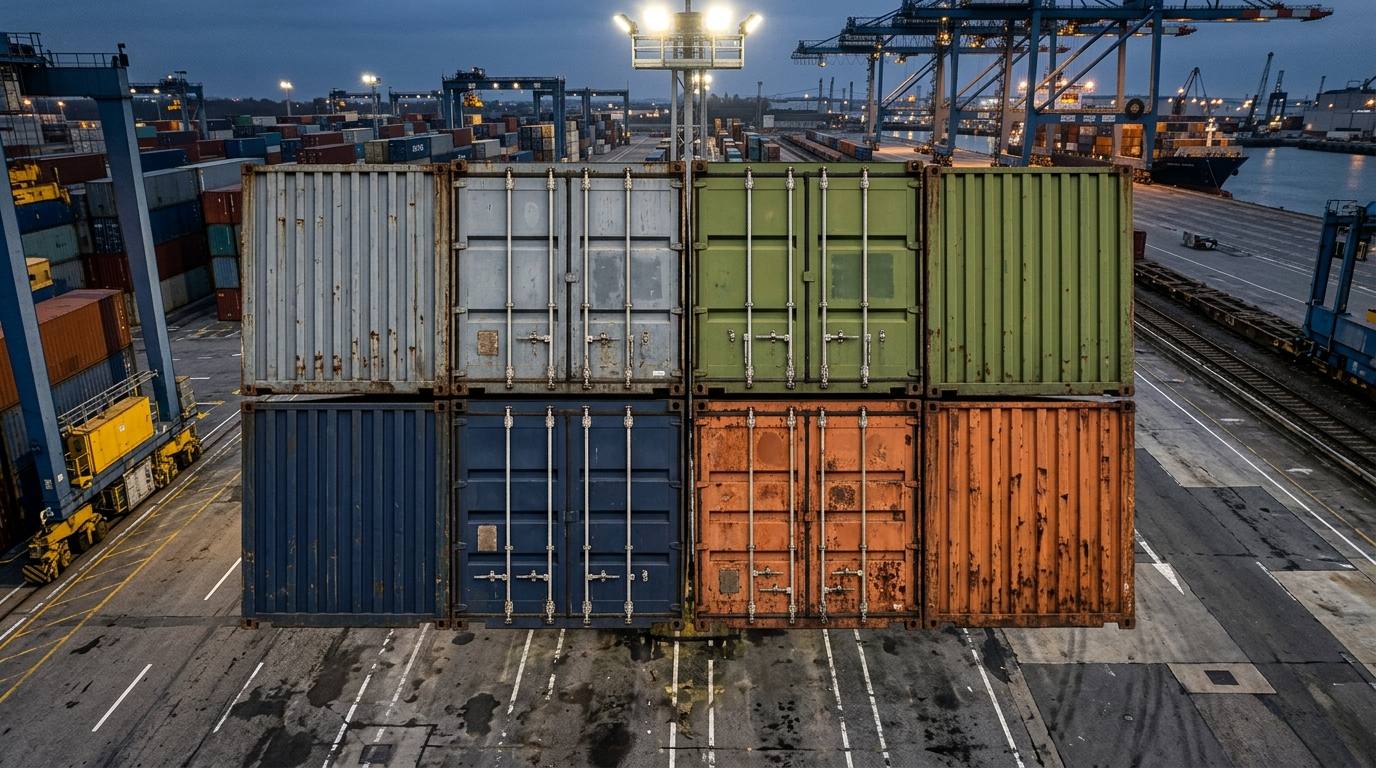
A standard 20-foot shipping container is, by design, one of the most generic objects on earth. It is a steel rectangle engineered to be interchangeable, stackable, and indifferent to its contents. That radical standardization is precisely what made the global supply chain possible — and it is exactly what is now making the shipping container one of the most versatile building blocks of the early 21st century.
In just the past few weeks, four stories have surfaced that together span the full range of what people are doing with these steel boxes. The scale of ambition and the intimacy of purpose could not be more different. The container is the same.
Energy · Denmark
Copenhagen Atomics
A 100-megawatt thorium molten salt reactor designed to fit inside a standard 40-foot shipping container — with a target cost below $20 per megawatt-hour at manufacturing scale.
Defense · Germany
Rheinmetall
A standard 20-foot container fitted to launch swarms of 18 loitering munitions — kamikaze drones deployable from the back of a truck, operating at 100km range.
Community · Florida
The Village, Clearwater
A shipping container retail and entrepreneurial incubator in North Greenwood, designed to lower barriers to small business ownership in a historically underserved community.
Retail · Michigan
Detroit Souvenir Shop
A single shipping container converted into a souvenir shop in downtown Detroit — the least remarkable use of the four, and in some ways the most significant.
Copenhagen Atomics: A Nuclear Reactor That Ships on a Truck
Of all the recent repurposings of the shipping container, the most audacious by a considerable margin is what Copenhagen Atomics is attempting in Denmark. The company is building a thorium molten salt reactor rated at 100 megawatts of heat — and the entire core assembly is designed to fit inside a standard 40-foot shipping container. No on-site reactor construction. You install it, you do not build it.
The reactor runs on a principle understood since the 1960s but largely abandoned: thorium, seeded with low-enriched uranium, can sustain a nuclear reaction in a molten salt medium that operates at atmospheric pressure rather than the extreme pressures required by conventional water-cooled reactors. There is no thick steel pressure vessel and no boiling-dry failure mode. The salt does double duty as both fuel and coolant. The United States actually ran a successful molten salt reactor experiment at Oak Ridge National Laboratory in Tennessee in the 1960s before quietly shelving the technology in favor of uranium reactor designs that became the global standard.
Copenhagen Atomics' design — trademarked as the Onion Core — adds a further twist: it can run on the transuranic waste left behind by conventional nuclear reactors, material that currently requires storage for 100,000 years. Fed through the thorium reactor, that waste converts into fission products that stay dangerous for roughly 300 years instead. Co-founder Thomas Jam Pedersen has said the reactors can extract about ten times more energy from spent fuel than the original reactor extracted the first time.
The manufacturing ambition is where the container framing becomes most significant. Copenhagen Atomics is not proposing to build reactors the way the industry always has — one enormous, site-poured concrete structure at a time over the better part of a decade. The stated target is one reactor per day per assembly line, with finished units bolted together like Lego bricks for larger plants. The sticker price is $50 million per unit plus a $2 million annual fee, with a cost target below $20 per megawatt-hour at full manufacturing scale — which would undercut natural gas.
An honest accounting of where Copenhagen Atomics actually stands
The company has built two full-size prototype reactors and is assembling a third — but all run on non-radioactive salts heated electrically. They are engineering test rigs, not power plants. No Copenhagen Atomics reactor has ever gone critical. The one genuinely impressive hardware achievement is a molten salt pump that ran continuously for two years at high temperature with more than 100,000 hours of combined runtime across test loops — the unglamorous component reliability problem that has historically sunk molten salt concepts before they reached a chain reaction.
The first actual fission test at the Paul Scherrer Institute in Switzerland has slipped from a 2026–2027 window to no earlier than 2028. Commercial reactors are penciled in for the early 2030s. The assembly line stamping out a reactor a day is a rendering. It is also, at this point, the most serious attempt anyone has made to manufacture nuclear power the way we manufacture cars.
Rheinmetall: The Container as a Weapons Platform
While Copenhagen Atomics is thinking about energy at civilizational scale, German defense giant Rheinmetall is thinking about the same steel box at the scale of the battlefield. At the Eurosatory defense exhibition outside Paris on June 16, the company unveiled a concept for deploying loitering munitions — essentially one-way attack drones — by the dozens out of standard 20-foot shipping containers.
One container holds 18 of Rheinmetall's FV-014 munitions. Each exits the container via rocket-assisted start, spreads its stabilizer fins, and navigates toward coordinates fed by a reconnaissance and strike sensor network. The munitions carry a 4-kilogram warhead with a maximum range of 100 kilometers and a flight time of up to 70 minutes — enough to loiter over a target area while ground commanders decide where to strike.
The applications Rheinmetall is pitching reflect the character of modern high-intensity warfare as demonstrated in Ukraine. Loaded containers could be driven to the front line on trucks and discharged on demand — mass drone strikes from mobile, deployable infrastructure. Alternatively, containers could be arranged along a border, potentially camouflaged, to spring into action when an adversary approaches. The standard 20-foot container is inconspicuous among the millions circulating in global logistics; it requires no special handling equipment and no fixed installation.
Rheinmetall is opening the container's interface architecture — disclosing the physical slots and electronic connectors so other manufacturers could design alternative munitions to the same standard. A platform approach to drone warfare, not a proprietary weapons system.
— ContainerCompass, based on Defense News reporting
The FV-014 was recently awarded an approximately €300 million contract by the German Bundeswehr, making Rheinmetall the third domestic manufacturer — alongside Stark Defence and Helsing — to secure major German government investment in loitering munitions. The open-platform architecture is notable: Rheinmetall's Timo Haas said the company will disclose the container's physical and electronic specifications so other manufacturers can design compatible munitions, turning the container into a platform rather than a product.
Clearwater's Village: Community Economic Development
From weapons systems to community economic empowerment, the container's range is striking. In Clearwater, Florida, the Clearwater Urban Leadership Coalition is building what it calls The Village — a shipping container retail and entrepreneurial incubator in the North Greenwood Community Redevelopment Area.
The project has been six years in the making. The City of Clearwater Community Development Board unanimously approved it in May. The first containers are expected to be installed by December, with the Village fully operational by early 2027. The economic logic is clear: the traditional barriers facing entrepreneurs in underserved communities — high commercial rents, prohibitive build-out costs, limited access to financing — are precisely what shipping containers address.
"We have more people who want to be in the container village than we have spaces."
— Gloria Campbell, Executive Director, Clearwater Urban Leadership Coalition
The Village will accommodate 10 small businesses with permanent container spaces and approximately 10 rotating pop-up companies cycling in and out monthly. About 30% of tenant businesses are expected to outgrow their container space within three years and move to larger facilities — with pop-up operators then cycling into the vacated permanent slots. The tenant mix at a preview event illustrated the breadth of the project's appeal: an IV therapy and wellness clinic, a coffee company, a natural remedies business. Diverse businesses, shared ambition, a community the coalition describes as "totally disenfranchised" by decades of economic marginalization.
Detroit: The Container as a Storefront
At the most intimate end of the spectrum, a Detroit entrepreneur has opened a souvenir shop inside a single shipping container in downtown Detroit. The story is a small one by the scale of nuclear reactors and drone platforms — and perhaps the most telling.
The shipping container has become ordinary enough, accessible enough, and inexpensive enough that a single small-business owner can use one as a storefront the way a prior generation might have rented a mall kiosk. Detroit has a longer history with container repurposing than most American cities. The Detroit Shipping Company — an 8,000-square-foot food collective built from 21 refurbished containers in Midtown — helped establish the form as commercially viable long before it became a national trend. A single-container souvenir shop is, in that context, not an experiment. It is a mature market doing what mature markets do: normalizing the unconventional.
What These Four Stories Have in Common
From a thorium reactor to a drone launcher to a small business incubator to a souvenir shop, the unifying thread is not the container itself — it is the logic of modularity and standardization that makes the container so useful across such wildly different contexts.
Copenhagen Atomics is betting that the reason nuclear power failed to scale isn't the physics — it's that the industry builds reactors like medieval cathedrals rather than manufacturing them like cars. Rheinmetall is applying the same logic to drone warfare. Clearwater's Village applies it to small business development. Detroit's shopkeeper applied it to the simplest possible use case: a weatherproof, secure, mobile retail space that costs a fraction of a conventional storefront.
What connects them is that they are all solving a deployment problem — how to put something useful somewhere quickly, affordably, and without requiring permanent fixed infrastructure. The shipping container has always been a solution to the deployment problem. The only thing that has changed is the range of things people are deploying.
Key takeaways
- →The container's standardization is the feature, not the limitation. The same 20-foot box that works for a drone launcher works for a souvenir shop because interchangeability that makes logistics efficient also makes creative repurposing low-cost and low-risk.
- →Copenhagen Atomics represents the most technically ambitious container application yet. A 100-MW thorium reactor in a 40-foot container, with a target cost below $20/MWh, could reshape nuclear economics — if the hardware performs when it goes critical, which won't happen before 2028.
- →Rheinmetall's drone container is a direct product of Ukraine. The battlefield logic of mass loitering munitions deployed from mobile, low-signature platforms is a direct lesson from the conflict. The shipping container is the ideal delivery vehicle — inconspicuous, globally mobile, no fixed installation required.
- →Community economic development is a growing use case. Clearwater's Village joins a national pattern of container-based incubators and retail villages designed to reduce barriers to entrepreneurship in underserved communities.
- →Detroit shows the container market's maturity. When a single entrepreneur opens a souvenir shop in a container without it being remarkable, the technology has passed from novelty to infrastructure.
- →The deployment problem is universal. A nuclear startup, a defense contractor, a community coalition, and a Detroit shopkeeper are all using the same tool for the same fundamental reason: it lets them put something useful somewhere without the time, cost, or permanence of conventional construction.
Sources
- "A Danish Company Is Building a Thorium Reactor That Fits in a Shipping Container" — Luis Reyes, AutoNotion. July 1, 2026.
autonocion.com - "Rheinmetall Pitches Shipping Container That Can Spit Out Swarms of Attack Drones" — Sebastian Sprenger, Defense News. June 16, 2026.
defensenews.com - "Clearwater's Shipping Container Retail 'Village' Gets a Preview" — Michael Connor, St. Pete Catalyst via Tampa Bay Beacons. June 23, 2026.
tampabaybeacons.com - "Unassuming Shipping Container Doubles as a Detroit Souvenir Shop" — MLive. June 2026.
mlive.com - Copenhagen Atomics — Company Website.
copenhagenatomics.com - "Once-Reluctant Germany Goes Big on One-Way Attack Drones" — Sebastian Sprenger, Defense News. February 26, 2026.
defensenews.com