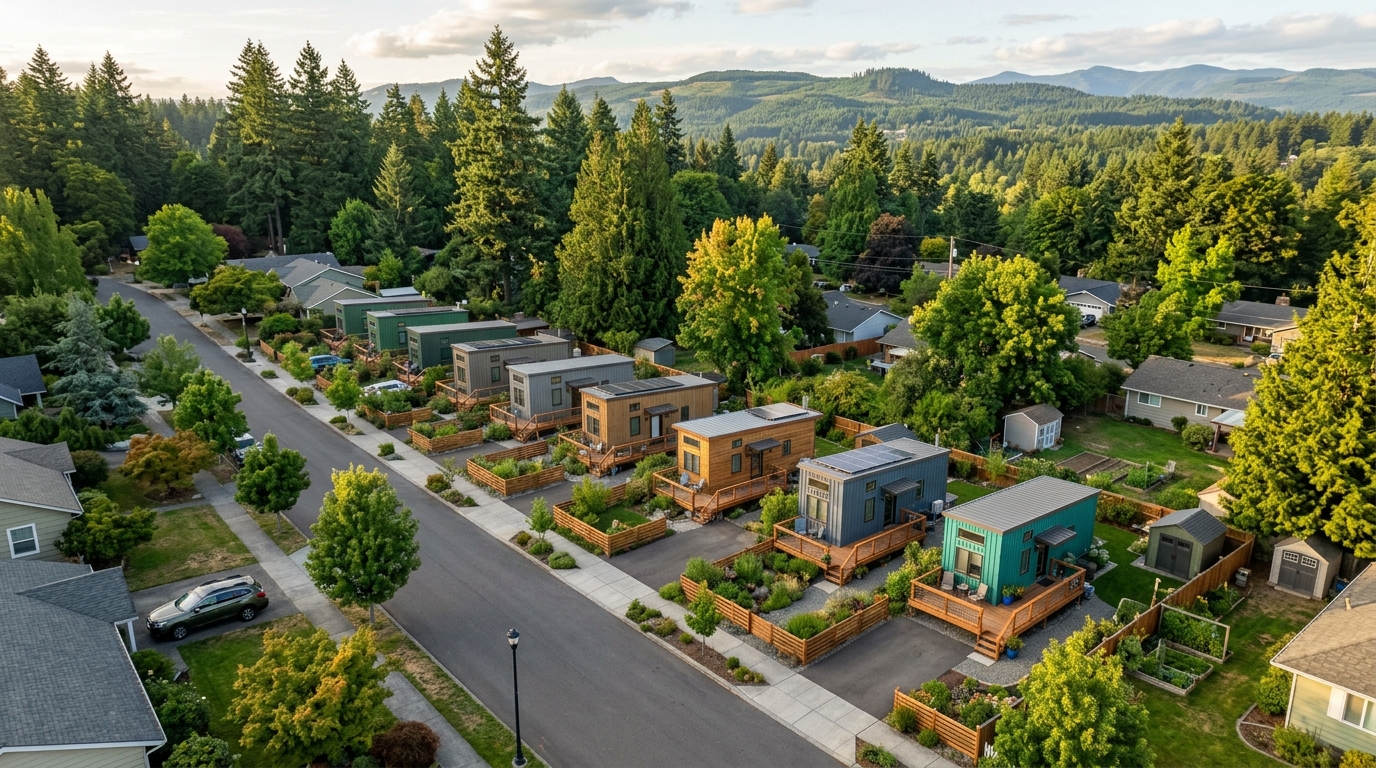
Across the country, a rusted, repurposed symbol of global trade is quietly being reimagined as the next frontier in American housing. From a small Missouri city holding public hearings, to Rhode Island state lawmakers touring factory-built units, to an Indianapolis veteran's advocate fighting to house those who served — the shipping container is having a moment. And behind each story lies the same stubborn problem: the United States simply does not have enough affordable places to live.
A National Crisis, Local Experiments
The urgency driving these experiments is real. Rhode Island alone needs to build roughly 15,000 new homes by 2030 to meet resident demand. Nationally, approximately 771,480 people experienced homelessness on a single night in 2024 — an 18% increase from the prior year, according to the U.S. Department of Housing and Urban Development. Into that gap, an unlikely construction material is stepping forward.
What makes the current moment different from earlier waves of container home enthusiasm is where the conversation is happening. This is no longer just architects and tiny house enthusiasts. It's state senate presidents, city planning commissions, and nonprofit founders — people with the authority and resources to actually scale an idea.
State Senate President Valarie Lawson led a tour of factory-built container units from ContainerSolutions, framing the technology as a direct response to the state's housing crisis.
Status: Active policy exploration
Planning and Zoning Commissioners held a public hearing on container home use inside city limits, with roughly 20 residents debating the trade-offs between affordability and neighborhood aesthetics.
Status: Recommendations pending
Nonprofit founder John Pfeifer partnered with container home builder 8Forty to develop a rent-to-own housing model for homeless veterans, with two model units already completed.
Status: Land acquisition underway
Rhode Island: State Leaders Tour the Future
State leaders and residents gathered in East Providence to tour a new option in the fight to create more affordable housing in Rhode Island: shipping containers. Rhode Island Senate President Valarie Lawson was direct about the appeal.
"We have a housing crisis, and we have tried to address this, but there's just so much more need in finding affordable solutions for people. This fits that bill."
— Rhode Island Senate President Valarie Lawson
The company behind the tour, ContainerSolutions, is pitching what its founder calls a fundamentally different construction model. "It's a factory-built home, which means it's faster and more affordable than traditional site-built construction," said founder Chris Barrett. "The cost and timeline are predictable, something traditional construction can almost never promise."
Barrett is careful not to oversell the concept. "I think these are … not necessarily a solution, but a step toward helping with the affordable housing crisis," he said. The company offers flexible financing and sells units for use as primary residences or accessory dwelling units. For every home sold, it donates $5,000 to the Rhode Island Community Food Bank — a detail that underscores the social mission threading through the container home movement.
Nevada, Missouri: A Town Weighs the Trade-Offs
While Rhode Island is moving toward policy, Nevada, Missouri — a small city of roughly 8,000 — is still in the deliberation phase. City Planning and Zoning Commissioners held a public hearing, inviting Custom Container Sales Director Bryce Smith to speak with about 20 residents in attendance.
The conversation revealed a community caught between pragmatism and aesthetics. Planning and Zoning Chairman Marvin Knoche acknowledged the housing pressure directly: "We hear all the time that there is a housing issue here in Nevada. We are now working on our comprehensive plan — part of that is real estate, part of that is housing and things like that."
Smith made the case for containers as a practical tool: "It sounds like there are some housing challenges within the city of Nevada — being able to provide something that is strong, safe, secure, low maintenance, eco-friendly can be a really good solution."
But residents pushed back. Kendall Vickers, who attended the meeting, voiced the concern that surfaced repeatedly: "Putting doors and windows in it, maybe they meet the codes, but it wouldn't be very attractive to the neighborhoods." The Planning and Zoning Commissioners will present their recommendations to city council following further review.
It's a tension familiar to other cities. Corpus Christi, Texas encountered similar community resistance when container home proposals first surfaced there — a reminder that the container's biggest obstacle may not be engineering or cost, but perception.
Indianapolis: One Man's Mission for Veterans
Perhaps the most personal story in the current container home moment is unfolding in Indianapolis. John Pfeifer, a 61-year-old workplace safety consultant, spent years trying to solve veteran homelessness through affordable housing — and nearly gave up when the economics didn't add up. Then he met two brothers who said they were up to the challenge.
"If I can't be in the military and I can't fight for the country, I can fight for the ones that did."
— John Pfeifer, founder, Shipping Container Homes for Veterans (SCHV)
Sam and Hamed Nouri, cofounders of a company called 8Forty, completed two model homes from shipping containers — one 8×40 feet, the other 8×20 feet — outside a warehouse on Indianapolis's south side, each with an American flag printed along the side. Hamed said the company could build up to a dozen of the larger units per month.
Pricing isn't finalized, but the goal is to sell the smaller unit for around $40,000 and the larger for $60,000, with Pfeifer purchasing them through his nonprofit foundation, Shipping Container Homes for Veterans. He estimates the all-in cost — buying the home, preparing land, and connecting utilities — runs about $100,000 per unit.
Land remains the critical bottleneck. Pfeifer said as little as 0.17 acres would work for a 40-foot home, and he's hoping to find offers from private sellers or through the city's land bank. His financing model is built around flexibility: veterans could rent, buy outright, or rent-to-own, with paid rent eventually converted into a down payment — bypassing traditional bank qualification hurdles entirely.
Where the Stories Agree — and Diverge
Across Nevada, Rhode Island, and Indianapolis, the same themes surface: housing shortages are urgent, traditional construction is too slow and too expensive, and containers offer a faster, cheaper path. All three situations share a belief that innovation must be part of the solution.
Where they differ is in scope and audience. Rhode Island is pursuing a statewide policy conversation, with elected officials actively exploring containers as a scalable tool. Nevada is wrestling with community-level resistance, particularly around aesthetics — a tension that speaks to the gap between housing need and neighborhood identity. Indianapolis is driven not by policy but by a single advocate's mission to serve a specific and underserved population.
The aesthetic concern raised in Nevada is notably absent from the Rhode Island and Indianapolis narratives — likely because those efforts target populations or locations where community opposition is less of a factor. It's a reminder that adoption will happen unevenly: faster in rural counties and at-risk populations, slower in established residential neighborhoods with active HOAs and zoning boards.
Key takeaways
- →Affordability is the core driver. In every case, the push for container homes stems from a housing market that is pricing out renters, low-income families, and vulnerable populations like veterans.
- →Speed matters. Factory-built container units can be completed and delivered far faster than traditional site-built homes — a critical advantage when housing need is immediate.
- →Regulatory and aesthetic hurdles are real. Community acceptance, zoning compliance, and building codes remain significant barriers to widespread adoption, particularly in established residential neighborhoods.
- →The target populations vary. Container homes are being proposed simultaneously for veterans, low-income residents, and the general public — suggesting the model is flexible enough to serve multiple needs.
- →No one is calling it a silver bullet. Even proponents like ContainerSolutions founder Chris Barrett frame container homes as "a step," not a complete solution.
Looking Ahead
The momentum behind container homes signals something broader than a construction trend — it reflects a growing willingness among cities and advocates to think unconventionally about a problem that conventional approaches have failed to solve. Whether the container home becomes a mainstream fixture of American neighborhoods or remains a niche workaround will depend largely on how well advocates can address the aesthetic and regulatory concerns that continue to slow adoption.
What's clear is that the urgency driving these experiments is not going away. Neither, it seems, are the containers.
Sources
- "City Explores Shipping Container Homes Amid Housing Crisis" — Yahoo News / Four States Homepage. Nevada, Missouri planning and zoning hearing. Published June 2026.
yahoo.com/news - "RI Explores Container Homes as Affordable Housing Solution" — WPRI 12 News, East Providence, Rhode Island. Published May 2026.
wpri.com - "Indy Man Wants to Help Solve Veteran Homelessness with Container Homes" — Tyler Fenwick, Mirror Indy. Published December 8, 2025.
mirrorindy.org