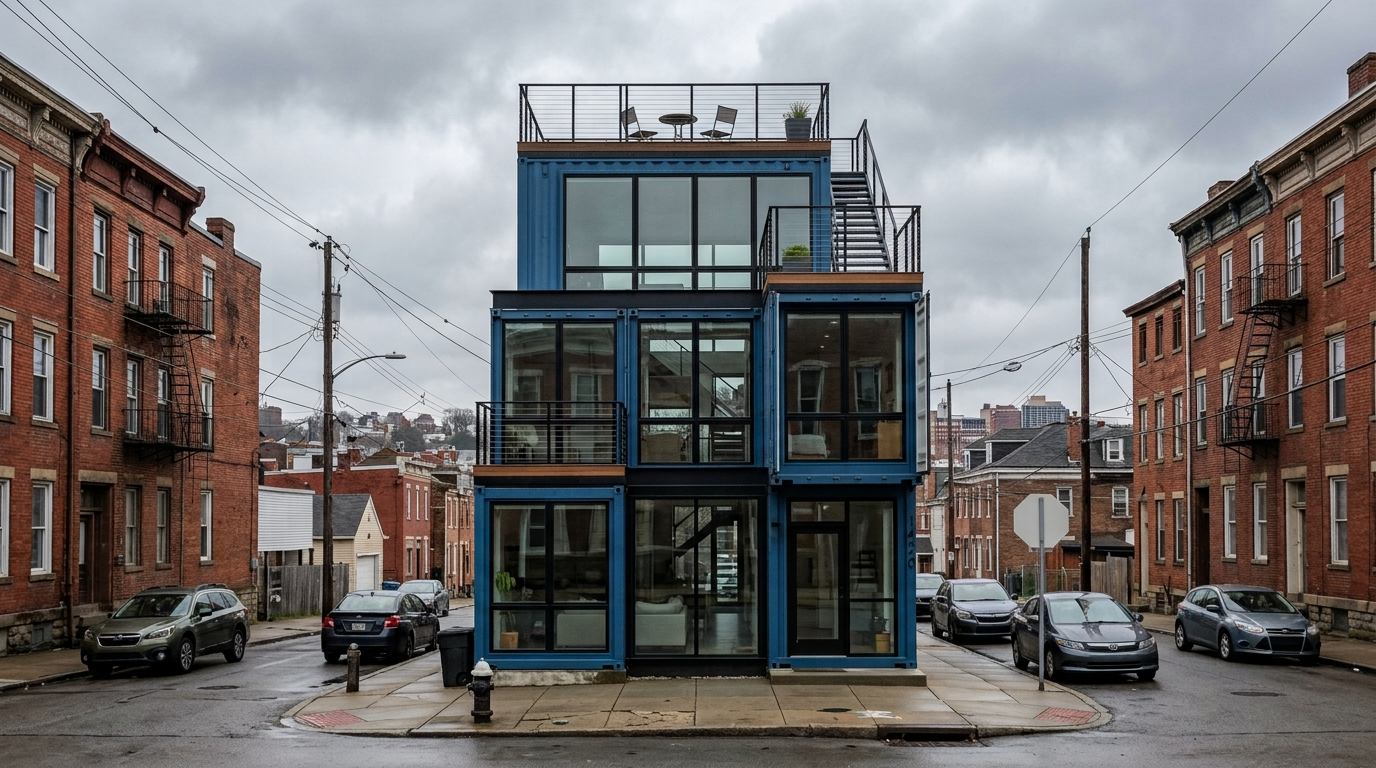
Pittsburgh is a city that has always understood steel. What it has not seen before — at least not at this scale — is a home built entirely from it. The Blue Pearl, a three-story single-family residence constructed from six 40-foot shipping containers stacked and welded together on Pearl Street in Bloomfield, has just hit the market at $799,900. In less than two weeks, it accumulated nearly 20,000 Zillow views — a number that signals something more than local curiosity.
How It Came Together
The project started the way many unusual real estate projects do: two old friends with shared ambition and a vacant lot. Eric Smooke, a full-time landlord and real estate investor based in Point Breeze, reconnected with Rebekah Siegel — a fellow graduate of Pittsburgh's Allderdice High School — in Shadyside roughly three years ago. They began discussing what could be done with a 1,255-square-foot lot at 413 Pearl Street in the heart of Bloomfield, one block from Liberty Avenue, within walking distance of UPMC Children's Hospital, West Penn Hospital, and UPMC Shadyside.
The idea of building with shipping containers emerged from conversations about what would be genuinely new in a city where too much residential construction tends toward the conventional. Smooke and Siegel formed Siegel Smooke Holdings LLC and sourced six new 40-foot containers from Container Homes USA, a prefabricator based in Cleveland. Each container was modified in Cleveland before delivery to Pittsburgh, where they were assembled and welded into the three-story structure.
The Blue Pearl — specifications
The Design: Bigger Than You Think
The single most consistent surprise visitors report when encountering container homes is space. The expectation — shaped by the knowledge that a container is 8 feet wide — is a narrow, cramped interior. The Blue Pearl is built to defeat that expectation at every turn.
"My favorite part of the house is the use of space. Everyone thinks when they're coming into a shipping container, it will be small. Every single square foot and inch of this house is laid out and used so well."
— Eric Smooke, co-developer
Six containers arranged across three stories produce approximately 1,920 square feet with ceilings running nearly nine feet high — significantly more than the 7-foot finished ceiling height achievable in a standard-height container. Large, energy-efficient windows prioritize natural light throughout. Several of the original shipping container walls are incorporated directly into the interior design as textural and visual elements rather than being concealed behind drywall — the industrial chic aesthetic that has made container architecture commercially appealing in cities from Scottsdale to Columbus.
The design details reach into the unexpected: a vintage 1970s Forbidden Fruit wallpaper pattern on a bathroom accent wall, imported from England. The original exterior hardware on each container left intact as architectural detail. The exterior remains the blue of the original containers — which is how the project got its name.
"I named it Blue Pearl because the containers were blue and it's on Pearl Street. Blue Pearl was born."
— Artem Kovalevskiy, listing agent, Re/Max Select Realty
The smallest room in the house — a nook fitted with two large single-pane windows — delivers sweeping views across Oakland, Bloomfield, Lawrenceville, and beyond. It is the kind of vantage point that would anchor the design of a much more conventional and considerably more expensive home.
The Insulation Decision That Made It Buildable
The City of Pittsburgh required closed-cell spray foam insulation as a condition of permitting. Smooke describes it as working extremely well on steel structures — and the requirement reflects sound engineering judgment. Closed-cell spray foam addresses the most common failure modes of steel container construction simultaneously: extreme temperature swings (Pittsburgh winters reach well below freezing; the steel walls would otherwise act as massive thermal bridges), condensation buildup on interior steel surfaces, mold risk, and ongoing corrosion. Get the insulation wrong in a steel home in a Pittsburgh winter and the building becomes unlivable. Get it right and steel's thermal mass becomes an asset — slow to heat, slow to cool, naturally resistant to the temperature swings that stress wood-frame buildings.
The closed-cell requirement also eliminates the condensation problem that is the most common technical failure in inexperienced container builds: warm interior air hitting cold exterior steel without an adequate vapor barrier produces condensation that soaks open-cell foam or fiberglass batt insulation and creates mold conditions within months. Closed-cell spray foam is simultaneously the insulation layer and the vapor barrier — a single material that solves both problems.
The Rooftop: The Showstopper
"The rooftop is the showstopper."
— Eric Smooke
Above the building's three residential floors sits a rooftop deck with panoramic sightlines over Pittsburgh's East End neighborhoods. Bloomfield sits at a geographic elevation that already provides elevated sightlines toward Oakland and Downtown; the rooftop deck amplifies that advantage to a degree that no comparable single-family home in the neighborhood can match. It is also the element that signals most clearly what Smooke and Siegel set out to build: not a tiny home or an experiment in minimal living, but a full-featured urban residence that happens to be made of steel.
The Case for Steel in the Steel City
Pittsburgh's identity is so thoroughly bound to steel that the city's NFL franchise is named for it. Bloomfield is a symbolically resonant location for a home made of recycled industrial steel, and Smooke leans into the framing explicitly: "This home embodies 'green living' at its truest. It is truly Steel City living."
The sustainability argument for container homes, when made carefully, rests on legitimate pillars. Steel containers are engineered to survive decades of maritime conditions — salt, humidity, temperature extremes, constant vibration. That structural redundancy means a properly built container home can outlast wood-frame construction with less maintenance. The material eliminates termite and wood-boring pest vulnerabilities entirely. Steel is far more rodent-resistant than timber framing.
The counterargument deserves acknowledgment: the Blue Pearl uses new containers — manufactured specifically for this project, not reclaimed from the shipping industry. The sustainability case is strongest for truly repurposed used containers; it is more nuanced for new-build applications. The developers implicitly acknowledge this distinction by emphasizing durability and longevity as the primary environmental benefits rather than material rescue — a more defensible position.
Pittsburgh's Container Architecture Context
Pittsburgh's container building history
- 2022 — Lawrenceville addition, Inter Architecture: Pittsburgh's first documented residential container project — a single container used to extend the living space of an existing home in lower Lawrenceville. A container addition, not a standalone home.
- 2022 — The Cargo Lofts, Upper Lawrenceville: K Bennett Development Group / architect Peter Margittai. Three townhouse units, one constructed primarily from shipping containers, priced at $649,000. A container-integrated multi-unit project, not a standalone home.
- 2026 — The Blue Pearl, Bloomfield: First standalone, full-scale residential dwelling made entirely from shipping containers in Pittsburgh. Six 40-foot containers. Permitted and designed as a conventional single-family home.
Whether Pittsburgh produces a second full-scale container home will depend largely on how the Blue Pearl transaction goes — not just the price it achieves, but the buyer experience, the permitting lessons, and whether the construction approach is documented in a way that gives other developers a roadmap. Every housing market that now has a functioning container home ecosystem got there through early projects that worked, were documented, and created institutional knowledge for the market to build on. The Blue Pearl, if it sells well, is that first project for Pittsburgh.
"Whoever buys it is gonna be a happy person."
— Artem Kovalevskiy, listing agent
Key takeaways
- →Pittsburgh's first full-scale container home is now on the market at 413 Pearl Street, Bloomfield — a four-bedroom, 2½-bath, three-story structure built from six 40-foot new-build steel containers, listed at $799,900.
- →The rooftop deck is the signature feature — panoramic views across Pittsburgh's East End that no comparable single-family home in Bloomfield can replicate.
- →City-required closed-cell spray foam addresses the most common failure modes of steel container construction: temperature swings, condensation, mold, and corrosion.
- →Design defies the small-space expectation. At ~1,920 sq ft with nine-foot ceilings, large windows, and four bedrooms, the home is built to surprise visitors who expect a cramped industrial feel.
- →New containers, not repurposed ones — an important distinction for buyers evaluating sustainability claims. The environmental case rests on durability and longevity rather than material rescue.
- →Nearly 20,000 Zillow views in two weeks signals national interest well beyond Pittsburgh — the buyer pool for a $799,900 architectural experiment is a defined niche searching across markets, not just locally.
- →A market-making project. Pittsburgh's container architecture ecosystem will develop based largely on whether this first full-scale home transacts successfully and creates a permitting roadmap for future builders.
Sources
- "Bloomfield Shipping Container Home Offers Cool Digs, Rooftop Living" — Joyce Hanz, TribLive. May 1, 2026.
triblive.com - "Bloomfield Home Will Be Fabricated with Shipping Containers for $825K" — TribLive. December 2023.
triblive.com - 413 Pearl Street — Official Listing Site — Siegel Kovalevskiy Group / Re/Max Select Realty.
413pearlstreet.com - "The Cargo Lofts, Complete with Shipping Containers, Coming to Lawrenceville" — Kim Lyons, Next Pittsburgh. August 31, 2022.
nextpittsburgh.com - Container Home — Lawrenceville Addition — Inter Architecture, Pittsburgh.
interarchitecture.com