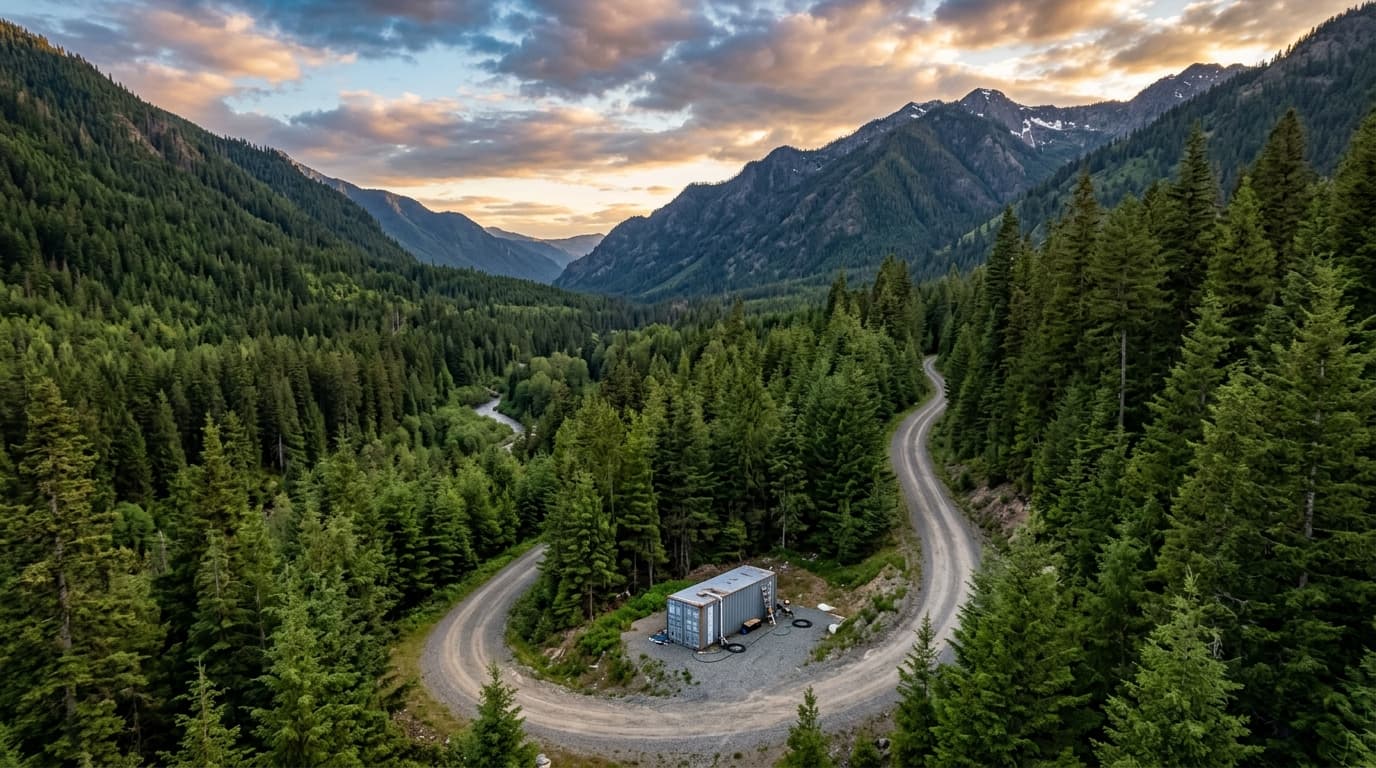
When a wildfire tears through a remote valley in Washington State, the difference between a saved home and a lost one can come down to a single question: how close is the nearest water? In Chelan County — a region that sits at the collision point of dense mountain forests, high winds, and a century of accumulated fuel — that question has no good answer in many of its most vulnerable areas. A federally funded project now moving toward installation is attempting to change that, one shipping container at a time.
The county is deploying a network of 21,000-gallon water storage tanks — built from repurposed mobile cargo containers — across its most wildfire-prone corridors, with the first units expected in the ground as early as this summer. The project, backed by nearly $900,000 in federal funds secured by Congresswoman Kim Schrier, addresses a problem that fire chiefs and community coalitions have been warning about for years: in the remote drainages where wildfires burn hottest and fastest, there is simply nothing for fire trucks to refill from.
The Problem: Ten Trips to the River
Currently, when a wildfire breaks out in a rural area of Chelan County without access to hydrants or natural water sources, fire departments rely on water tenders — vehicles designed to haul water to the scene. A standard tender carries approximately 2,000 gallons. A single container tank holds 21,000 gallons. The math is unsparing: one strategically placed tank eliminates nearly ten critical refill trips per tender load.
Those trips are not merely inconvenient. Every round-trip to Lake Wenatchee, a local river, or a distant hydrant is time a fire burns uncontested. In a valley with heavy, contiguous fuel loads and limited road access, the delay between refills is the gap in which structures are lost.
"Water for firefighting purposes is of the utmost importance in the Chumstick drainage. This is the largest area of the Fire District that doesn't have a water source for fire protection. A water source can mean the difference between saving homes or not — and it could mean the difference in how aggressive firefighters will be while fighting the fire."
— Kelly O'Brien, Fire Chief, Chelan County Fire District #3
The Chumstick drainage — a valley running northeast of Leavenworth — concentrates the problem. More than 600 homes sit in a corridor that has not seen significant fire activity in over 100 years, leaving fuel loads that fire experts describe as heavy and contiguous the entire length of the drainage. Remote locations including Eagle Creek, Merry Canyon, and Little Chumstick have been identified as priority sites for tank placement. The valley is widely considered one of the most wildland fire-threatened valleys in Washington State.
The Solution: A Shipping Container Built for Water
The tanks at the center of the project are not traditional water storage infrastructure. They are mobile cargo containers — purpose-designed for water storage — repurposed into stationary firefighting assets.
Tank specifications
The design threads a practical needle: permanent enough to serve as a reliable, pre-positioned water source through fire season, but mobile enough to respond dynamically as fire behavior and threat patterns shift across the county. Congresswoman Schrier's office described the project on the federal record as repurposing mobile cargo containers "designed for use as water storage tanks into stationary water tanks" — a framing that captures exactly how the container concept translates from logistics to emergency management.
The structural characteristics that make shipping containers durable for ocean transport — weather resistance, modular portability, standardized dimensions — make them well-suited for remote, all-weather water storage. It is the same logic that drives container use in housing, offices, and disaster relief: the container is already engineered for the hardest conditions.
Funding, Scope, and Timeline
Project funding breakdown
| Community Project Funding — Rep. Kim Schrier | $893,250 |
| Chelan County PUD contribution | $50,000 |
| Community fundraising (Chumstick Coalition) | Ongoing |
| Total estimated cost (12 tanks) | ~$1,200,000 |
At least half of the initial 12 tanks will be placed in the Upper Valley, primarily along the Chumstick Corridor. The remaining units are slated for Manson, Chelan, Entiat, and Malaga — a geographic spread that reflects the breadth of fire risk across the county rather than concentration in a single area. As of early 2026, county officials were in final negotiations with the PUD and expected to purchase eight to ten tanks in the spring, with optimistic expectations that several units would be placed before this year's wildfire season.
"What we're doing here is going to be able to be replicated — not just in other places in Washington State. This can be replicated in rural communities across the country."
— Ron Cridlebaugh, Chelan County Economic Services Director
Community Roots: The Chumstick Coalition
The county's container tank program did not emerge from a government planning office. Its roots run through the Chumstick Wildfire Stewardship Coalition — a community organization that has spent years working alongside Chelan County Fire District #3, the Washington State Department of Natural Resources, the Cascadia Conservation District, and the U.S. Forest Service to address wildfire risk in the Chumstick drainage.
The Coalition launched its own Water Tank Placement Project as a community fundraising effort, recognizing that the water supply gap in the Chumstick would not be solved by fuel reduction work alone.
"Getting water available to CCFD #3 in these remote locations is critical to saving homes and assisting the fire department in their firefighting efforts. We need to act now to plan and implement placement of these containers in strategic locations."
— John Callahan, Chair, Chumstick Wildfire Stewardship Coalition
That community-level urgency helped build the case for federal investment. The Coalition's sustained advocacy, combined with the fire district's operational documentation of the water access problem, gave Congresswoman Schrier's office the evidence base needed to secure Community Project Funding for a solution that might otherwise have remained a local fundraising challenge for years.
The Insurance Dimension
Fire suppression capability is not purely a public safety question in regions like Chelan County — it is increasingly an insurance question as well. Congresswoman Schrier noted that pre-positioned water infrastructure "has the potential to better protect rural neighborhoods, and may even help secure or even lower home insurance rates."
That framing reflects a broader reality playing out across the rural West. As insurance companies reassess wildfire risk in fire-prone communities, the presence or absence of local firefighting infrastructure is becoming a material factor in coverage availability and pricing. A valley with documented pre-positioned water supply is a demonstrably different risk profile than one without it. For the 600-plus households in the Chumstick drainage, the container tanks are not just a firefighting asset — they are potentially an argument for continued insurability in a market that is becoming increasingly difficult for rural Western homeowners to navigate.
Key takeaways
- →Ten trips eliminated per fill-up. A single 21,000-gallon container tank replaces approximately ten water tender round-trips per load, dramatically compressing fire response time in remote areas.
- →The container design is purpose-built. These are mobile cargo containers specifically engineered for water storage — insulated to -10°F, fitted with adaptable plumbing, and mounted on axles for mobility.
- →Federal funding made scale possible. Nearly $900,000 in Community Project Funding, combined with PUD support, is financing 12 initial tanks across the county's highest-risk corridors.
- →The Chumstick drainage is the epicenter. More than 600 homes in one of Washington State's most fire-threatened valleys sit in a corridor with no local firefighting water supply.
- →Community advocacy drove federal investment. The Chumstick Coalition's years of organizing built the foundation that eventually attracted $893,250 in federal support.
- →The model is designed to be replicated. County officials explicitly frame this as a blueprint for rural communities nationwide facing the same intersection of wildfire risk and remote water access gaps.
- →Insurance rates may follow. Pre-positioned firefighting infrastructure is increasingly relevant to home insurance availability in fire-prone regions.
Looking Ahead
Chelan County's container tank program arrives at a moment when the calculus of wildfire risk management is shifting across the American West. Fuel loads accumulated over a century of fire suppression, combined with hotter and drier conditions, have made the question of water access in remote areas not a planning abstraction but an operational emergency.
The shipping container — an object designed to move things reliably across long distances in all weather — turns out to be a quietly elegant answer to a problem that has resisted more conventional solutions. If the Chumstick tanks perform as designed this summer, the replication that county officials are already anticipating may follow faster than anyone expects.
Sources
- "Chelan County to Place Water Tanks in Wildfire-Prone Areas as Early as This Summer" — Lake Chelan Mirror. June 2026.
lakechelanmirror.com - "Congresswoman Schrier Secures $900,000 for Mobile Water Tanks to Bolster Wildfire Fighting Capabilities in Chelan County" — Lake Chelan Mirror. June 9, 2024.
lakechelanmirror.com - Chelan County Water Tank — Project Summary. Office of Representative Kim Schrier.
schrier.house.gov - "Leavenworth Wildfire Coalition Outlines Progress, Plans Under Federal Defense Grant" — The Leavenworth Echo. February 11, 2026.
leavenworthecho.com - Chumstick Remote Water Tank Project — Chumstick Wildfire Stewardship Coalition.
chumstickcoalition.org - "Water Tank Placement Project in Chumstick Drainage Will Aid Remote Firefighting" — Wenatchee World. February 2023.
wenatcheeworld.com