They hauled cargo across oceans. Now they're hauling in bookings. Across the country, a growing wave of entrepreneurs is transforming decommissioned shipping containers into high-end short-term rentals — and the results are challenging assumptions about what travelers want and what a hospitality business can look like. From an Ohio couple generating over $1 million a year in the hills of Hocking to a real estate investor building custom container retreats near state parks, the model is proving that uniqueness, done right, is its own marketing strategy.
- Started 2018 with a 3-container property
- First property fully booked for 2 consecutive years
- Now 6 container holiday homes + wedding venue
- Largest: 7-container Hygge Box Hop, 5 bedrooms
- Revenue exceeds $1M/year
- Also offer construction, design, and cleaning services
- Pulled back from NC and MI expansion — now focused on consulting
- Came from real estate investment, not hospitality
- Built a proof-of-concept in an office parking lot to win over regulators
- Develops container homes and custom treehouses as STR assets
- Self-manages all properties with his wife
- Expanding into container pizza restaurant
- Core thesis: the experience is the product, not the cost savings
The Box Hop: A Million-Dollar Blueprint
When Seth and Emily Britt transformed a cluster of shipping containers into a vacation rental in Ohio's Hocking Hills region in 2018, they were betting on a hunch: that a new generation of travelers wanted more than a clean bed and a continental breakfast. They wanted an experience.
The bet paid off. The Box Hop's first three-container property was fully booked for two consecutive years straight out of the gate. Emily Britt described the appeal as "experiential hospitality" — stays that feel nothing like a hotel and everything like a story worth telling.
"I wanted a touch of modern edginess to it. A lot of the spaces down there have a more rustic, country feel, and I didn't want that for this house."
— Emily Britt, The Box Hop
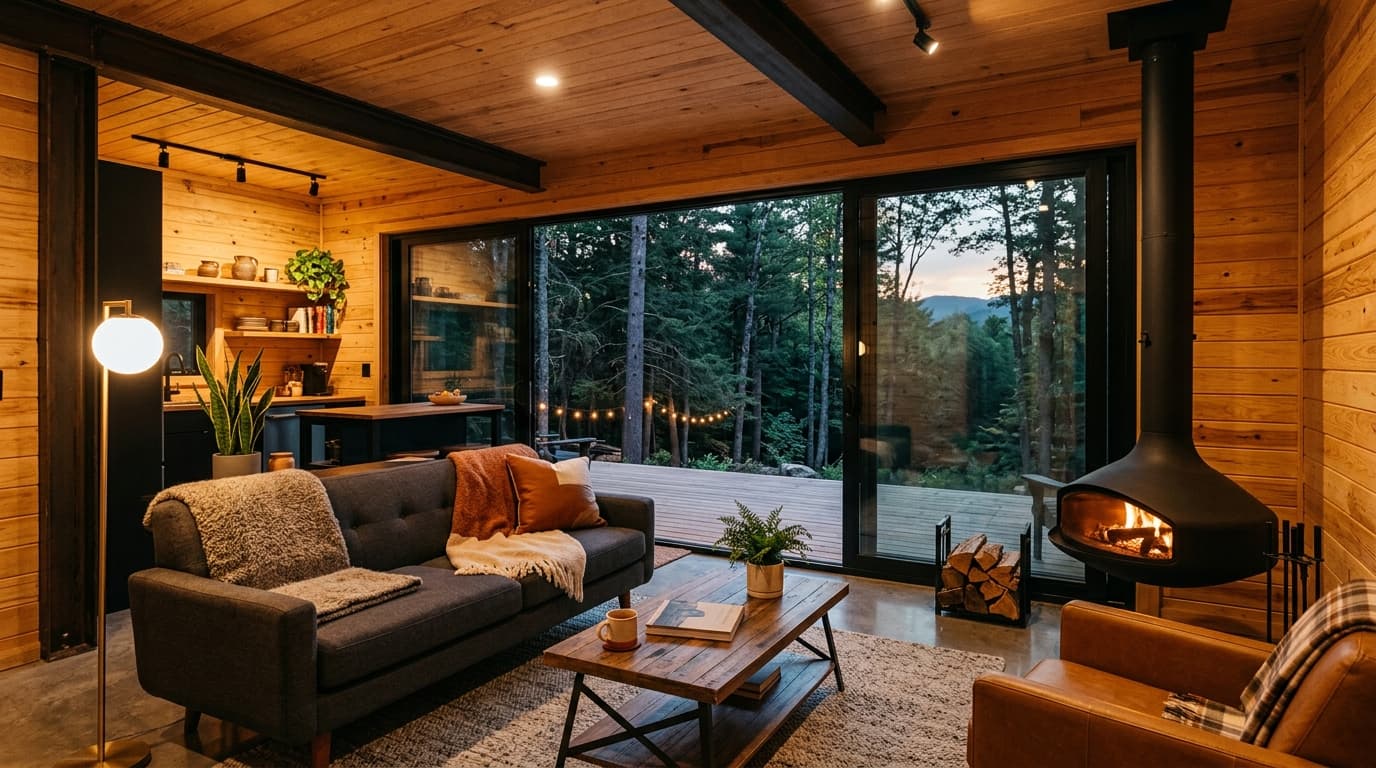
The design philosophy behind the Britts' properties is deliberate and detailed. Emily's goal for the original Box Hop was to let the natural landscape in: a 15-foot glass sliding door floods the interior with light and frames the surrounding woods. Their largest property, the Hygge Box Hop, uses seven containers arranged around an open floor plan with five bedrooms, suspended wood-burning fireplaces, a glass barrel sauna, and a hot tub overlooking a ravine. Guests are asked to notice whether they can even tell it was built from shipping containers — most can't.
Total annual revenue now exceeds $1 million, spread across six container-based holiday homes and a wedding venue. The business has also expanded into construction, interior design, and cleaning services — effectively becoming a vertically integrated container home hospitality operation.
Where the expansion strategy broke down
The Box Hop's trajectory wasn't without wrong turns. The Britts purchased expansion properties in North Carolina and Michigan in 2021 and 2022, only to sell both by 2025 as rising interest rates and operational strain made the economics uncomfortable. Seth Britt drew a pointed lesson from the experience.
"Scaling too quickly risked the entire venture. Growth without clear purpose could cause a company to implode."
— Seth Britt, The Box Hop
Their strategy has since pivoted from geographic expansion to exporting their expertise — offering container construction and design consulting to short-term rental owners nationwide. It's a model that leverages what they've built without repeating what went wrong: the Britts are now in the business of teaching others to do what they did, not just doing more of it themselves.
Mike Hicks: The Investor-Builder's Playbook
Mike Hicks came to container homes from a real estate investment background, not a hospitality one — and his approach reflects that difference. Where the Britts built their brand around a specific property in a specific place, Hicks has operated more as a builder-entrepreneur, developing container homes and custom treehouses as short-term rental assets across multiple locations.
His entry into the space was characteristically unconventional. To prove the concept to skeptical local officials, Hicks built a container home in an office parking lot — a proof-of-concept that demonstrated the structures were viable before he ever broke ground on a rental property.
The regulatory reality this reveals
Hicks' parking-lot prototype wasn't just an engineering test — it was a political strategy. Regulatory approval is often the hardest part of a container STR project, and demonstrating a finished, livable structure to skeptical building officials is one of the most effective ways to move the process forward. New operators entering this space should treat zoning due diligence not as a box to check but as the foundation of the entire investment thesis.
See our full container home legality guide for state-by-state permitting guidance.
Hicks is candid about the economics: building with shipping containers isn't necessarily cheaper than traditional construction. The appeal isn't in the cost savings — it's in the marketable experience the final product delivers. A container home commands attention on Airbnb listings in a way that a conventionally built cabin simply doesn't. That differentiation translates directly into occupancy rates and nightly pricing power.
Finding the right land, Hicks says, is the single most critical and most difficult step in the process. Extensive due diligence on county zoning, deed restrictions, and whether a lot allows for non-traditional or multi-unit structures is mandatory before any purchase. He's also evolved his model over time — adding custom stick-built treehouses alongside container homes, a pivot that allows for even greater creative freedom and commands higher nightly rates. Future plans include additional treehouses, new container home builds, and a shipping container pizza restaurant.
His operational model is also telling. Hicks and his wife self-manage their properties rather than outsourcing to a property management company — a choice driven by their belief that guest experience is too important to delegate. Amenities like hot tubs, pizza ovens, and fire pits, he notes, are not luxuries but necessities: they drive occupancy and justify premium pricing in ways that square footage alone never could.
What Makes Container Rentals Work — And What Doesn't
Both the Britts and Hicks converge on the same core insight: in the short-term rental market, uniqueness is the product. The container is the hook, but the experience is the sale. Travelers booking a Box Hop property or a Hicks-built container retreat aren't just looking for a place to sleep — they're buying a story, an aesthetic, a departure from the ordinary.
That insight has practical implications for how these businesses are built and managed. Both operators invest heavily in design. Both prioritize natural settings and proximity to outdoor attractions. Both treat amenities as revenue drivers rather than cost centers. And both have learned that operational discipline — self-management, hands-on guest service, careful quality control — is what separates a thriving short-term rental from a mediocre one.
Where they differ is in growth strategy. The Britts scaled fast, hit limits, pulled back, and found a sustainable model in consulting and staying close to home. Hicks has pursued a more diversified portfolio approach, adding product types and expanding his construction capability. Both lessons are instructive: the container home STR business rewards creativity and operator involvement, and punishes over-extension.
Key lessons from both operators
- →Uniqueness is the core product. Container homes command attention on booking platforms in ways conventional rentals can't match. That differentiation drives occupancy and justifies premium nightly rates.
- →Experience beats square footage. Hot tubs, fire pits, glass walls, and thoughtful design generate bookings. Basic amenities do not.
- →Land selection is the highest-stakes decision. Zoning, deed restrictions, and local permitting can make or break a container rental project before a single container is delivered.
- →Scaling requires discipline. The Box Hop's retreat from North Carolina and Michigan is a cautionary tale: rapid expansion without operational infrastructure is a threat, not a milestone.
- →Self-management drives quality. Both operators manage their properties personally — a choice that reflects how central guest experience is to the business model.
- →Container construction isn't automatically cheap. The value proposition is experiential, not cost-based. Operators who build for the experience, not the savings, perform better.
Looking Ahead
The container home short-term rental market is still early — early enough that the pioneers are still defining what the category looks like, and early enough that differentiation remains accessible to new entrants. As the short-term rental market broadly matures and competition intensifies on platforms like Airbnb and VRBO, the premium on truly unique, experience-driven properties will only grow.
The container home, built right, is one of the more compelling ways to deliver that experience. The operators who understand that the container is the beginning of the story — not the story itself — are the ones building businesses that last.
Sources
- "Shipping Container Vacation Home Rentals Business Scaling — Box Hop" — Business Insider. Published February 2026.
businessinsider.com - "How to Set Up Container Homes as Short-Term Rentals with Mike Hicks" — B&B Investing Group / Rich Monroe. YouTube, 2025.
youtube.com - "Shipping Containers Become a Million-Dollar Blueprint for Couple Who Transform Them Into Holiday Homes" — Interior Daily / Business Insider. February 11, 2026.
interiordaily.com - The Box Hop Official Website — Property listings and background.
theboxhop.com