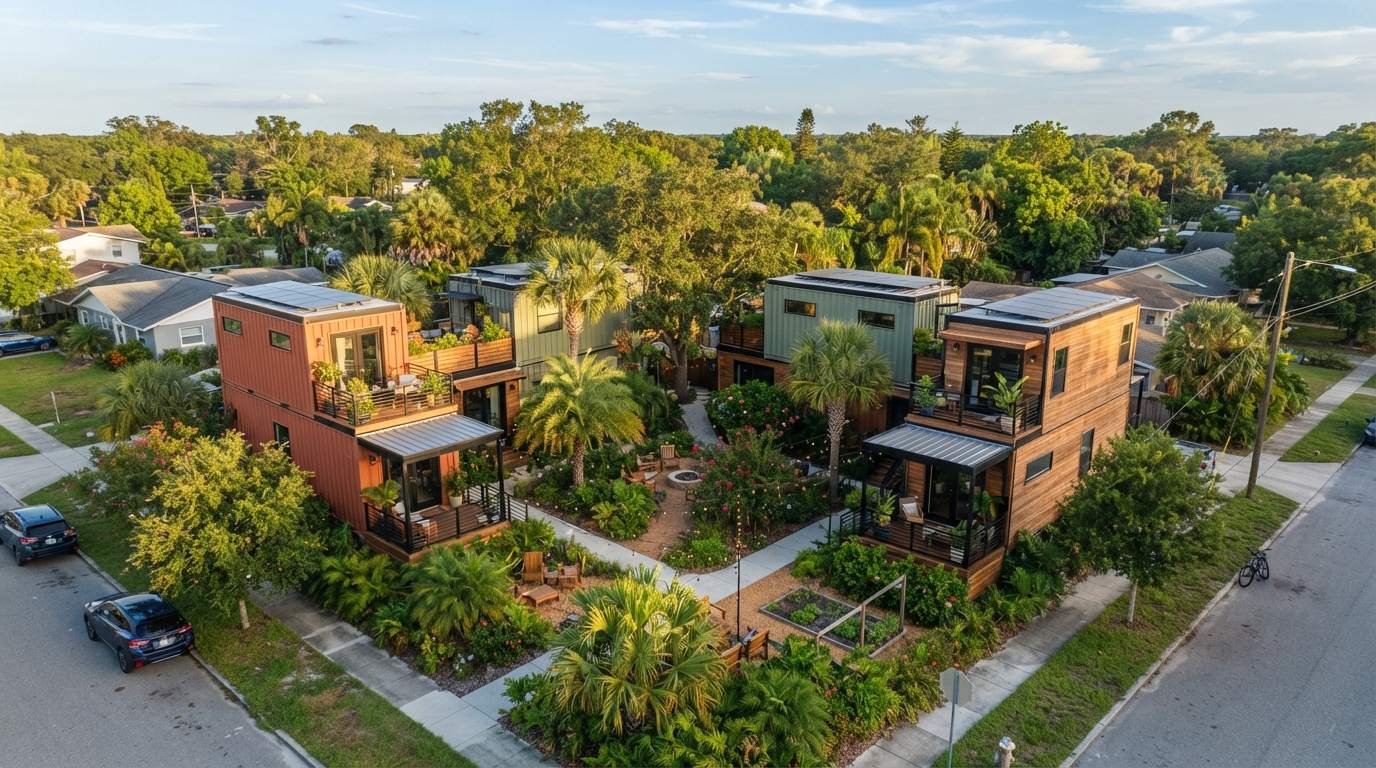
Four years of planning came to a head on July 1, 2026, when a small group gathered on a vacant property near Palmetto Avenue in DeLand, Florida, and broke ground on something Volusia County has never seen: a village of transitional homes built from repurposed shipping containers, designed to move people out of emergency shelters and toward stable, independent living. The project — developed by the Neighborhood Center of West Volusia and built by container conversion firm Innovar Structures — is modest in its physical footprint but significant in what it signals: a local government's willingness to change its zoning rules to accommodate alternative housing, a nonprofit's persistence across four years of planning, and a community's decision to build something real in a county where the affordable housing gap is measured in the tens of thousands of units.
Volusia County is currently about 55,000 affordable housing units short of what its residents need. DeLand only began permitting tiny-home communities at all in September 2025. The container village at 114 W. Walts Ave is among the first projects to move forward under that ordinance change — and its CEO hopes it will not be the last.
The Organization Behind It: Four Years From Vision to Groundbreaking
The Neighborhood Center of West Volusia is a DeLand-based nonprofit that describes itself as a safety net for individuals facing financial crisis. The organization operates an emergency shelter adjacent to the project site, case management services, and a range of wraparound support programs for people experiencing housing instability. For Savannah-Jane Griffin, the center's CEO and the driving force behind the container village, the project grew out of a clear-eyed assessment of what the population moving through her organization's emergency shelter actually needed: not just a roof for a night, but enough time and financial breathing room to build toward something permanent.
"We're just one step closer to actually housing more individuals that are struggling."
— Savannah-Jane Griffin, CEO, Neighborhood Center of West Volusia
That framing — a step, not a solution — reflects a realistic understanding of what transitional housing can and cannot do. The container village is not intended to replace permanent affordable housing. It is intended to function as a bridge: a stable, dignified, cost-sharing environment where residents can rebuild financial stability while continuing to access the case management services the Neighborhood Center already provides next door.
The project was four years in the making partly because the regulatory framework to permit it did not exist until September 2025, when DeLand's planning board passed an ordinance allowing tiny-home communities within city limits. Kurt Backstrom of First Presbyterian Church is credited with nurturing the original vision of building tiny homes for the homeless — a recognition that the project's origins predate the nonprofit's formal engagement and reflect a longer community conversation about what alternatives to conventional shelter and housing look like in this county.
The Design: Ten Units, One- and Two-Bedroom, One Fully Accessible
The project will deliver ten housing units created from standard 8-by-40-foot shipping containers — the same dimensions covered throughout this series. The units will be fashioned into a mix of one- and two-bedroom configurations, including one duplex unit and one home built to be fully accessible for people with disabilities. The community is being built on the same property as the Neighborhood Center's existing shelter, positioning case managers and support services within walking distance of every resident.
Project specifications
Address
114 W. Walts Ave, DeLand, Florida
Container spec
8×40ft shipping containers, repurposed and converted
Unit mix
One- and two-bedroom configurations, one duplex, one fully ADA-accessible unit
Capacity
Up to 16 residents at full occupancy
Conversion contractor
Innovar Structures, Wauchula, Florida (~120 miles south of DeLand)
General contractor
Ken Goldberg Construction Co.
Groundbreaking
July 1, 2026
Expected completion
Early 2027
The Neighborhood Center was explicit in its presentations to DeLand's planning board about the finished character of the units: the homes would include roofs, siding, and porches, built so they do not resemble bare shipping containers. The emphasis reflects a lesson this series has documented repeatedly — the shipping container is a structural starting point, not an aesthetic destination. At completion, the DeLand village will house up to 16 people in units that read architecturally as homes, not as freight equipment.
Innovar Structures, a container conversion company based in Wauchula, Florida, is handling the conversion work. Innovar operates a container conversion plant in Wauchula and brings industrial-scale conversion experience to a project that, at ten units, is at the small end of what such a firm typically produces. The selection of a Florida-based conversion specialist rather than a national firm reflects both the project's cost constraints and the practical logistics of delivering finished units to a Central Florida site.
The Funding: $795,000 Raised, $405,000 Still Needed
The project's total budget is $1.2 million — a figure that includes the container conversion costs, site preparation, utility connections, furnishings, patios, and the amenities Griffin has described as essential to making the units feel livable rather than institutional. As of the groundbreaking, the Neighborhood Center had raised approximately $795,000 through a combination of grants, individual donations, and community partnerships — roughly two-thirds of the total budget, leaving $405,000 still to be secured.
The $1.2 million budget translates to $120,000 per unit — higher than the raw container purchase price but reflecting the full cost of a finished, habitable, code-compliant residential unit including site work, utilities, and furnishings. That figure compares favorably with conventional affordable housing construction in Florida, where per-unit costs typically range from $200,000 to $350,000 or more depending on land costs and regulatory requirements.
The funding coalition assembled for this project reflects the breadth of community investment built over four years of planning:
That roster spans government, faith communities, private philanthropy, and civic organizations — precisely the cross-sector coalition that makes a project like this financially viable for a nonprofit without access to conventional real estate development capital.
The Program Model: Two Years, 30% of Income, a Path to Permanence
The program model at the DeLand container village is built around a core insight that distinguishes effective transitional housing from emergency shelter: residents need time, not just space. The village will accept residents from the Neighborhood Center's emergency shelter population — individuals and families who have stabilized enough to move beyond emergency services but who do not yet have the financial resources or documented rental history to qualify for market-rate housing.
Residents will stay for up to two years. During that period, they will pay 30% of their monthly income toward housing costs — the federal standard for housing affordability — with the remainder available for savings, food, transportation, childcare, and the other building blocks of economic stability. At the current fair-market rent for a one-bedroom apartment in the DeLand area of approximately $1,200 per month, the 30% cost structure means a resident earning $2,000 per month would pay $600 in rent — saving $600 per month compared to a conventional market-rate unit. Over two years, that difference compounds meaningfully.
The proximity of the village to the Neighborhood Center's existing shelter and case management offices is a deliberate design feature rather than a geographic convenience. Residents will remain connected to the support services — employment assistance, financial counseling, mental and behavioral health referrals, childcare connections — that the Neighborhood Center provides to shelter residents. The goal is not simply to move people from a shelter bed to a container unit; it is to provide a supported environment in which the transition from crisis to stability can actually happen.
The Regulatory Breakthrough: DeLand's Tiny-Home Ordinance
The project would not have been possible without a specific regulatory change: DeLand's September 2025 planning board vote approving an ordinance that allows tiny-home communities within the city's residential zones. Before that vote, the legal framework to permit a cluster of sub-400-square-foot dwelling units on a single property simply did not exist in DeLand.
"We crafted an ordinance that would allow something like this within city limits. Now, this is a building block. This can be expanded upon in the future."
— Mayor Chris Cloudman, City of DeLand
That framing — a building block, expandable in the future — is the language of policy infrastructure rather than one-off exception. The ordinance did not approve the Neighborhood Center's project specifically; it created a framework within which any organization meeting the criteria could pursue a tiny-home community. The container village is demonstrating what that framework looks like in practice.
The approval process required the Neighborhood Center to address questions about the finished appearance of the units — hence the commitment to roofs, siding, and porches that make the homes visually consistent with the surrounding neighborhood. That requirement mirrors the aesthetic tension documented in this series' coverage of other container housing projects, where residents raised concerns about how containers would look in established residential neighborhoods. DeLand resolved that tension through design requirements built into the ordinance, rather than prohibiting the use category entirely.
Volusia County's Housing Gap: 55,000 Units Short
The DeLand container village is a ten-unit project in a county that is 55,000 affordable housing units short of what its residents need. Those two numbers do not resolve into each other — ten units do not close a 55,000-unit gap. Griffin has been direct about this: the project's ambition is not to solve the housing shortage but to demonstrate a model that, if replicated, could contribute meaningfully to addressing it.
"My hope is that this could lead to more projects like this in the future," she said.
That replication argument — which appears in every successful transitional housing pilot in this series' coverage — depends on several conditions: that the pilot performs well enough operationally to build credibility for the model, that the regulatory frameworks enabling it are maintained and extended rather than reversed, and that the funding mechanisms are legible enough for other nonprofits to replicate. The Neighborhood Center's cross-sector partnership model is replicable in communities that have similar institutional ecosystems. The Innovar Structures conversion model is replicable wherever a container conversion firm is within practical delivery distance. The DeLand ordinance framework is replicable wherever a city council is willing to adopt it.
Where DeLand Fits in This Series
The DeLand container village is the latest in a series of transitional housing projects using shipping containers covered here, alongside Youngstown's Veterans' Haven, Indianapolis' 8Forty veteran homes, and Rhode Island's statewide container home exploration. Each project reflects a different organizational model and a different target population. What connects them is the same argument heard in different forms across every container housing story: the shipping container's structural efficiency, cost advantages relative to conventional construction, and speed of delivery make it possible to build livable housing at a price point that nonprofit organizations without conventional development capital can actually reach.
At $120,000 per finished unit in DeLand, the project is expensive relative to a raw container purchase but inexpensive relative to the conventional affordable housing development market. That gap is the container's value proposition in the nonprofit housing sector, and DeLand's groundbreaking is one more data point confirming that organizations are finding it compelling.
Key takeaways
- →Ten units at 114 W. Walts Ave, DeLand — one- and two-bedroom configurations from 8×40ft shipping containers, including one duplex and one fully accessible unit. Expected completion: early 2027.
- →$1.2 million total budget; $795,000 raised at groundbreaking. The Neighborhood Center is still seeking approximately $405,000 in additional donations.
- →Innovar Structures of Wauchula, Florida is the container conversion contractor, bringing in-state industrial experience to the build.
- →The 30% income model keeps housing costs below market rate while allowing residents to accumulate savings toward permanent housing over a two-year maximum stay.
- →DeLand's September 2025 tiny-home ordinance created the legal framework that made the project possible — framed explicitly by the mayor as a building block for future expansion.
- →Volusia County is 55,000 affordable units short. The ten-unit village is a pilot, not a solution — but every pilot that succeeds makes the case for replication stronger.
- →The project sits next to the Neighborhood Center's existing shelter, keeping residents connected to the wraparound case management services that distinguish transitional housing from mere temporary lodging.
Looking Ahead
When the first residents move into 114 W. Walts Ave in early 2027, DeLand will have completed something that required four years of community organizing, regulatory advocacy, cross-sector fundraising, and construction. That timeline is not an indictment of the process — it is an honest accounting of what it takes to build something new in a community that had no existing framework for it. The ordinance DeLand passed in September 2025 is already doing what Mayor Cloudman said it would: serving as a building block that other organizations can build on. The container village, when complete, will be living proof that the building block works.
Sources
- Shannon Germaine, "Florida Nonprofit Breaks Ground on Volusia County's First Shipping-Container Tiny-Home Village," The Cool Down, July 18, 2026. thecooldown.com
- Molly Reed, "DeLand's First Tiny-Home Community Aims to Tackle Affordable Housing Shortage," WKMG ClickOrlando, July 13, 2026. clickorlando.com
- "DeLand Takes a Big Step, Breaks Ground on Tiny Community," Hometown News Volusia, July 2026. hometownnewsvolusia.com
- Barb Shepherd, "Construction Begins on DeLand's First Tiny-Home Village," West Volusia Beacon, July 2026. beacononlinenews.com
- "Tiny Home Community for Transitional Housing Breaks Ground in DeLand," Spectrum News 13, July 2, 2026. mynews13.com
- "Tiny Home Community Planned in Volusia County to Help Families in Crisis," FOX 35 Orlando, July 2026. fox35orlando.com
- "DeLand Nonprofit Plans $1M Container Homes Project," Hoodline, March 24, 2026. hoodline.com
- Neighborhood Center of West Volusia. neighborhoodcenterofwestvolusia.org
- Innovar Structures. innovarstructures.com
More from the series