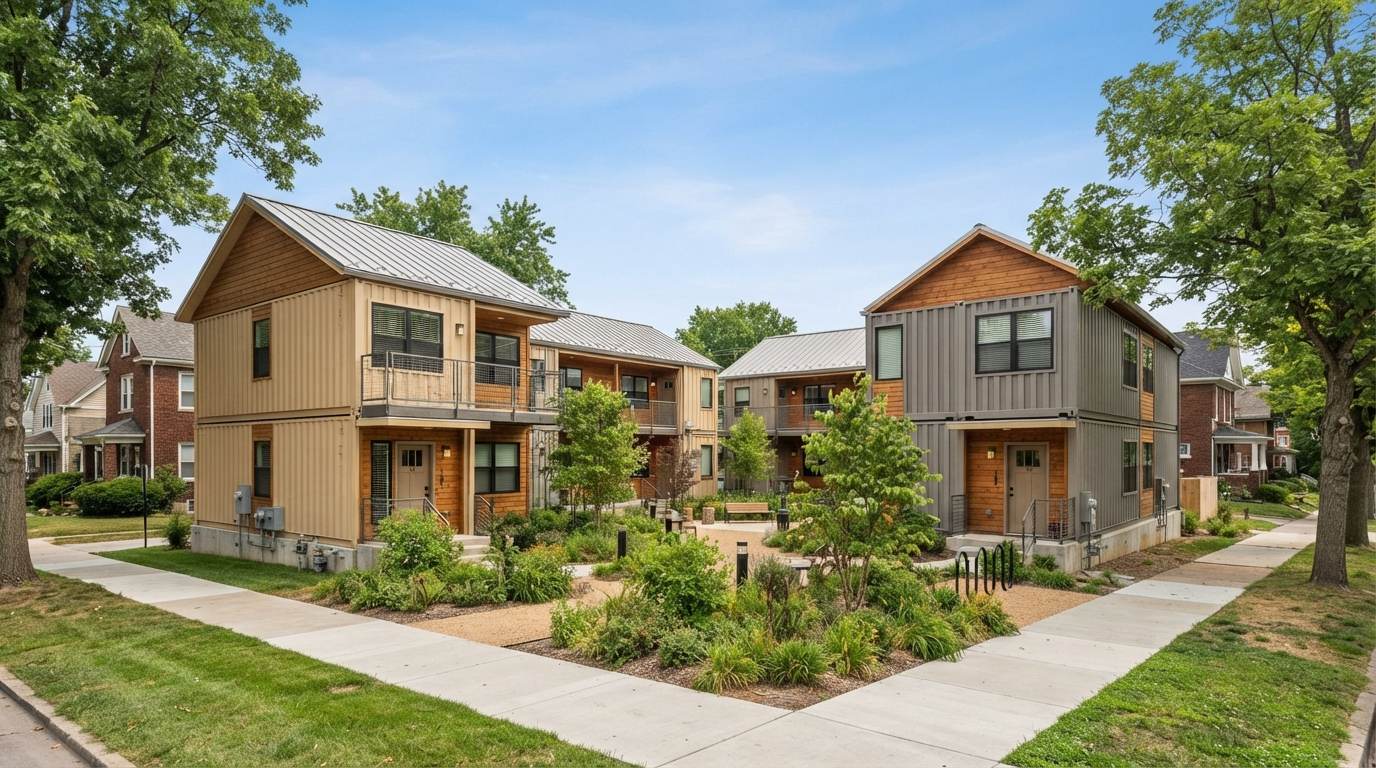
On the South Side of Youngstown, Ohio, at the corner of West Warren Avenue and Hillman Street, fourteen shipping containers are in the final weeks of being transformed into something this region has never seen: the first container-based veterans transitional housing facility in Northeast Ohio. The Veteran's Haven project, developed by Axess Family Services Inc. and slated to open in October 2026, represents years of community advocacy, cross-sector partnership, and one woman's refusal to accept that the veterans of Mahoning County had to travel forty miles to access transitional housing services.
Drywall is going up. HVAC is being installed. The fourteen individual living units — each one a full shipping container converted into a private bedroom and bathroom — are taking shape around a central common space built with traditional construction methods. When the Veterans' Affairs inspector approves it and the first veterans move in this fall, Youngstown will have done something the rest of Ohio's northeast corridor has not yet done: built a home for its homeless veterans out of steel.
The Problem the Project Solves
Brandi Parker, assistant director of veterans services for Axess Family Services, has been the driving force behind Veteran's Haven since its earliest conceptual stages roughly five years ago. The need she identified was both geographic and structural. Prior to this project, the closest veterans shelter to Mahoning County outside of Axess's original Trumbull County location was Freedom House in Kent — one of Axess's own veterans programs, roughly 40 miles away. For a homeless veteran in Youngstown without reliable transportation, 40 miles is not a commute. It is a barrier.
Parker's vision was for a facility that would bring the services to the veterans — not just housing, but the full ecosystem of wraparound support that makes transitional housing actually transitional rather than merely temporary. Case managers to help with employment, health, and mental health referrals. A VA liaison on-site. Creative arts therapies. A kitchen, laundry, and lounge. A place where staff are present 24 hours a day.
"Take pride in saying, 'This is my home when I'm here. This is our space. This was built for veterans.'"
— Brandi Parker, Assistant Director of Veterans Services, Axess Family Services
Axess Family Services — formerly known as Family and Community Services before its merger with AxessPointe — already operates six transitional veteran housing facilities in Ohio: locations in Canton, Lorain County, and Akron, as well as programs in the Mahoning Valley. Youngstown will be the seventh. It is the only one in the organization's portfolio using shipping containers. It is also, according to Parker and the project's coverage across multiple Northeast Ohio outlets, the first of its kind in the state.
How the Idea Found Its Builder
The container concept did not originate with Parker. It arrived through a phone call she describes as the universe delivering an unexpected answer to a problem she had been working on for years. Ed Macabobby, owner of Steel Valley Container Structures — a North Lima, Ohio company specializing in shipping container construction — reached out after being connected to Parker through Youngstown City Councilman Julius Oliver, who represents the 1st Ward covering the South Side neighborhood where the project would eventually be built.
"And it was just one of those moments, like the universe and the stars. I was like, wait a minute, are you serious?"
— Brandi Parker, recalling the call from Steel Valley Container Structures
What followed was not a quick decision but a methodical process: presentations to Youngstown City Council and Mahoning County commissioners, meetings with neighborhood watch groups, coordination with the Mahoning County Land Bank, and focus group sessions with contractors. The community engagement dimension was not incidental — it was built into the process from the beginning. The location itself was deliberate. The intersection of West Warren Avenue and Hillman Street was, by Parker's own description, a neighborhood notorious for crime. Placing a well-designed, professionally managed transitional housing facility for veterans there is not just a housing decision. It is a community revitalization statement.
The Design: One Container, One Veteran
Facility layout
14 private container units
Each shipping container is a self-contained living unit with a private bedroom, full bathroom, and exterior door. One unit is fully wheelchair accessible. Privacy is the foundational design principle — each veteran controls who enters their space.
Central common area
Built with conventional construction rather than containers, the shared hub houses Axess case management offices, a programs office, a VA liaison office, creative arts therapy space, a lounge, laundry, and a kitchen.
Hybrid construction rationale
Containers for private living, conventional construction for shared services — each building type doing what it does best. The container's structural efficiency works for defined-purpose individual rooms. The conventional core provides the open-plan flexibility a multi-function common area requires.
Exterior appearance
Parker explicitly described the design goal: it looks like a traditional home built out of wood and lumber once finished. In a neighborhood context, a facility that reads as a conventional building does not announce its residents' vulnerability to every passerby.
The one-container, one-veteran model is not arbitrary. The dignity of private space is a documented factor in the effectiveness of transitional housing programs for veterans, particularly those who have experienced trauma. A private room with a locking door gives a veteran the ability to regulate their own environment — to control who enters their space, to decompress in solitude, to recover without the constant stimulation of a shared dormitory floor.
Greener, Faster, Less Expensive
Parker summarized the project's construction rationale in a phrase that captures the essential container housing value proposition: it is greener, faster, and less expensive than traditional construction — and it looks like a traditional home built out of wood and lumber once finished.
The project's timeline reflects both the container method's advantages and the genuine challenges of pioneering a new construction approach in a community unfamiliar with it. The original timeline called for an earlier opening; the project experienced delays due to increases in material costs and the extended coordination required when contractors and officials have no local precedent to reference. Those delays are the cost of being first in Northeast Ohio — and the most honest documentation of what it actually takes to deploy an innovative housing model in a region where institutional knowledge has to be built from scratch alongside the building itself.
"If they're anything like me, they're going to be very emotional. This is so nice. I have not seen this done on this level — and for it to be in Youngstown, Ohio. It's just so awesome."
— Debra Jordan, Veteran's Haven Program Manager
The Program: Six to Eight Months Toward Independence
The housing model at Veteran's Haven is explicitly transitional, not permanent. Veterans will live in the container units for six to eight months, with the explicit goal of moving to permanent housing — either public housing or with a private landlord — by the time they complete the program. The facility is open to both men and women. Staff will be on-site 24 hours a day. A curfew will be enforced, and drugs and alcohol are prohibited.
Participation is mandatory in a meaningful sense: veterans sign up understanding that engagement is not optional. Case managers guide residents through employment, health, mental health, and housing resources. The design of the program reflects an understanding that housing alone does not end homelessness — and that transitional housing whose only offering is a bed is not doing the work the word "transitional" implies.
The Bigger Vision: A Veterans Community
Axess Family Services has already purchased land on each of the three other corners of the West Warren and Hillman intersection, with plans to build single-family housing units for veterans on those lots. There is no construction timeline yet for that next phase, but the purchase establishes the project's ultimate ambition: not a single transitional facility in a neighborhood, but a veterans-oriented community in a neighborhood previously defined by what it lacked.
"We want you to be a part of history. There are lives that are being changed with your support. This legacy project will live far beyond a lot of us."
— Brandi Parker
Hawah Okai, Axess director of veteran services, put the long-term vision plainly: "That's where the real need is." The transitional shelter at West Warren and Hillman proves the concept. The permanent housing on the surrounding corners fulfills the deeper promise — not just temporary refuge, but a place where veterans and their families can build lasting roots in a community that built something lasting for them.
Context: Container Housing for Veterans Nationwide
Veteran's Haven joins Indianapolis' 8Forty container home initiative as one of two container-based veteran housing programs in the Midwest with active construction underway in 2026 — part of a broader national pattern of container architecture being applied to housing needs that conventional construction has not adequately served. The two projects have distinct approaches: 8Forty is building individually sold or rented container homes for veteran ownership, while Veteran's Haven is a programmatic transitional facility with wraparound services. Both arrive at the same destination through different routes — using the shipping container's structural efficiency, cost advantages, and speed of deployment to address a housing crisis.
In a Rust Belt city that has spent decades managing population decline and disinvestment, a first-in-the-state veterans housing facility built from repurposed steel containers, on land that sat blighted, in a neighborhood that had given up waiting for investment — is not a small thing. It is the kind of thing that cities remember as the moment a corner turned.
Key takeaways
- →First in Northeast Ohio. Veteran's Haven is the first container-based veterans housing facility in the state — 14 private units, each a full shipping container with bedroom, bathroom, and exterior door, surrounding a conventional-construction common area.
- →Opening October 2026 after delays from material cost increases and the time required to work through regulatory and contractor processes unfamiliar with container construction.
- →One container, one veteran is the core design principle. Private space with a locking door is foundational to dignity and effective transitional housing for veterans with trauma histories.
- →Steel Valley Container Structures (North Lima, OH) is the container construction partner — the connection made through Youngstown City Council, illustrating how municipal relationships brought a private construction innovator to a nonprofit's vision.
- →Six to eight months of mandatory engagement in case management, employment, health, and mental health services. Housing is the platform, not the product.
- →Axess has purchased the three surrounding corners of the intersection for future permanent single-family veteran housing — framing the project as a neighborhood anchor, not an isolated facility.
- →Community buy-in was built into the process through City Council presentations, county commissioner engagement, neighborhood watch meetings, Land Bank coordination, and contractor focus groups before a container was ever placed.
Related on ContainerCompass
Sources
- "Shipping-Container Veterans' Housing Facility Takes Shape" — Ed Runyan, The Vindicator (Vindy.com). May 8, 2026.
vindy.com - "Veterans Housing Project Taking Shape in Youngstown" — Business Journal Daily. May 7, 2026.
businessjournaldaily.com - "Veteran's Haven Will Provide Transitional Housing for 14 Vets" — Business Journal Daily.
businessjournaldaily.com - "Shelter for Homeless Veterans Scheduled to Open in 2026" — WFMJ-TV Youngstown. November 13, 2025.
wfmj.com - "Veterans Housing Project Is Making Progress with Shipping Container Homes" — WKBN-TV Youngstown. August 28, 2024.
wkbn.com - "An Interview on Veteran's Haven's Container Home Project" — Axess Family Services Inc. November 21, 2025.
axessfamilyservices.org - Steel Valley Container Structures — North Lima, Ohio.
steelvalleycontainerstructures.com