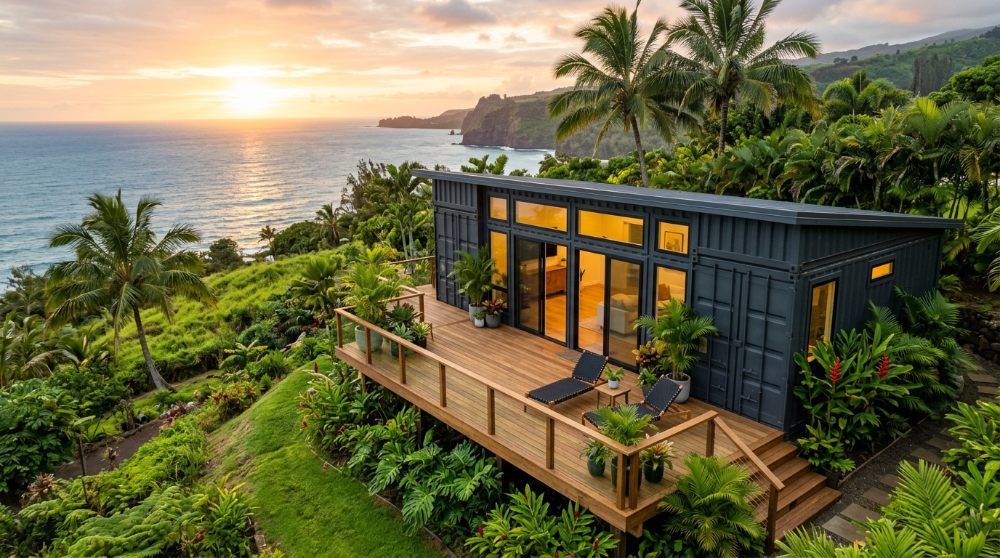
Hawaii has the highest housing costs in the nation. That sentence has opened the University of Hawaii's Housing Factbook for the second year running, and the 2026 edition does nothing to soften it. The statewide median price for a single-family home was $950,000 in 2025. On Oahu it reached $1,162,000 by April 2026. Affording the median home statewide requires roughly 180% of Hawaii's median household income — putting it within reach of only about one in five households. For the four in five who can't reach that threshold, the choices the Factbook describes are genuinely grim: leave the state, tolerate substandard or overcrowded housing, or fall into homelessness.
Into that market, a family-owned company based on the North Shore of Oahu is offering something different: shipping container homes, built new and fully finished, starting at $79,000. Hawaii Tiny Homes, operating from Kahuku on Oahu's windward coast, has spent eight years building what it describes as the state's premier tiny home provider. Its three-model lineup spans 20-foot, 40-foot, and 45-foot container builds, each constructed from brand-new intermodal containers and delivered complete to the buyer's property.
In a housing market this broken, starting at $79,000 is not a footnote. It is the entire argument.
The Housing Context: What $79,000 Means in Hawaii
The crisis is not a simple function of high prices. It is compounded by simultaneous cost pressures that have been building for years. Hawaii now has the second-highest median monthly HOA fees in the country at $470 statewide — and Oahu listings in February 2026 showed a median advertised HOA fee of $882 per month. Property insurance premiums jumped more than 13% in 2024 alone, the largest annual increase in over a decade, as insurers have pulled back from the Pacific market following catastrophic weather losses. Updated FEMA flood maps taking effect this year are expected to place roughly 3,700 additional Oahu properties into high-risk flood zones. And rising interest rates are simultaneously making mortgages more expensive and slowing new construction by raising developer borrowing costs.
The supply side is equally constrained. Hawaii has extremely limited buildable land and strict zoning requirements. Hawaii County recorded the fastest single-family permit processing times in the state in 2025 at a median of 127 days — down 27% from the prior year, but still more than four months. On Oahu the delays are longer. Against that backdrop, the ability to deliver a fully built, permitted, and code-compliant dwelling without a conventional construction timeline is not merely a convenience feature. It is a fundamental competitive advantage.
What Hawaii Tiny Homes Actually Builds
Hawaii Tiny Homes' product line is built on a straightforward premise: new shipping containers are structurally superior to older repurposed ones, and a clean, uncontaminated build is worth the premium over surplus containers. Every unit is constructed from a brand-new container that has never carried cargo.
The build process runs five steps from inquiry to delivery. After an initial quote request, buyers place an order with a 25% down payment. The company then works with the buyer on custom layout and design, including material selections from an upgrades catalog. Construction begins once layout is approved. Build times range from four to seven months. On completion the unit is delivered to the buyer's property, with final payment due at that point.
Each finished home includes a comprehensive package of standard features that amounts to a fully habitable dwelling requiring only site hookup:
- Structure and weatherproofing: Spray foam insulation, dual-pane windows, interior and exterior paint, porch light sockets, exterior outlets
- Electrical: Interior breaker panel, LED lighting, ceiling fans, USB outlets, pendant lights, wiring for A/C systems (unit not included)
- Plumbing: Plug-and-play hookup drain lines, under-mount kitchen sink, bathroom sink with faucet, tile shower with glass doors, standard toilet, bathroom vent fan
- Interior finishes: Luxury vinyl flooring, tile bathroom, wall paneling, tongue-and-groove ceilings, aluminum kitchen and bathroom cabinets, countertops
The plug-and-play electrical, plumbing, and wastewater connections deserve particular attention in the Hawaii context. A unit that connects to existing site utilities without requiring full mechanical rough-in dramatically reduces the on-site labor and permitting burden relative to conventional construction. For buyers placing an ADU on an existing property with hookup infrastructure already in place, the delivery-and-connect model is a significant practical advantage.
The Three Models
20 ft
160 sq ft. Best suited to single occupants, couples, guest cottages, home offices, or short-term rental units on properties with an existing primary residence. Less than one-tenth the median Oahu single-family home price.
40 ft
320 sq ft. The sweet spot of the lineup. Enough space for a functional single-bedroom layout with full kitchen, bathroom, living area, and sleeping space. Competes meaningfully against what $500,000 buys in a typical Oahu condo building.
45 ft
360 sq ft. Premium positioning for buyers wanting full-time living capability or high-end short-term rental operation. At $122,000 fully finished and delivered, it has essentially no price-equivalent in the conventional Hawaii housing market.
What Customers Are Using Them For
The customer use cases Hawaii Tiny Homes documents map directly onto how Hawaii's constrained market drives alternative housing strategies. One buyer describes a unit performing as a short-term rental — hosting friends, family, and paying guests for several years with excellent construction and beautiful finishes. Another, living full-time in a container home, describes the interior as "basically a gorgeous condo." Others report guest house and primary residence uses.
"Basically a gorgeous condo."
— Taylor Conroy, full-time container home resident, Hawaii Tiny Homes customer
The short-term rental angle is particularly relevant in Hawaii's tourism economy. A 40-foot container home sited on a property already containing a primary residence can function as a guest cottage for personal use and a revenue-generating rental during tourist season — exactly the model that has made container-based short-term rentals viable in markets from Ohio's Hocking Hills to Florida's Gulf Coast.
Disaster Relief: The Lahaina Connection
Hawaii Tiny Homes occupies an unusual position in the post-Lahaina recovery landscape. The August 2023 wildfire that destroyed most of Lahaina's historic town center on Maui killed 100 people and displaced thousands from a community where housing was already among the least affordable in the state. Maui's single-family home median has since fallen — down 7.3% year over year by March 2026 — partly reflecting the ongoing disruption, while the rebuild's early stages have kept housing demand suppressed relative to pre-fire levels.
Hawaii Tiny Homes explicitly positions itself as a natural disaster relief partner, stating that the company provided fast, sustainable housing for those impacted by the Lahaina fire and has expanded its support to communities across Hawaii and the mainland. The container home's characteristics make it well-suited for disaster response: rapid delivery compared to site-built construction, structural durability from steel framing, resistance to pests and moisture, and plug-and-play utility connections that can operate on simplified site infrastructure while permanent systems are restored.
The Practical Realities
Build times of four to seven months reflect the genuine complexity of fabricating a fully finished dwelling. The 25% down payment required to initiate a build is a meaningful capital commitment — roughly $19,750 for the entry-level 20-foot model and $27,250 for the 40-foot — that buyers need to have available before construction begins.
Land and siting remain the buyer's responsibility. In Hawaii's zoning environment, where county rules on accessory dwelling units, temporary structures, and non-conventional residential uses vary significantly by island and district, buyers are well-advised to confirm local permitting requirements before placing an order. A container home permitted as an ADU on an existing residential lot is a different zoning question than a standalone residential unit on a vacant parcel.
Utility connections — while simplified by the plug-and-play design — still require site infrastructure. Buyers without existing water, sewer, and electrical hookup on their property will need to factor those costs in separately.
Key takeaways
- →Hawaii is the most expensive housing market in the US. The statewide single-family median was $950,000 in 2025; Oahu's reached $1,162,000 by April 2026. Affording the median home requires roughly 180% of state median income — within reach of one in five households.
- →Hawaii Tiny Homes starts at $79,000 for a fully finished 20ft container home — insulation, electrical, plumbing, cabinetry, flooring, and bathroom tile included as standard. Build from new containers only.
- →Build times run four to seven months with a 25% down payment to initiate. Custom layout developed collaboratively before construction begins.
- →Plug-and-play utility connections reduce on-site hookup complexity — a meaningful advantage in Hawaii's slow-permitting environment for buyers placing units on properties with existing infrastructure.
- →Use cases span the full range — primary living, guest cottages, STR units, and home offices — reflecting the variety of strategies Hawaii buyers pursue in a constrained market.
- →Active in post-Lahaina disaster recovery. The company provided container housing after the August 2023 Lahaina wildfire and has expanded disaster relief work to mainland communities.
- →Land, zoning, and utilities remain the buyer's variables. County permitting for container homes in Hawaii varies by island, district, and intended use — due diligence before ordering is essential.
Looking Ahead
The UHERO Housing Factbook 2026 concludes with a clear prescription: Hawaii must significantly expand its housing supply to reverse its population decline and restore affordability. What it does not specify is what form that supply expansion should take. Hawaii Tiny Homes is making a quiet argument that at least some of it can take the form of 8-by-40-foot steel boxes, delivered in months rather than years, priced below the cost of a used car in the rest of the country.
Whether container homes become a meaningful part of Hawaii's housing supply response will depend partly on regulatory adaptation — whether counties streamline permitting for factory-built modular structures the way some mainland jurisdictions have — and partly on whether the market for sub-$150,000 delivered dwellings finds the buyers, the land, and the utility infrastructure to put them to work. The demand, in a state where one in five households can afford a median home, is not in question.
Sources
- Hawaii Tiny Homes — Official Website.
hitinyhomes.com - The Hawaiʻi Housing Factbook 2026 — University of Hawaii Economic Research Organization (UHERO). Published May 2026.
uhero.hawaii.edu - "Hawaiʻi Housing Affordability Improves Slightly but Housing Crisis 'Remains Severe'" — Aloha State Daily. May 8, 2026.
alohastatedaily.com - "High Housing Costs Force Hawaiʻi Residents Into 'Impossible Choices'" — Honolulu Civil Beat. May 11, 2026.
civilbeat.org - Hawaii Housing Market 2026 — ManageCasa.
managecasa.com