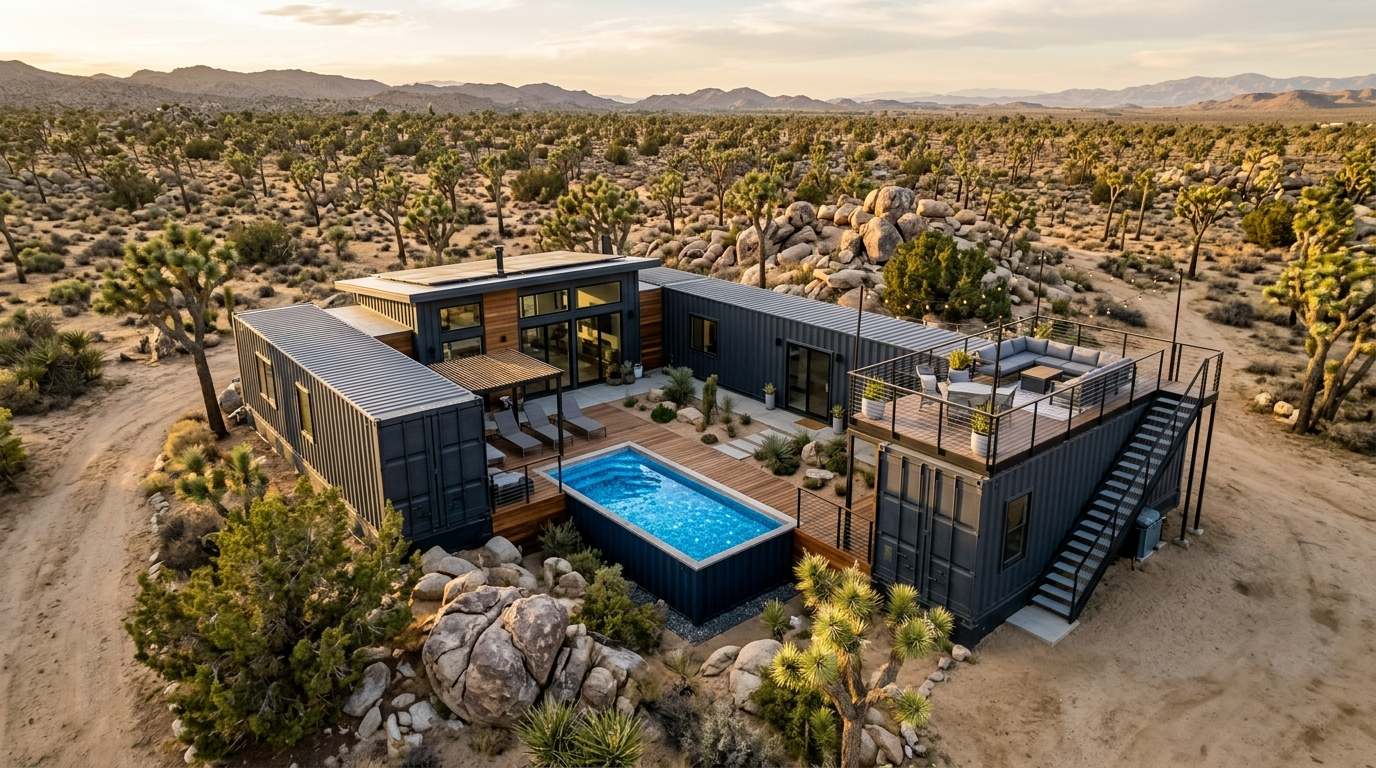
"We thought this process was going to be easy. This thing kicked our butts."
— Neil, builder of Box on the Rocks
Neil and his partners wanted a fun, unique group escape — somewhere in the desert where friends and family could disconnect from everyday life and reconnect with each other. They found a 1.25-acre parcel just outside Joshua Tree National Park for $36,000 and estimated they could build a three-container home for $150,000. After permits, foundation engineering, desert water and electrical infrastructure, a container pool, and luxury finishes, the final bill was $650,000.
Box on the Rocks is one of the most thoroughly documented container home projects in the Joshua Tree area — toured by Tiny House Giant Journey, documented in a YouTube video with hundreds of thousands of views, and now operating as a premium short-term rental on both Airbnb and VRBO. Neil's transparency about both what went right and what cost far more than expected makes this one of the most instructive container home builds available to study.
In this case study
- The staggered H-shape layout
- The $650K cost breakdown
- The $150K to $650K budget explosion
- Interior design — textures and luxury finishes
- Outdoor spaces — pool, patio, rooftop deck
- Short-term rental operations
- Solar and off-grid infrastructure
- Box on the Rocks vs. Ben Uyeda's Joshua Tree build
- 5 honest lessons from Neil
- Watch the tour
The staggered H-shape layout — why it matters
Most three-container builds default to linear stacking or simple L-shapes. Neil's H-shape configuration is significantly more complex to engineer and more expensive to execute — but it creates a fundamentally different property. Understanding why is the key to understanding everything that follows.
What the H-shape creates
A courtyard, not a yard. The 40×40-foot patio sits between the arms of the H, feeling enclosed and private on multiple sides without being boxed in — outdoor dining and social areas feel intentional, not incidental.
A natural pool position. The container pool sits where the H-shape's geometry creates a visual terminus — visible from both the patio and through the home's glass doors from inside.
Privacy between zones. The offset between containers separates sleeping and social areas acoustically and visually without requiring solid interior walls across the full footprint.
A rooftop runway. The uppermost container's 40-foot length gives the rooftop deck its sweeping size — a consequence of the H-shape that a stacked configuration wouldn't produce at grade level.
The tradeoffs
Engineering complexity. An H-shape requires structural connections between containers at their offset junction points — more engineering, more welding, more foundation complexity than parallel or L-shape arrangements.
Higher foundation cost. The H-shape footprint requires a larger, more complex foundation. Box on the Rocks spent $72,000 on foundation alone — the single largest construction line item after the containers themselves.
Longer timeline. Neil's initial estimate of 1–2 years stretched considerably longer. The design complexity contributed to a longer-than-expected build process in addition to the permitting challenges.
Harder to replicate. The H-shape is not something a first-time owner-builder should attempt without experienced structural engineering support from the start of the design process, not added afterward.
The $650,000 cost breakdown
Neil's transparency about costs is one of the most valuable contributions of this build to the container home knowledge base. Every major line item is documented.
| Line item | Cost | Notes |
|---|---|---|
| Land (1.25 acres, outside Joshua Tree NP) | $36,000 | Rural San Bernardino County; notably low for California |
| Foundation | $72,000 | Largest construction surprise; desert soil and H-shape complexity drive cost |
| Containers (3× 40-ft high-cube, fully built out) | $250,000 | Includes container purchase, modification, interior finish, insulation, windows, doors |
| Electrical | $26,000 | Grid connection in remote desert location; panel, wiring, EV charger |
| Permits | $35,000 | Building permit + STR permit; San Bernardino County known for complexity |
| Water | $30,000 | Desert water access is expensive; well or connection infrastructure |
| Container pool (20-ft, by Container Pool) | $60,000 | Finished container pool unit plus crane placement and plumbing/electrical connection |
| Solar panels (grid-tied) | $46,000 | ~7% of total budget; essential for desert utility cost management |
| Additional (landscaping, furnishings, misc) | $95,000 | 40×40 patio, outdoor furniture, rooftop deck furnishings, interior furnishings, landscaping |
| Total all-in | $650,000 | Includes land, all infrastructure, containers, pool, solar, and furnishings |
Cost per square foot
At 960 square feet and $650,000 all-in, Box on the Rocks cost approximately $677 per square foot. That's higher than a custom conventional home in most US markets — but the comparison is imperfect. The $650,000 includes land, desert infrastructure that has no equivalent in suburban builds (water connection, desert electrical grid extension), and a $60,000 container pool that adds amenity value far beyond its square footage. Stripping out land ($36,000) and pool ($60,000), the structure and infrastructure cost was approximately $554,000 — or $577 per sq ft for the built structure in a challenging desert jurisdiction.
The $150,000 to $650,000 budget explosion
California container homes cost 3–4× what you'll initially estimate
Neil's initial estimate was $150,000. The actual cost was $650,000 — 4.3 times the budget. This is not unique to Neil. It represents the standard experience of first-time container home builders in California who underestimate four specific cost categories: foundation engineering, permitting, desert utility infrastructure, and luxury finish costs in a rental-oriented build.
For anyone planning a similar project in San Bernardino County: assume $25,000–$50,000 in permits, $50,000–$100,000 in foundation for a three-container build, $25,000–$40,000 in electrical and water infrastructure, and plan construction costs at 2× your initial estimate before contingency.
The four cost categories that drove the explosion from $150K to $650K:
- Foundation: $72,000 — Desert soil conditions, combined with the H-shape footprint's complexity, produced a foundation cost that alone exceeded Neil's total initial budget by nearly half. Foundation is consistently the most underestimated line item in container home builds.
- Permits: $35,000 — The building permit alone is expensive in San Bernardino County. Adding the short-term rental permit — a separate process with its own requirements — pushed total permitting costs well above what most builders budget. The STR permit requires a certificate of occupancy, fire safety compliance, and TOT registration.
- Water infrastructure: $30,000 — Desert water access has no suburban equivalent. Whether a well or a connection to a water district, the cost is significant and non-negotiable.
- The pool: $60,000 — Added to the original vision as the build progressed. A $60,000 line item that wasn't in the original $150,000 estimate accounts for 40% of the difference between the original budget and the final cost.
Interior design — textures, color, and a spa bathroom
Neil's stated design philosophy for Box on the Rocks centers on a single principle: the importance of colors and textures. In a 960-square-foot space divided across three 7'8"-wide container interiors, creating warmth and visual interest required deliberate material choices at every surface.
The color and material palette
- Walls: white throughout as the base — maximizing the sense of space in narrow containers
- Accents: orange and blue — picking up the desert sunset palette and echoing the container's original blue exterior
- Floors: concrete epoxy — durable, easy to clean in a rental context, and industrial-appropriate
- Furnishings: brown leather — warm against the white walls and concrete floors; durable for rental use
- Art: Joshua Tree-inspired artwork throughout — grounding the interior in its specific landscape
- Beds: floating bed frames with luggage storage beneath — solving the container's limited bedroom footprint problem practically and elegantly
The spa bathroom — the standout interior feature
The master bathroom is the most consistently praised interior space in guest reviews and the video tour. Neil designed it as a genuine spa experience rather than a compromise squeezed into container dimensions:
- Two rain showers
- Soaking tub with waterfall faucet
- Large-format tiles with white grout mimicking marble slabs
- Backlit mirrors
- Hidden drain (linear, flush-mounted)
The kitchen — 56 linear feet
The most surprising aspect of Box on the Rocks for visitors expecting a tiny home compromise: a kitchen with 56 linear feet of counter and storage space. The full 40-foot length of a single container makes this achievable in a way that's impossible in a conventional small home.
- Full-size refrigerator and freezer as separate units — not under-counter
- Full-size washer and dryer (in-unit laundry is a significant STR amenity)
- Stainless steel appliances throughout
- Floating shelves instead of upper cabinets — preserves visual height in the container's already-limited ceiling space
- Dedicated coffee station — a deliberate STR amenity for Joshua Tree's outdoors-oriented guests
Outdoor spaces — the real heart of the property
At Box on the Rocks, outdoor spaces outperform the interior in experiential impact. The 40×40-foot patio, the container pool, and the 40-foot rooftop deck collectively provide more memorable moments than the 960-square-foot interior — and they are the primary drivers of STR bookings and guest reviews.
The container pool — $60,000, built by Container Pool
The 20-foot custom shipping container pool is the single feature that most differentiates Box on the Rocks from every other Joshua Tree rental property. Built by Container Pool — a specialist manufacturer that converts decommissioned shipping containers into finished pools — it arrives as a completed unit requiring only crane placement and plumbing/electrical connection.
Why a container pool makes particular sense with a container home
Traditional in-ground pools in Joshua Tree require excavation through desert rock — expensive, slow, and sometimes impossible depending on site conditions. A container pool arrives finished, is placed by crane, and requires only connections. The material consistency — the same Corten steel container for both the home and the pool — creates a unified aesthetic that would be very difficult to achieve by mixing container architecture with a conventional pool. At $60,000, it represents 9% of the total build cost but is the primary revenue-generating amenity for the STR. In a desert market where a private pool can double nightly rates, the ROI case is strong.
The 40-foot rooftop deck — the stargazing platform
Joshua Tree is a designated International Dark Sky Community. The rooftop deck spans the full length of the uppermost container — 40 feet — accessible via an exterior staircase. Guest reviews consistently cite rooftop stargazing as a highlight. The deck provides 360-degree views: Joshua Tree's boulder formations and the National Park to the south, desert vistas in all directions, and a Milky Way view that is a rarity within a 3-hour drive of Los Angeles.
Short-term rental operations
Box on the Rocks was built explicitly as both a personal retreat and an income-generating STR — the $650,000 investment requires a revenue justification, and Neil planned for it from the start. The property is listed on both Airbnb and VRBO.
STR permit — the final milestone before opening
Obtaining the short-term rental permit from San Bernardino County is explicitly cited as one of the final milestones before Box on the Rocks could open to guests. The $35,000 permits line item likely covers both the building permit and the STR permit process — which requires a certificate of occupancy, fire safety compliance, transient occupancy tax (TOT) registration, and in some zones, neighbor notification. Operating without the STR permit in San Bernardino County risks fines and forced closure.
Guest amenities from the VRBO and Airbnb listings
- Container pool heated to ~80°F
- 6-person hot tub
- 40-foot rooftop deck, furnished with seating and dining
- Fire pit with outdoor furniture
- Full chef's kitchen — full-size appliances, utensils, dinnerware
- Coffee station with local Joshua Tree Coffee Company grounds
- Indoor and outdoor dining for 6
- Full washer and dryer in-unit
- Parking for 3 vehicles with EV charger (Tesla-compatible)
- Starlink WiFi
- High-speed streaming (Roku — YouTube TV, Netflix, Max, Disney+)
- BBQ grill (propane)
- Dog-friendly (up to 30 lbs, max 2 dogs, $100 non-refundable fee)
- Cornhole and Jenga available
- 3 external security cameras (no interior cameras, none at patio)
Select guest reviews
"Felt like a hotel but also like a home away from home."
— Airbnb guest
"Rooftop deck, hot tub, and outdoor furniture — highlights of the stay."
— Airbnb guest
"One of the best Airbnbs I've ever stayed in."
— Airbnb guest
Solar and off-grid infrastructure
The $46,000 solar installation — approximately 7% of the total project budget — is grid-tied, meaning the property connects to the electrical grid but generates its own electricity via solar panels, reducing or eliminating utility bills. In Joshua Tree, where sunshine is effectively unlimited, a properly sized system can produce more energy than the home consumes and sell the excess back to the grid.
The rationale is practical rather than purely environmental: electricity costs in San Bernardino County's desert communities are high; summer cooling loads are extreme; the container pool and hot tub are energy-intensive. The on-site EV charger reflects the reality that a significant portion of Joshua Tree visitors from Los Angeles drive electric vehicles — and an EV charger is a meaningful STR amenity for that market.
Box on the Rocks vs. Ben Uyeda's Joshua Tree build
ContainerCompass has documented two permitted container home builds in Joshua Tree — Ben Uyeda's architect-led Modern Home Project and Neil's Box on the Rocks. Both use 40-foot high-cube one-trip containers in San Bernardino County. The differences reveal two entirely different approaches to the same location and material.
Ben Uyeda — Modern Home Project
- Architect-led (Cornell B/M.Arch, ZeroEnergy Design)
- Land: $20,000 / 10 acres
- Containers: 2× 40-ft + 1× 20-ft (H-shape equivalent footprint)
- Land cost: $20,000 for 10 acres (more remote)
- Focus: code compliance, engineering rigor, documentation
- Design language: industrial-minimalist, passive solar
- Pool: none
- Primary use: primary residence
- Total cost: not fully disclosed (~$77,000+ in documented hard costs)
Neil — Box on the Rocks
- Owner-developer with partners, contractor-built
- Land: $36,000 / 1.25 acres (closer to town and park)
- Containers: 3× 40-ft high-cube, staggered H-shape
- Land cost: $36,000 for 1.25 acres (better location)
- Focus: STR revenue, luxury amenities, guest experience
- Design language: desert luxury, warm textures, spa finishes
- Pool: $60,000 container pool
- Primary use: short-term rental + personal retreat
- Total cost: $650,000 all-in (fully disclosed)
The two builds are complementary study materials. Ben's documents what a code-compliant permitted build looks like when led by a licensed architect who prioritizes engineering documentation. Neil's documents what a luxury STR-oriented build costs when led by a developer willing to spend on amenities that generate rental revenue. Neither is the "right" answer — they serve different purposes and reflect different priorities.
5 honest lessons from Neil
-
1
Budget for 3× your initial estimate in California
San Bernardino County permits, foundation engineering in desert soil, desert water and electrical infrastructure, and luxury finishes collectively push container home costs far beyond what most first-time builders expect. $150,000 became $650,000. This is a feature of California permitting and desert infrastructure — not a mistake Neil made. Plan accordingly.
-
2
Permit complexity scales with ambition
A simple ADU container on a residential lot has different permit requirements than a three-container luxury compound with a container pool and an STR permit. Engage a local permit expediter or contractor familiar with San Bernardino County before finalizing the design — not after.
-
3
Source your containers before designing around them
One-trip, pesticide-free, high-cube 40-foot containers are not always immediately available at the specification required for habitable use. Design choices — ceiling height, structural spans, window placement — depend on exact container dimensions. Source the containers first, finalize the design second.
-
4
The pool is the revenue engine, not the luxury add-on
At $60,000, the container pool represents 9% of the total build cost but is the primary driver of STR bookings and premium nightly rates in a hot desert market. A private pool may be the most defensible STR amenity investment in Joshua Tree — it doubles the competitive tier the property operates in.
-
5
Design for photography
STR bookings are driven by photography. Every design decision at Box on the Rocks — the staggered H-shape, the container pool, the oversized chair, the rooftop deck, the Joshua Tree artwork — creates a photographic moment. A container home that looks striking in photographs will fill its calendar. One that doesn't will struggle regardless of quality of construction.
Watch the tour
▲ YouTube: "This family home is built from 3 shipping containers" (published October 20, 2023). Additional coverage: Tiny House Giant Journey (May 2026), livinginacontainer.com (November 2023). Cost data and analysis: ContainerCompass.
Sources for this case study:
- YouTube — "This family home is built from 3 shipping containers." ID: Y-AiwNSMvKs. Published October 20, 2023
- Tiny House Giant Journey — "Box on the Rocks: Stunning Joshua Tree Container Home That Redefines Desert Living." May 5, 2026
- livinginacontainer.com — "$650K Eco-Home from 3 Shipping Containers in Joshua Tree, CA." November 2, 2023
- VRBO listing: "Box on the Rox Container home + heated pool" — vrbo.com/3459949
- Airbnb listing: "3-Story Container Home | Pool • Spa • Rooftop Deck" — airbnb.com/rooms/728091517814307485
- Cost data: confirmed $650,000 all-in by multiple independent sources including builder and livinginacontainer.com
Ready to source your containers?
Shipped.com supplies one-trip high-cube containers across the US — the spec Neil used for Box on the Rocks — with delivery to your site included.