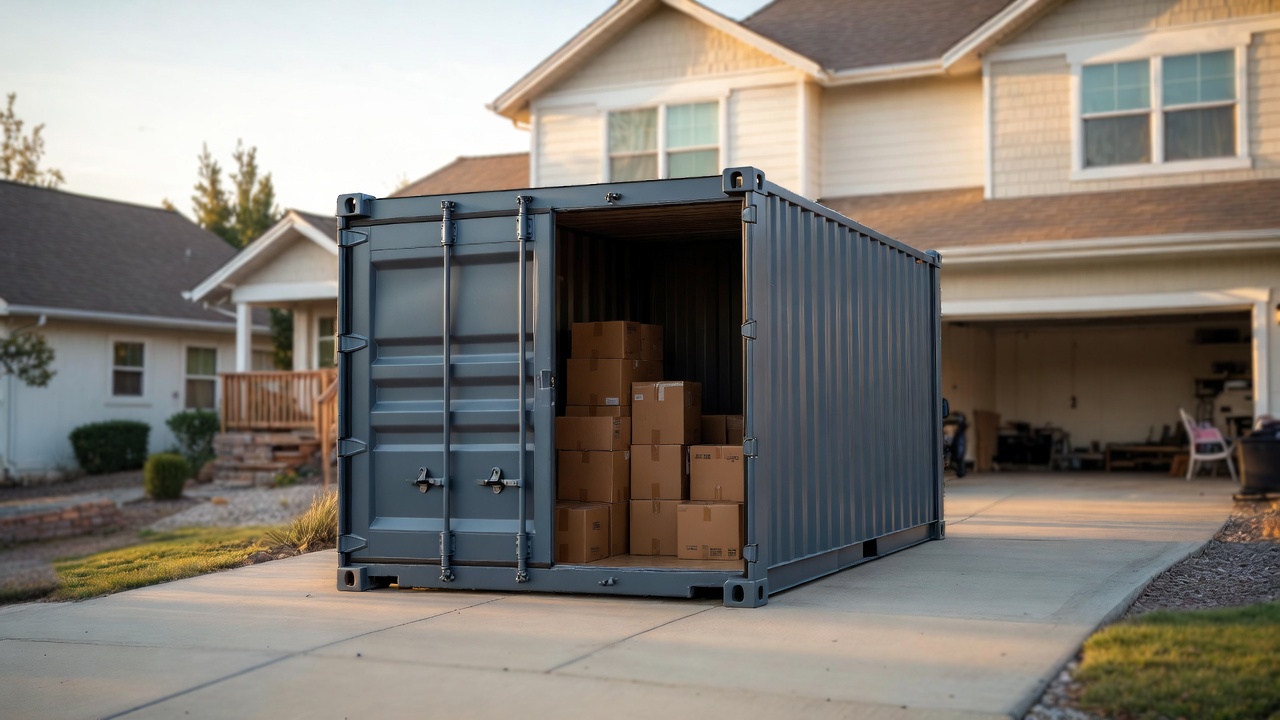
Portable storage containers for moving work by delivering a steel unit to your door, giving you days or weeks to load at your own pace, then transporting it to your new home — or storing it at a depot while you're between addresses. It's slower than hiring full-service movers but significantly cheaper, and less stressful than a one-day rental truck scramble. The main choice is whether you use a branded portable storage company (PODS, 1-800-PACK-RAT, U-Box) or a traditional shipping container supplier — each has real trade-offs.
Portable storage options at a glance
Best overall (moving)
PODS or 1-800-PACK-RAT
Cheapest option
U-Haul U-Box
Most space (local moves)
20ft shipping container
Monthly storage cost
$60 – $250/mo
In this guide
- How portable container moving works
- Brand comparison: PODS, 1-800-PACK-RAT, U-Box and more
- Container vs truck vs full-service movers
- What it costs: real numbers by move type
- Local vs long-distance moves
- Packing tips for container moves
- Access and site requirements
- Rent vs buy portable storage
- Cheapest portable storage options
- Portable storage container sizes
- FAQ
How portable container moving works
The process is straightforward across all suppliers:
- Order and schedule delivery — choose your container size, pick a delivery date, and confirm you have driveway or street access. Most suppliers need 24–48 hours notice.
- Load at your pace — the container sits on your property for a set period (typically 1–4 weeks). You load it whenever works for you — no moving day pressure.
- Pickup and transport — the supplier picks up the loaded container and drives it to your destination city. Transit typically takes 2–14 days depending on distance.
- Delivery and unloading — the container is delivered to your new address. You unload at your own pace, then the supplier picks it up empty.
- Optional: depot storage — many suppliers will store the container at a local depot between moves, useful if there's a gap between your move-out and move-in dates.
Brand comparison: PODS, 1-800-PACK-RAT, U-Box and more
The major portable storage brands all use the same general model — they differ in container sizes, coverage areas, pricing structures, and storage facility quality. Here's how each compares.
PODS
Largest network1-800-PACK-RAT
U-Haul U-Box
SMARTBOX
Moving container (20ft)
Most spaceMobile Mini
Get quotes from at least two suppliers
Prices vary significantly by zip code, season, and availability. The same move quoted to PODS in spring can cost 20–30% more than in fall when demand drops. Always get multiple quotes for the same service window and compare the all-in price including delivery, pickup, and any storage fees.
Container vs truck vs full-service movers
Portable container
$800–$3,500
- Load at your own pace — no time pressure
- Cheaper than full-service for most moves
- Can store between moves at a depot
- You do the packing and loading
- Delivery dates not always exact
- Container sits on driveway — needs access
Rental truck (DIY)
$200–$1,200
- Cheapest option for local moves
- You control pickup and drop-off timing
- Good for small households
- Must load and drive in a single day
- You drive a large truck — stress and skill
- Fuel costs add up fast long-distance
Full-service movers
$2,000–$10,000+
- They pack, load, drive, and unload
- Fastest and least physical effort
- Insurance coverage on belongings
- Most expensive by far
- Less control over timing
- Estimates often grow on moving day
What it costs: real numbers by move type
| Move type | PODS est. | 1-800-PACK-RAT est. | U-Box est. | Shipping container |
|---|---|---|---|---|
| Local (under 50 mi) | $300–$700 | $250–$650 | $200–$500 | $600–$1,200 (delivery both ways) |
| Regional (50–500 mi) | $1,200–$2,500 | $1,100–$2,200 | $900–$2,000 | Not typically available |
| Long-distance (500+ mi) | $2,500–$5,000+ | $2,200–$4,500+ | $1,800–$3,500+ | Not typically available |
| Monthly storage only | $100–$250 | $100–$200 | $60–$90 | $100–$200 (on your property) |
These are estimates — actual quotes depend heavily on your specific zip codes, the time of year, and current demand. Summer (May–September) is peak moving season and prices run 15–25% higher than off-peak. If your timeline is flexible, booking a fall or winter move can save several hundred dollars.
Watch for fees not in the base quote
Branded portable storage companies often quote a base container rate that doesn't include: fuel surcharges, long-carry fees if the truck can't park close, stair fees, overweight fees, and extended rental charges if your move takes longer than the quoted period. Ask for a full itemized quote before booking.
Local vs long-distance moves
Local moves (under 50 miles)
For local moves, the shipping container option is often the best value — especially for large households. The container is delivered, you take your time loading, it's transported across town, and you unload. Monthly rental is $100–$200; delivery and pickup are the main costs. Branded portable storage companies work well here too, with more flexibility in storage if you need it.
Best option: shipping container (most space) or PODS/1-800-PACK-RAT (depot storage option)
Long-distance moves (500+ miles)
Traditional shipping containers are not designed for long-distance consumer moves — suppliers don't typically offer this service. For cross-country moves, PODS and 1-800-PACK-RAT are the main options in the portable container space. U-Box is cheaper but uses a smaller container. Budget an extra week or two for transit and confirm the transit time in writing before booking.
Best option: PODS or 1-800-PACK-RAT for most long-distance moves; U-Box if budget is the primary concern
Moves with a storage gap
If your move-out date doesn't align with your move-in date, depot storage is the main advantage of branded portable storage companies. PODS and 1-800-PACK-RAT will store your loaded container at a climate-controlled facility between moves. A shipping container supplier can leave the unit on your property but can't store it at a depot for you.
Best option: PODS or 1-800-PACK-RAT — their depot storage network is the key advantage here
Large household / farmhouse moves
Standard portable storage units (7–16ft) can feel limiting for a 4–5 bedroom household. A 20ft shipping container (160 sq ft of floor space) typically holds more than a 16ft PODS unit. A 40ft container handles even the largest households. If your move is local and you have driveway access, a shipping container gives you the most space at the lowest monthly rate.
Best option: 20ft or 40ft shipping container for maximum space; plan for delivery access requirements
Packing tips specific to container moves
- Load heavy items first, pushed to the front wall. Appliances, book boxes, and tool chests go in first. Furniture and lighter boxes go in last. This keeps the load stable during transport and means you unload lighter items first.
- Fill the full height. Container moves pay by the unit, not by weight. Stack boxes floor to ceiling — use wardrobe boxes for odd-shaped items at the top. Unfilled vertical space wastes money you've already paid for.
- Tie-down straps prevent shifting. Items shift during transport — especially on long hauls. Use cam buckle straps anchored to the container's floor rings or wall rings to secure large furniture. Blanket wrapping helps too.
- Protect floors against moisture. Container floors (plywood on most shipping containers) can transmit cold and moisture. Lay cardboard or moving blankets on the floor before stacking furniture or fabric-covered items.
- Take photos of the container interior before and after. Document the condition before loading and when you finish loading. This protects you if any damage dispute arises at pickup or delivery.
- Don't ship hazmat. Compressed gas, flammables, and certain cleaning chemicals are prohibited in both branded portable storage units and shipping containers. Check your supplier's list — violations can result in fines and liability.
Access and site requirements
The most common problem with portable container moves is access — either the truck can't get close enough, or the container can't be placed where you need it. Check these before booking:
- Overhead clearance: Delivery trucks need 14–18ft of overhead clearance. Trees, power lines, and overhangs commonly block delivery. Measure your driveway clearance before booking.
- Driveway length: A 20ft container delivery truck needs approximately 60–80ft of clear straight space to operate. Winding or short driveways may require street placement — which needs a permit in many cities.
- Street permits: If the container needs to sit on a public street, most cities require a permit — typically $50–$150. Your supplier may handle this or may expect you to. Confirm before delivery.
- Ground surface: Containers placed on asphalt in summer heat can sink the corner blocks into the surface. Plywood pads under the corners prevent this. Ask your supplier if they provide these.
- HOA rules: Many HOAs restrict or prohibit storage containers on property. Check your HOA rules — some allow them for a maximum of 30 days, others prohibit them entirely.
Rent vs buy portable storage containers
"Rent or buy portable storage containers" is one of the most common questions people land on — and for most people the answer is clear once you run the numbers.
Renting makes sense when…
- You need it for a move (under 6 months)
- You want the supplier to transport it for you
- You need climate-controlled depot storage in between addresses
- You don't have space to permanently store a container
- You're using a branded service (PODS, 1-800-PACK-RAT) — you can only rent, not buy
Buying makes sense when…
- You need long-term on-site storage (12+ months)
- You'll use it after the move as a shed or workshop
- You want to modify it (add shelving, electricity, climate control)
- You have space on your property for a permanent placement
- You're comparing: a 20ft container costs $2,500–$4,000 to buy vs $100–$200/mo to rent
The breakeven point for renting vs buying a shipping container is roughly 18–24 months. If you need storage for longer than that, buying typically wins on cost — and you still have an asset with resale value when you're done. For anything under a year, renting is almost always the better choice.
Cheapest portable storage options
If budget is the primary concern, here are the portable storage options ranked from cheapest to most expensive — and where each cuts corners to get there.
| Option | Monthly cost | Local move cost | The trade-off |
|---|---|---|---|
| U-Haul U-Box | $60–$90/mo | $200–$500 | Small container (8×5×7ft) — you may need multiple boxes for a full household |
| 20ft shipping container (rented) | $100–$200/mo | $600–$1,200 (delivery both ways) | No long-distance moving service; no depot storage option |
| SMARTBOX | $200–$500/mo | $300–$700 | Southeast/Mid-Atlantic only; limited coverage |
| 1-800-PACK-RAT | $100–$200/mo storage | $250–$650 | Metro areas only; check coverage before quoting |
| PODS | $100–$250/mo storage | $300–$700 | Most expensive per unit; broadest coverage and most flexible |
The cheapest long-distance option for a full household move is almost always U-Box — but budget for multiple boxes if you have more than a 2-bedroom's worth of stuff. The cheapest local option with the most space is a 20ft shipping container rental from a local supplier.
Off-peak moves save 15–25%
Portable storage prices peak in summer (May–September). Moving in October–March with a flexible window can save $300–$800 on a long-distance move with branded services. If your timeline allows, asking for an off-peak discount is worth the conversation.
Portable storage container sizes
Container size is one of the biggest decision points — too small and you need multiple units, too large and you're paying for empty space. Here's how the common sizes compare.
| Size | Floor space | Fits approx. | Available from |
|---|---|---|---|
| 7ft (PODS small) | ~35 sq ft | Studio / 1-bedroom apartment | PODS |
| 8×5×7ft (U-Box) | ~40 sq ft | 1–2 rooms of furniture | U-Haul |
| 8ft (1-800-PACK-RAT small) | ~48 sq ft | 1–2 bedroom apartment | 1-800-PACK-RAT |
| 12ft | ~84 sq ft | 2–3 bedroom home | PODS, 1-800-PACK-RAT |
| 16ft | ~112 sq ft | 3–4 bedroom home | PODS, 1-800-PACK-RAT |
| 20ft shipping container | ~160 sq ft | 4–5 bedroom home | Local container suppliers |
| 40ft shipping container | ~320 sq ft | Large household or commercial | Local container suppliers |
Rule of thumb: a 16ft unit handles most 3-bedroom homes comfortably. If you're on the fence between sizes, go larger — you won't regret the extra room for awkward furniture shapes, and the price difference between a 12ft and 16ft unit is usually modest relative to the cost of renting a second unit.
Frequently asked questions
What is the best portable storage container for moving?
For long-distance moves, PODS and 1-800-PACK-RAT are the most established options — both offer nationwide coverage, climate-controlled depot storage, and consistent service. For local moves where you want maximum space, a 20ft shipping container rental is typically the best value — more room than any branded portable storage unit at a lower monthly rate, though without the depot storage option. U-Box is the best budget option for long-distance moves if cost is the primary concern.
How much does a portable storage container for moving cost?
For a local move (under 50 miles), expect to pay $300–$700 with a branded service like PODS or $600–$1,200 total with a shipping container rental (delivery both ways). For a long-distance move (500+ miles), budgets of $2,500–$5,000 with major branded services are common. Shipping containers are not typically used for long-distance consumer moves. Monthly storage runs $60–$250 depending on the provider and your location.
How long can you keep a portable storage container?
Most providers bill monthly — you can keep the container as long as you need it and continue paying the monthly rate. Branded services like PODS can store the container at their facility for as long as you need between move-out and move-in dates. Shipping container rentals from local suppliers are typically month-to-month with no fixed end date — return it when your move is complete.
Are portable storage containers waterproof?
ISO shipping containers are designed to be weathertight and hold up well in rain. Branded portable storage units (PODS, 1-800-PACK-RAT) are also weather-resistant. Neither is 100% waterproof under all conditions — heavy sustained rain can occasionally find gaps around door seals on older units. For valuable or moisture-sensitive items, wrap them in plastic or use sealed bins rather than relying solely on the container's weatherproofing.
Can I pack a portable storage container myself?
Yes — self-packing is the standard approach with portable storage containers. That's the main appeal of the model: you load at your own pace rather than in one stressful moving day. Most services include a loading period in the quoted price (typically 1–4 weeks). If you want help loading, you can hire movers separately through services like HireAHelper or TaskRabbit to load and unload the container while you handle the booking.
What's the difference between PODS and a shipping container for moving?
PODS units range from 7–16ft long — smaller than a standard 20ft shipping container. PODS handles long-distance moves and offers climate-controlled depot storage. Shipping containers are larger (more space per dollar) and work well for local moves, but suppliers don't typically offer long-distance consumer transport. PODS costs more per month but offers more flexibility. Shipping containers cost less monthly but require you to manage the logistics of the actual move separately.
Need a container for your move?
Shipped.com offers portable storage container rentals and rent-to-own options across the US, with delivery to your location.