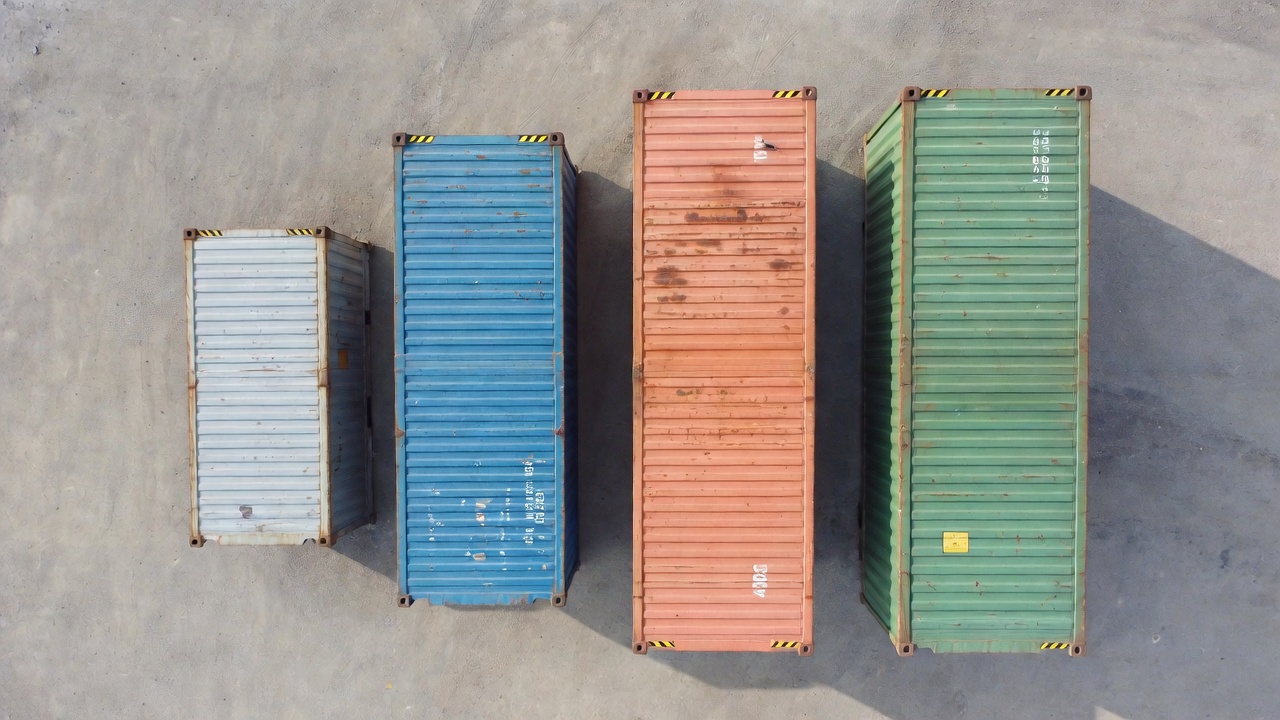
Shipping containers come in a standardized range of sizes set by the International Organization for Standardization (ISO). The most common are the 20ft and 40ft — together they account for over 90% of containers in circulation. But there are also 10ft, 45ft, 48ft, and 53ft units, plus high cube variants of almost every size that add one foot of height. Here is every size with full specifications.
In this guide
Quick reference: all sizes at a glance
10ft
Compact
10 × 8 × 8'6"
~80 sq ft
Tight spaces, small sites
20ft
Most common
20 × 8 × 8'6"
~160 sq ft
Storage, offices, 1-car garage
40ft
Standard long
40 × 8 × 8'6"
~320 sq ft
Workshop, homes, moving
40HC
High cube
40 × 8 × 9'6"
~320 sq ft
Homes, offices, tall cargo
Full specification tables
All measurements are nominal ISO standards. Actual dimensions vary slightly by manufacturer. Interior measurements are after structural walls — usable space is what matters for most buyers.
Exterior dimensions
| Size | Length | Width | Height | Length (m) | Width (m) | Height (m) |
|---|---|---|---|---|---|---|
| 10ft standard | 10ft 0in | 8ft 0in | 8ft 6in | 3.05m | 2.44m | 2.59m |
| 10ft high cube | 10ft 0in | 8ft 0in | 9ft 6in | 3.05m | 2.44m | 2.90m |
| 20ft standard | 20ft 0in | 8ft 0in | 8ft 6in | 6.10m | 2.44m | 2.59m |
| 20ft high cube | 20ft 0in | 8ft 0in | 9ft 6in | 6.10m | 2.44m | 2.90m |
| 40ft standard | 40ft 0in | 8ft 0in | 8ft 6in | 12.19m | 2.44m | 2.59m |
| 40ft high cube | 40ft 0in | 8ft 0in | 9ft 6in | 12.19m | 2.44m | 2.90m |
| 45ft high cube | 45ft 0in | 8ft 0in | 9ft 6in | 13.72m | 2.44m | 2.90m |
| 48ft standard | 48ft 0in | 8ft 6in | 9ft 6in | 14.63m | 2.59m | 2.90m |
| 53ft standard | 53ft 0in | 8ft 6in | 9ft 6in | 16.15m | 2.59m | 2.90m |
Interior dimensions
| Size | Interior length | Interior width | Interior height | Floor area | Cubic ft | CBM |
|---|---|---|---|---|---|---|
| 10ft standard | 9ft 4in (2.85m) | 7ft 8in (2.35m) | 7ft 10in (2.39m) | 71 sq ft | 558 cu ft | 15.8m³ |
| 10ft high cube | 9ft 4in (2.85m) | 7ft 8in (2.35m) | 8ft 10in (2.69m) | 71 sq ft | 629 cu ft | 17.8m³ |
| 20ft standard | 19ft 4in (5.90m) | 7ft 8in (2.35m) | 7ft 10in (2.39m) | 148 sq ft | 1,169 cu ft | 33.1m³ |
| 20ft high cube | 19ft 4in (5.90m) | 7ft 8in (2.35m) | 8ft 10in (2.69m) | 148 sq ft | 1,317 cu ft | 37.3m³ |
| 40ft standard | 39ft 5in (12.03m) | 7ft 8in (2.35m) | 7ft 10in (2.39m) | 302 sq ft | 2,389 cu ft | 67.7m³ |
| 40ft high cube | 39ft 5in (12.03m) | 7ft 8in (2.35m) | 8ft 10in (2.69m) | 302 sq ft | 2,694 cu ft | 76.3m³ |
| 45ft high cube | 44ft 5in (13.55m) | 7ft 8in (2.35m) | 8ft 10in (2.69m) | 340 sq ft | 3,040 cu ft | 86.0m³ |
| 53ft standard | 52ft 6in (16.0m) | 8ft 2in (2.49m) | 8ft 10in (2.69m) | 429 sq ft | 3,779 cu ft | 107m³ |
Door opening dimensions
The cargo door opening is always narrower and shorter than the interior — a critical measurement if you're moving large equipment or vehicles in and out.
| Size | Door width | Door height | Door width (m) | Door height (m) |
|---|---|---|---|---|
| 10ft standard | 7ft 8in | 7ft 5in | 2.34m | 2.28m |
| 20ft standard | 7ft 8in | 7ft 5in | 2.34m | 2.28m |
| 20ft high cube | 7ft 8in | 8ft 5in | 2.34m | 2.58m |
| 40ft standard | 7ft 8in | 7ft 5in | 2.34m | 2.28m |
| 40ft high cube | 7ft 8in | 8ft 5in | 2.34m | 2.58m |
| 45ft high cube | 7ft 8in | 8ft 5in | 2.34m | 2.58m |
| 53ft standard | 8ft 2in | 8ft 10in | 2.49m | 2.69m |
Weight specifications
| Size | Tare weight (empty) | Max gross weight | Max payload | Floor load |
|---|---|---|---|---|
| 10ft standard | 2,900 lbs (1,315 kg) | 30,864 lbs (14,000 kg) | 27,964 lbs (12,685 kg) | ~8,800 lbs/axle |
| 20ft standard | 4,850 lbs (2,200 kg) | 52,910 lbs (24,000 kg) | 48,060 lbs (21,800 kg) | ~16,500 lbs/axle |
| 20ft high cube | 5,070 lbs (2,300 kg) | 52,910 lbs (24,000 kg) | 47,840 lbs (21,700 kg) | ~16,500 lbs/axle |
| 40ft standard | 8,267 lbs (3,750 kg) | 66,139 lbs (30,000 kg) | 57,872 lbs (26,250 kg) | ~16,500 lbs/axle |
| 40ft high cube | 8,598 lbs (3,900 kg) | 66,139 lbs (30,000 kg) | 57,541 lbs (26,100 kg) | ~16,500 lbs/axle |
| 45ft high cube | 10,472 lbs (4,750 kg) | 66,139 lbs (30,000 kg) | 55,667 lbs (25,250 kg) | ~16,500 lbs/axle |
Roof load vs floor load
Container roofs are not designed for heavy loads — the standard static roof load is just 660 lbs (300 kg) on a standard container and 330 lbs (150 kg) on a high cube. If you're adding solar panels, a rooftop deck, or HVAC equipment, verify the combined weight stays within this limit or reinforce with structural supports from inside.
Standard vs high cube: the one-foot difference that matters
Standard height (8'6")
High cube (9'6")
One foot sounds minor but it's the difference between a finished space that feels low and one that feels like a normal room. Most building codes require a minimum 7ft ceiling for habitable spaces — a standard container after finishing often falls right at that boundary, while a high cube lands at 8ft 4in or so, which is comfortable by any standard.
20ft shipping container — detailed specs
The 20ft container is the global standard unit — so common that shipping capacity itself is measured in "twenty-foot equivalent units" (TEUs). It's the most available size at any depot and typically the most competitively priced per unit.
What fits in a 20ft container
A 20ft container holds the equivalent of a 3–4 bedroom home's contents, two standard pallets side-by-side for the full length, a mid-size car (doors open partially), three motorcycles, or a full set of construction site tools and equipment. At 148 sq ft of floor space, it's comparable to a large bedroom or a single-car garage bay.
| Spec | Standard 20ft | High Cube 20ft |
|---|---|---|
| External L × W × H | 20'0" × 8'0" × 8'6" | 20'0" × 8'0" × 9'6" |
| Internal L × W × H | 19'4" × 7'8" × 7'10" | 19'4" × 7'8" × 8'10" |
| Door W × H | 7'8" × 7'5" | 7'8" × 8'5" |
| Floor area | 148 sq ft (13.9m²) | 148 sq ft (13.9m²) |
| Volume | 1,169 cu ft (33.1m³) | 1,317 cu ft (37.3m³) |
| Tare weight | 4,850 lbs (2,200 kg) | 5,070 lbs (2,300 kg) |
| Max payload | 48,060 lbs (21,800 kg) | 47,840 lbs (21,700 kg) |
| Max gross weight | 52,910 lbs (24,000 kg) | 52,910 lbs (24,000 kg) |
40ft shipping container — detailed specs
The 40ft container offers twice the floor space of a 20ft at roughly 60–70% more cost — making it better value per square foot. The high cube variant is the most popular choice for any conversion project where interior height matters.
What fits in a 40ft container
A 40ft container holds the equivalent of a 4–5 bedroom home's contents, two cars front to back, a full woodworking or metalworking workshop, a complete 1-bedroom apartment conversion, or a lap pool. At 302 sq ft it's comparable to a large studio apartment or a standard 2-car garage — though at only 8ft wide, it can't park two cars side by side.
| Spec | Standard 40ft | High Cube 40ft |
|---|---|---|
| External L × W × H | 40'0" × 8'0" × 8'6" | 40'0" × 8'0" × 9'6" |
| Internal L × W × H | 39'5" × 7'8" × 7'10" | 39'5" × 7'8" × 8'10" |
| Door W × H | 7'8" × 7'5" | 7'8" × 8'5" |
| Floor area | 302 sq ft (28.1m²) | 302 sq ft (28.1m²) |
| Volume | 2,389 cu ft (67.7m³) | 2,694 cu ft (76.3m³) |
| Tare weight | 8,267 lbs (3,750 kg) | 8,598 lbs (3,900 kg) |
| Max payload | 57,872 lbs (26,250 kg) | 57,541 lbs (26,100 kg) |
| Max gross weight | 66,139 lbs (30,000 kg) | 66,139 lbs (30,000 kg) |
10ft shipping container — detailed specs
The 10ft container is the smallest standard ISO size. It's less common than 20ft and 40ft units — fewer are in circulation, which means higher prices per square foot and less availability at any given depot. They're popular for urban gardens, tight residential lots, and small-business storage where space is at a premium.
| Spec | Standard 10ft | High Cube 10ft |
|---|---|---|
| External L × W × H | 10'0" × 8'0" × 8'6" | 10'0" × 8'0" × 9'6" |
| Internal L × W × H | 9'4" × 7'8" × 7'10" | 9'4" × 7'8" × 8'10" |
| Door W × H | 7'8" × 7'5" | 7'8" × 8'5" |
| Floor area | 71 sq ft (6.6m²) | 71 sq ft (6.6m²) |
| Volume | 558 cu ft (15.8m³) | 629 cu ft (17.8m³) |
| Tare weight | 2,900 lbs (1,315 kg) | 3,080 lbs (1,397 kg) |
| Max payload | 27,964 lbs (12,685 kg) | 27,784 lbs (12,603 kg) |
45ft, 48ft and 53ft containers
These larger units are primarily used in North American domestic freight — they're too long for most international shipping routes but common on US roads and railways. They're available for sale and lease but less common at general depots than 20ft and 40ft units.
| Spec | 45ft HC | 48ft | 53ft |
|---|---|---|---|
| External L × W × H | 45'0" × 8'0" × 9'6" | 48'0" × 8'6" × 9'6" | 53'0" × 8'6" × 9'6" |
| Internal length | 44'5" (13.55m) | 47'6" (14.48m) | 52'6" (16.0m) |
| Internal width | 7'8" (2.35m) | 8'1" (2.46m) | 8'2" (2.49m) |
| Internal height | 8'10" (2.69m) | 8'10" (2.69m) | 8'10" (2.69m) |
| Floor area | ~340 sq ft | ~384 sq ft | ~429 sq ft |
| Volume | ~3,040 cu ft | ~3,396 cu ft | ~3,779 cu ft |
| Common use | Domestic rail/road | Domestic road | Domestic road/retail |
Road permit requirements for 45ft+ containers
Containers over 40ft are classified as oversized loads on most US roads and require special transport permits. Delivery logistics and cost are significantly more complex than 20ft and 40ft units. Confirm with your supplier before ordering.
Which size container do you need?
| Use case | Recommended size | Why |
|---|---|---|
| Small residential storage | 10ft or 20ft standard | One household's seasonal or overflow storage fits comfortably in a 20ft |
| Job site tool storage | 20ft standard | Fits full tool inventory, lockable, delivers easily to most sites |
| Single-car garage | 20ft standard or HC | One car plus workbench; standard height works for most cars |
| 2-car garage (end to end) | 40ft standard or HC | Two cars front-to-back; add roll-up door to end for easy access |
| Backyard office | 20ft HC or 40ft HC | High cube essential — standard height finishes too low after subfloor/ceiling |
| 1-bedroom container home | 40ft HC | 320 sq ft + comfortable ceiling height after finishing |
| Container pool (lap) | 20ft or 40ft standard | 20ft = 20×8ft plunge pool; 40ft = full lap pool. HC not relevant for pools |
| Workshop / makerspace | 40ft HC | Ceiling height accommodates equipment, lifts, and large tool chests |
| Moving household goods | 20ft or 40ft | 20ft handles 2–3 bedroom home; 40ft for 4–5 bedroom or long-distance storage |
| Commercial storage / fleet | 20ft standard (multiple) | Easiest to stack, transport, and rearrange across sites |
Frequently asked questions
How wide is a shipping container?
All standard ISO shipping containers are 8ft (2.44m) wide externally. The interior width is 7ft 8in (2.35m) — the walls take up about 2 inches per side. The door opening width is 7ft 8in (2.34m). Wider containers (8ft 6in external) exist for domestic North American sizes like 48ft and 53ft units, but these are not common in the international ISO standard.
How tall is a shipping container?
A standard shipping container is 8ft 6in (2.59m) tall externally, with an interior height of 7ft 10in (2.39m). A high cube container is 9ft 6in (2.90m) externally, with an interior height of 8ft 10in (2.69m). High cube containers cost slightly more but are strongly recommended for any conversion project where people will work or live inside.
What are the dimensions of a 20-foot shipping container?
A standard 20ft shipping container is 20ft long × 8ft wide × 8ft 6in tall externally. Interior dimensions are 19ft 4in × 7ft 8in × 7ft 10in, giving approximately 148 sq ft of floor area and 1,169 cubic feet of volume. The cargo door opening is 7ft 8in wide × 7ft 5in tall. Empty weight is approximately 4,850 lbs (2,200 kg).
What are the dimensions of a 40-foot shipping container?
A standard 40ft shipping container is 40ft long × 8ft wide × 8ft 6in tall externally. Interior dimensions are 39ft 5in × 7ft 8in × 7ft 10in, giving approximately 302 sq ft of floor area and 2,389 cubic feet of volume. The 40ft high cube version is the same length and width but 9ft 6in tall externally, with an interior height of 8ft 10in. Empty weight for a standard 40ft is approximately 8,267 lbs (3,750 kg).
What is the difference between a 20ft and 40ft shipping container?
A 40ft container is exactly twice the length of a 20ft but the same width and height. It offers twice the floor space (302 vs 148 sq ft) and twice the volume. Cost is roughly 50–70% more than a 20ft in the same condition grade — making the 40ft better value per square foot. The 40ft is also harder to deliver to tight sites due to its length requiring a longer truck and more turning radius.
What does TEU mean?
TEU stands for Twenty-foot Equivalent Unit — the global standard measure for shipping capacity. One TEU equals one 20ft container. A 40ft container equals 2 TEUs. Port capacity, ship capacity, and global trade volume are all measured in TEUs. As of 2024, global port throughput is around 850 million TEUs per year.
How much does a shipping container weigh?
An empty 20ft standard container weighs approximately 4,850 lbs (2,200 kg). An empty 40ft standard container weighs approximately 8,267 lbs (3,750 kg). A 40ft high cube is slightly heavier at 8,598 lbs (3,900 kg). These are tare weights — the empty container weight. Maximum gross weight (container + contents) is 52,910 lbs for 20ft units and 66,139 lbs for 40ft units.
Can shipping container dimensions vary between manufacturers?
Yes, slightly. ISO standards define maximum external dimensions — containers can be fractionally smaller but not larger. In practice, interior dimensions vary by up to 1–2 inches between manufacturers due to differences in wall panel thickness and floor construction. For most purposes this doesn't matter, but if you're building modular furniture or prefabricated components to fit precisely inside a container, measure the actual unit before fabricating.
Compare prices by size near you
Shipped.com lists available inventory by size across the US — see current pricing on 20ft and 40ft units with delivery to your location.
See prices and availability →