The 20ft shipping container is the most widely available container in the US and the most common choice for storage, small builds, and first-time buyers. It's easier to deliver than a 40ft, fits on most residential properties, and is priced within reach of most budgets. Here's everything you need to know.
In this guide
Exact dimensions
The "20 foot" in the name refers to the exterior length. The interior is slightly smaller due to the steel wall thickness.
20ft Standard (most common)
ISO 1C / TEUExterior length
20' 0"
6.06 m
Exterior width
8' 0"
2.44 m
Exterior height
8' 6"
2.59 m
Interior length
19' 4"
5.90 m
Interior width
7' 8"
2.35 m
Interior height
7' 10"
2.39 m
Door opening width
7' 8"
2.34 m
Door opening height
7' 5"
2.28 m
Interior volume
1,172 cu ft
33.2 m³
Tare weight
4,914 lbs
2,229 kg
Max payload
47,900 lbs
21,727 kg
Floor area
~160 sq ft
14.9 m²
20ft High Cube
ISO 1CH — 1ft taller than standardExterior length
20' 0"
6.06 m
Exterior width
8' 0"
2.44 m
Exterior height
9' 6"
2.90 m
Interior length
19' 4"
5.90 m
Interior width
7' 8"
2.35 m
Interior height
8' 10"
2.69 m
Door opening height
8' 5"
2.58 m
Interior volume
~1,320 cu ft
37.4 m³
Tare weight
~5,291 lbs
2,400 kg
High cube is worth it for living spaces
The extra foot of interior height (7'10" → 8'10") transforms how a container home or office feels. For pure storage, standard height is fine. For any space you'll spend time in, the high cube premium of $300–$600 is almost always worth it.
Current prices
| Condition | Grade | Price range | Best for |
|---|---|---|---|
| New / one-trip | One-trip | $3,500–$5,500 | Homes, offices, visible applications |
| Like new | CWO+ | $2,800–$4,000 | Good-condition storage, conversions |
| Used — good | CWO | $1,800–$3,200 | Storage, most general purposes |
| Used — fair | WWT | $1,200–$2,200 | Budget storage, non-critical applications |
| As-is | AS-IS | $700–$1,800 | Buyers who inspect in person and know what they're buying |
Add $300–$1,500 for delivery depending on your distance from the nearest depot. Inland locations (more than 200 miles from a major port) typically pay toward the higher end.
What a 20ft container is good for
Secure storage
The most common use. Weatherproof, lockable, and stackable. Fits on most residential properties without a permit in many areas.
Studio or cabin
At 160 sq ft it's tight as a primary home but works well as a weekend cabin, guest suite, or artist studio — especially in high-cube form.
Home office
A properly insulated 20ft container makes a comfortable dedicated workspace. Separate from the house, no commute, and fully customizable.
Pop-up retail or bar
Container bars and retail units are a growing trend. The 20ft is the most common size — easier to permit as a temporary structure in many jurisdictions.
Job site storage
A 20ft container fits most commercial lots and driveways. Easier to maneuver into tight spaces than a 40ft and available for rent if you only need it temporarily.
Addition to a container home
A common approach: build the main home with 40ft containers, then add a 20ft as a guest room, extra bedroom, or utility space later.
20ft vs 40ft — which should you choose?
| 20ft container | 40ft container | |
|---|---|---|
| Interior floor area | ~160 sq ft | ~320 sq ft |
| Price (used, CWO) | $1,800–$3,200 | $2,500–$4,500 |
| Price per sq ft (used) | $11–$20 | $7–$14 |
| Delivery access needed | ~40ft clearance | ~60–70ft clearance |
| Weight (empty) | ~4,900 lbs | ~8,300 lbs |
| Availability | Very high | High |
| Best use | Storage, cabin, office, tight spaces | Living spaces, large storage, container homes |
The 40ft offers significantly better value per square foot. Choose the 20ft when space on your site is limited, delivery access is tight, or you genuinely only need 160 sq ft. For container homes and larger storage needs, the 40ft almost always makes more sense economically.
Delivery and placement
A 20ft container delivery uses a tilt-bed truck that needs approximately 40ft of clear straight access to slide the container off the rear. This makes 20ft containers significantly easier to deliver than 40ft on tight residential lots.
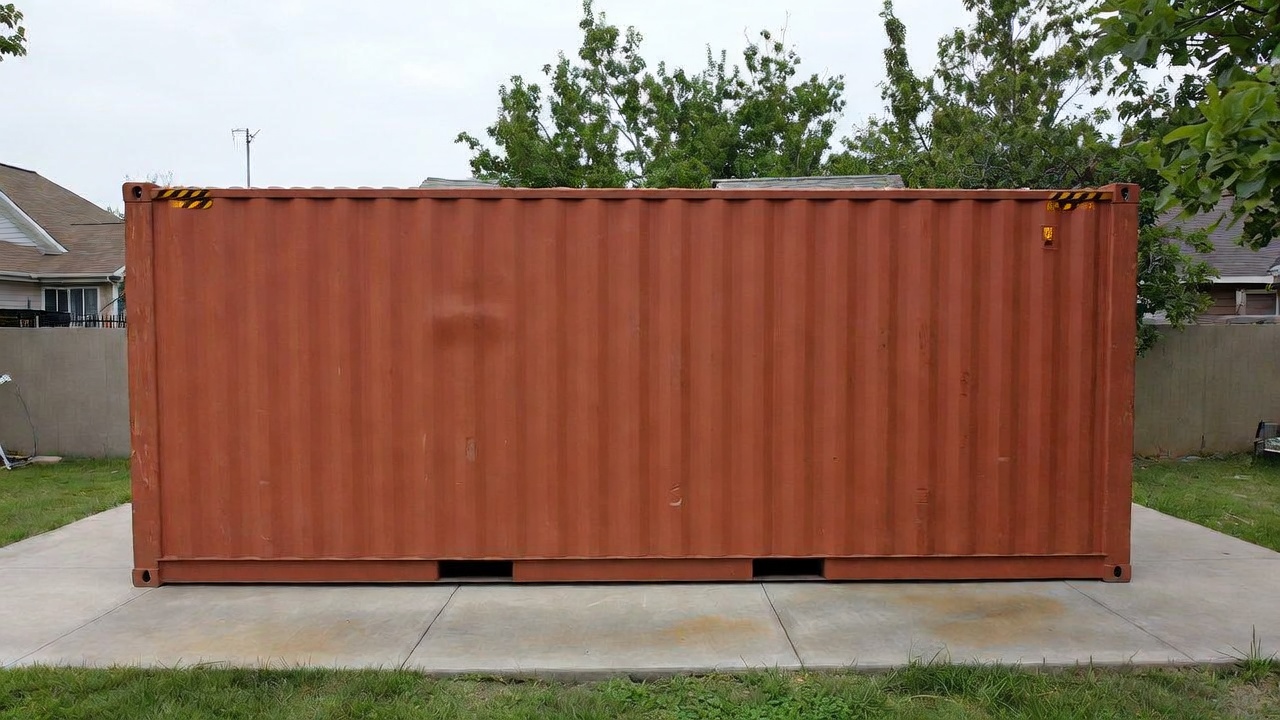
Prepare a level surface before delivery. Concrete deck blocks at all four corners (and mid-span for the 20ft) are the most common and affordable solution for residential use. For permanent installation, full concrete piers or a pad are recommended.
Delivery inspection checklist
- Roof: look for dents deep enough to hold water and rust-through spots
- Floor: check for soft spots, rot, or damaged hardwood planks — jump on it
- Doors: open and close fully, check seal gaskets are intact, confirm both locking rods work
- Interior walls: check for holes, heavy corrosion, or chemical residue
- Undercarriage: check cross members for rust — surface rust is normal, holes are not
- Corner castings: check all 8 corner castings for cracks or deformation (these carry the structural load)
- Smell: a strong chemical odor means the previous cargo may have contaminated the interior
Ready to get a price on a 20ft container in your area?
Shipped.com lets you compare new and used 20ft containers from local suppliers — with transparent delivery pricing to your zip code.