The 40ft shipping container is the workhorse of international freight — and increasingly the go-to choice for large-scale storage, container homes, workshops, and commercial conversions. It delivers twice the floor space of a 20ft at roughly 60–70% more cost, making it significantly better value per square foot. The main decision is whether to go standard height (8'6") or high cube (9'6") — a question that comes down to what you're using it for.
In this guide
Dimensions: standard and high cube
Standard 40ft
High cube 40ft
+1ft heightStandard or high cube? The practical rule
For any use where people stand up inside — an office, home, workshop — choose high cube. After adding a subfloor (–3in), ceiling panel (–2in), and any HVAC equipment, a standard 40ft finishes at around 7ft 5in of usable ceiling height. A high cube finishes at 8ft 5in. That extra foot is the difference between a space that feels like a converted container and one that feels like a room. For pure storage where headroom doesn't matter, standard is fine and costs less.
Weight and payload specs
| Spec | Standard 40ft | High cube 40ft |
|---|---|---|
| Tare weight (empty) | 8,267 lbs (3,750 kg) | 8,598 lbs (3,900 kg) |
| Maximum gross weight | 66,139 lbs (30,000 kg) | 66,139 lbs (30,000 kg) |
| Maximum payload | 57,872 lbs (26,250 kg) | 57,541 lbs (26,100 kg) |
| Floor load capacity | ~16,500 lbs per axle | ~16,500 lbs per axle |
| Roof load (static) | 660 lbs (300 kg) | 330 lbs (150 kg) |
| Stacking capacity | Up to 9 containers high (loaded) | Up to 9 containers high (loaded) |
High cube roof load is half that of standard
The high cube container's taller profile reduces its roof static load rating from 660 lbs to 330 lbs. If you're adding solar panels, rooftop HVAC, or a rooftop deck, calculate the total weight carefully. Two standard rooftop solar panels weigh roughly 100 lbs each — a small array can approach the limit. Distribute loads across multiple mounting points and consult a structural engineer if load is a concern.
Current prices by condition grade
Standard 40ft
$2,200–$7,500
- AS-IS (sold as-found) $1,200–$2,200
- WWT (wind & water tight) $2,000–$3,500
- CWO (cargo worthy) $2,800–$4,500
- One-trip (like new) $4,500–$7,500
- Delivery (within 50 mi) $400–$900
High cube 40ft
$2,600–$9,000
- AS-IS (sold as-found) $1,400–$2,600
- WWT (wind & water tight) $2,400–$4,000
- CWO (cargo worthy) $3,200–$5,200
- One-trip (like new) $5,500–$9,000
- Delivery (within 50 mi) $400–$900
High cube adds roughly $500–$1,500 over the equivalent standard grade. For any conversion project, one-trip containers are worth the premium — you start with no rust, no cargo residue, no floor damage, and a manufacturer's warranty. For basic storage, WWT or CWO used is the better value.
40ft vs 20ft: is the larger container worth it?
| 20ft container | 40ft container | 40ft advantage | |
|---|---|---|---|
| Floor area | 148 sq ft | 302 sq ft | 2× the floor space |
| Volume | 1,169 cu ft | 2,389 cu ft | 2× the volume |
| CWO used price | $2,000–$3,500 | $2,800–$4,500 | ~50–70% more cost |
| Cost per sq ft | ~$18–$24/sq ft | ~$11–$17/sq ft | 40ft wins on value |
| Delivery difficulty | Easier — shorter truck | Harder — needs more access | 20ft wins |
| Permit requirements | Often exempt under 200 sq ft | More likely to require permit | 20ft wins |
The 40ft is better value per square foot — you get twice the space for 50–70% more money. The trade-offs are delivery complexity and potentially triggering permit requirements that a smaller 20ft unit might avoid. If you have the site access and don't mind the potential permit process, the 40ft is almost always the smarter buy for anything other than tight residential lots.
Best uses for a 40ft container
Container home
A single 40ft high cube gives you roughly 302 sq ft — enough for a full 1-bedroom layout with kitchen, bathroom, living area, and bedroom. The most common single-container residential conversion.
Recommend: High cube one-trip
Workshop / garage
Two cars front-to-back, full tool storage, workbench, and still room for a compressor or welding station. A 40ft high cube with a roll-up door is the most practical container garage setup.
Recommend: High cube CWO or one-trip
Large-scale storage
Farm equipment, contractor tools, business inventory, vehicle storage. 302 sq ft of weatherproof steel storage with a 57,000 lb payload — more capacity than most small warehouses.
Recommend: Standard WWT or CWO
Backyard office / studio
Large enough for 4–6 workstations, a meeting area, and storage. High cube essential for comfortable working height. Add a split-system HVAC, electrical, and insulation for a professional space.
Recommend: High cube one-trip
Lap pool
A 40ft container makes a legitimate lap pool — 40×8ft is long enough for consistent swimming. Standard height is fine for a pool. No need for high cube since water depth is separate from container height.
Recommend: Standard WWT or CWO
Moving a large household
Holds the contents of a 4–5 bedroom home. Load at your own pace, transport locally, then unload. For long-distance moves, most suppliers don't transport 40ft containers for consumer moves.
Recommend: Standard WWT rental
Common modifications and what they cost
Roll-up garage door
Cut into one end of the container, replacing or supplementing the cargo doors. Makes daily vehicle or equipment access practical. Requires a structural header across the opening.
Installed cost: $1,500–$4,000
Personnel door
A standard 36in walk-through door cut into the side or end wall. Essential for any office or habitable conversion — entering through the cargo doors every time is impractical.
Installed cost: $800–$2,000
Windows
Sliding, fixed, or casement windows cut into the side walls. A typical office conversion includes 2–4 windows. Cut edges must be framed in steel and treated for rust before sealing.
Installed cost: $900–$2,000 per window
Spray foam insulation
Closed-cell spray foam applied to interior walls, ceiling, and floor. Standard for any habitable conversion — essential for office and home use. Stops condensation and maintains temperature.
Installed cost: $3,000–$7,000
Electrical sub-panel
100A sub-panel fed from the main house panel via underground conduit. Provides power for lighting, outlets, HVAC, and any workshop equipment. Requires a licensed electrician.
Installed cost: $1,500–$4,000
Mini-split HVAC
Single-zone ductless mini-split — the standard HVAC solution for container offices and homes. A 12,000–18,000 BTU unit is typically right for a 40ft container. Install after insulating.
Installed cost: $2,500–$5,000
Delivery requirements for a 40ft container
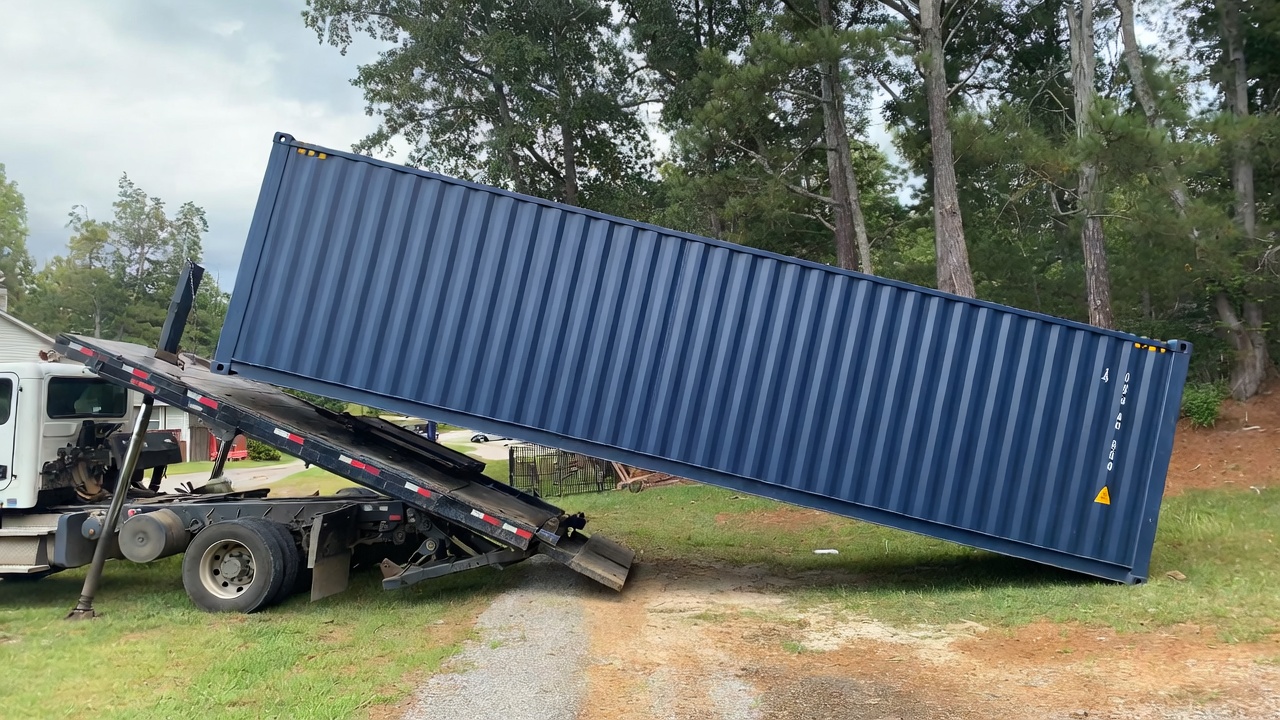
A 40ft container requires a 40ft tilt-bed truck to deliver. This is the most common source of problems for first-time buyers — the truck needs more space than most people anticipate.
- Straight run length: The tilt-bed truck needs approximately 80–100ft of straight, clear space to back in and unload. Curved driveways and tight turns often prevent delivery.
- Height clearance: The truck carrying a standard 40ft container sits at 13–13.5ft total height. A high cube container adds a foot — bringing total height to 14–14.5ft. Low bridges, tree canopies, and power lines are real obstacles.
- Ground bearing: A loaded delivery truck can weigh 60,000+ lbs. Soft ground, soggy soil, or paved surfaces in hot weather can be damaged. Ask your supplier about ground requirements.
- Crane delivery option: If your site can't accommodate a tilt-bed, crane delivery is available — the container is lifted from the road and set into place. Adds $800–$2,500 to delivery cost.
Pre-purchase inspection checklist
Whether buying in person or remotely (with photos), inspect or request documentation on all of these before paying:
- Roof: Check for dents, rust patches, and seam separation. The roof is the most common water ingress point on used containers.
- Floor: Lift corner boards if possible. Check for soft spots, rot, or rust holes penetrating from underneath. Floor replacement is expensive.
- Door seals: Door rubber gaskets should compress evenly and spring back. Cracked, flat, or missing sections mean weather infiltration.
- Door operation: Open and close both cargo doors fully. Doors that stick, bind, or don't lock flush indicate frame distortion — a structural red flag.
- Corner castings: The 8 corner fittings are the structural connection points. Any cracking, deformation, or weld repairs are dealbreakers.
- Wall corrugations: Look for deep dents that have cracked the steel or significantly compromised the corrugation profile. Surface dents are cosmetic; structural damage is not.
- Previous cargo: Ask what was stored in the container. Chemical, food, or hazmat cargo requires cleaning before use for other purposes. Smell the interior — persistent odors indicate residue.
- CSC plate: For CWO grade, confirm the CSC safety plate is present, legible, and not expired. This is what certifies it as cargo worthy.
Frequently asked questions
How much does a 40ft shipping container cost?
A used 40ft shipping container in cargo-worthy (CWO) condition costs $2,800–$4,500 before delivery in most US markets in 2026. WWT (wind and water tight) units run $2,000–$3,500. One-trip (like new) 40ft containers cost $4,500–$7,500. The 40ft high cube adds $500–$1,500 to any of these grades. Delivery typically adds $400–$900 within 50 miles of a major depot.
What are the dimensions of a 40ft shipping container?
A standard 40ft container is 40ft long × 8ft wide × 8ft 6in tall externally. Interior dimensions are 39ft 5in × 7ft 8in × 7ft 10in, giving 302 sq ft of floor area. The 40ft high cube version is the same length and width but 9ft 6in tall externally (8ft 10in interior height). Door opening is 7ft 8in wide × 7ft 5in tall for standard, 8ft 5in tall for high cube.
How much weight can a 40ft container hold?
A standard 40ft container has a maximum payload of approximately 57,872 lbs (26,250 kg) — the maximum weight of contents the container can carry. Maximum gross weight (container plus contents) is 66,139 lbs (30,000 kg). The empty container itself weighs about 8,267 lbs. Floor load capacity is approximately 16,500 lbs per axle. Roof static load capacity is 660 lbs for standard, 330 lbs for high cube.
What is the difference between a 40ft standard and high cube container?
The only difference is height. A standard 40ft is 8ft 6in tall externally (7ft 10in interior). A high cube 40ft is 9ft 6in tall externally (8ft 10in interior) — exactly one foot taller. Door height also increases from 7ft 5in to 8ft 5in. Everything else — length, width, corner castings, door configuration — is identical. The high cube costs $500–$1,500 more and has a lower roof static load rating (330 lbs vs 660 lbs).
Is a 40ft container enough for a house?
A single 40ft container gives you 302 sq ft — comparable to a small studio apartment. It can accommodate a 1-bedroom layout with a defined sleeping area, kitchen, bathroom, and living space, but it's compact. Most container home builds that feel genuinely spacious use 2+ containers joined together, or a 40ft combined with a 20ft. For a couple or single occupant willing to live small, one 40ft high cube is workable. For a family, plan for multiple containers.
Can a 40ft container fit two cars?
Two cars can fit in a 40ft container end-to-end (front to back), but not side by side — the interior is only 7ft 8in wide. Most cars are 5.5–6.5ft wide, so both can fit lengthwise along the container. You'd drive the first car in, then the second behind it. Getting both cars in and out requires moving one to access the other. For a two-car garage where you need independent access, two 20ft containers side by side (with the shared wall removed) is the better solution.
Get 40ft container quotes near you
Compare prices on standard and high cube 40ft containers from suppliers across the US, with delivery to your location.