From single-container studios to multi-unit family homes — what works, what doesn't, and why.
11 min read·Updated January 2026
Container home design is both simpler and more constrained than traditional architecture. You're working with fixed modules — 8ft wide, 20ft or 40ft long — and every design decision flows from those dimensions. The most successful container homes don't fight the form; they use the modular, industrial nature of the container as the design language itself.
Below are the most common configurations, from simplest to most complex, with honest notes on cost and trade-offs.
~160 sq ft1 person or couple$25K–$60KEasiest to permit
The 20ft container is the simplest starting point and the most permissive from a zoning standpoint — many jurisdictions that won't allow a full container home will approve a small accessory dwelling unit (ADU) or guest cabin of this size.
The 8ft interior width is tight but workable. The key is a linear layout: galley kitchen along one wall, bathroom in the middle, sleeping area at the far end. Full-height storage (floor to ceiling) makes the narrow footprint feel less cramped.
Best for: weekend cabin, guest house, short-term rental, home office
Biggest challenge: fitting a comfortable bathroom in 8ft of width
Design tip: high-cube (9.5ft interior height) transforms the feeling of space
Single 40ft — compact 1-bed
~320 sq ft1–2 people$40K–$100KGood starter build
Double the length of the 20ft gives you enough room for a genuinely comfortable one-bedroom home. The layout is still linear but has more breathing room — you can fit a proper kitchen, a bathroom with a tub or shower, and a dedicated bedroom with a closet.
Cutting windows and a door opening in the long sides is what makes this design work. Without natural light on the long walls, the 8ft width feels oppressive. Two or three well-placed windows transform the space.
Best for: primary residence for 1–2 people, vacation home, rental property
Biggest challenge: making 8ft feel comfortable as a living space
Design tip: use sliding doors internally instead of swing doors — every inch counts
Two containers — side by side
~640 sq ft2–3 people$80K–$175KMost popular layout
Two 40ft containers placed parallel with a gap between them — then connected by removing the facing walls and building a central section — is the most common container home configuration. It gives you roughly 640 sq ft in the containers plus whatever you add in the connector space.
The connector is key to the design. It can be an open breezeway (cheapest), an enclosed corridor, or a full open-plan central living space with a vaulted roof. The last option is the most dramatic and popular — it creates a space that feels nothing like a shipping container inside.
Best for: 2-bed family home, primary residence, short-term rental
Biggest challenge: the connector needs proper engineering and weatherproofing
Design tip: orient containers east-west with glazing on the south-facing connector
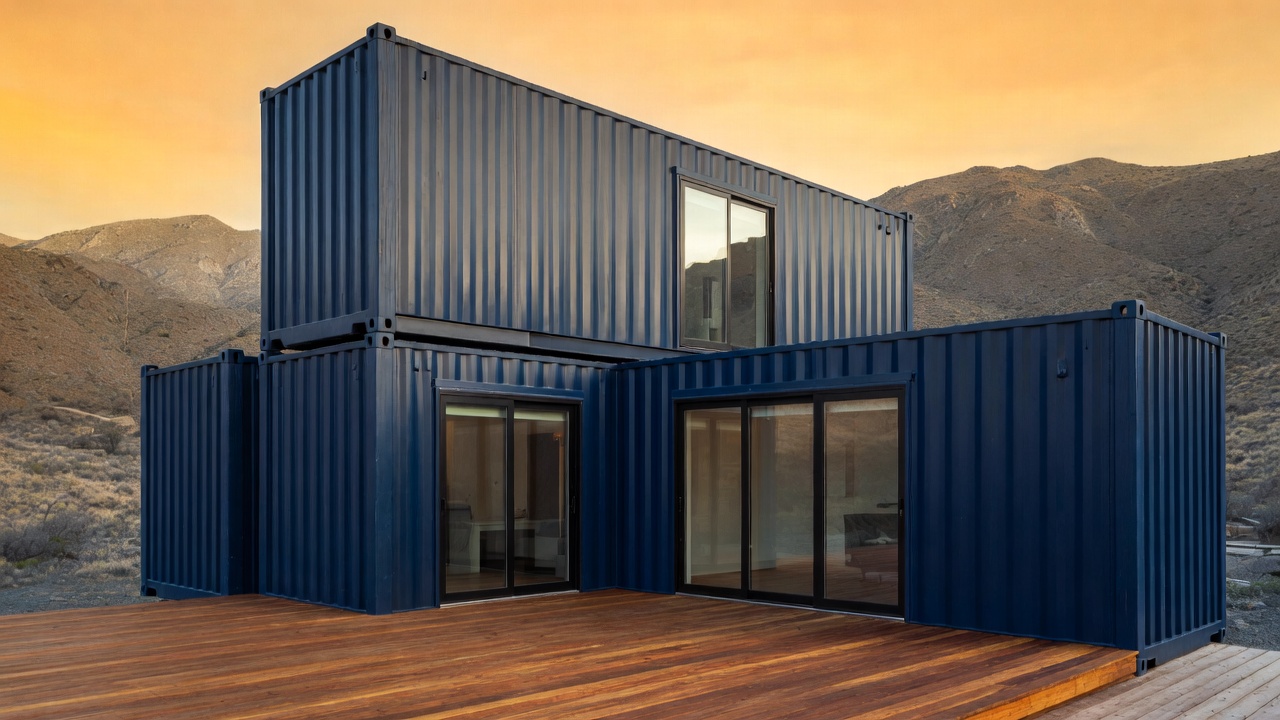
Stacking two containers with one offset from the other — so it cantilevers beyond the container below — is one of the most visually distinctive container home configurations. The overhang naturally creates a covered outdoor area below and adds drama to the exterior.
The structural engineering on this design is more complex than a straight stack. The cantilevering container needs additional steel reinforcement at the connection point, and the span is limited by the container's inherent structural properties. Budget extra for engineering.
Best for: architectural showcase, sloped lots, vacation homes
Biggest challenge: significantly more structural engineering than a straight stack
Design tip: the overhang works best facing north (shade) or south (roof for solar)
L-shape configuration
~640 sq ft2–4 people$95K–$190KGreat for outdoor living
Two containers placed at right angles to each other form an L-shape that naturally creates a sheltered courtyard or deck space in the corner. It's a particularly good design for warm climates where outdoor living is as important as interior space.
The corner junction requires custom fabrication — the containers need to be cut and welded at the connection point, which adds cost. But the result feels more like a conventional home layout than a linear design, with better separation between living and sleeping areas.
Best for: warm climates, outdoor entertaining, sloped or irregularly shaped lots
Biggest challenge: more complex foundation than linear layouts
Design tip: orient the courtyard to catch prevailing breezes and afternoon shade
Two-story stacked
~640 sq ft2–4 people$100K–$200KSmall footprint
Stacking two containers vertically doubles your living space without increasing the land footprint — ideal for smaller lots. The lower container handles living, kitchen, and bathroom; the upper handles bedrooms.
This design requires the most careful structural engineering of any two-container layout. Stacking is fine structurally at the corners (that's how containers are designed to work), but cutting window and door openings in a stacked container weakens it significantly and requires additional steel reinforcement. The stairs also eat into your floor area.
Best for: small lots, urban builds, hillside sites where lower level can be earth-sheltered
Biggest challenge: structural engineering costs are higher, stairs reduce usable space
Design tip: offset the upper container slightly for a covered porch below and architectural interest
Multi-container family homes (4+ containers)
Four or more containers open up genuinely house-sized floor plans — 1,200 sq ft and beyond. These builds typically combine multiple strategies: some containers stacked, some side by side, connected by purpose-built sections in between. At this scale, you're effectively doing conventional construction with a container structural frame, and the per-square-foot cost approaches traditional building.
The design freedom also increases: with enough containers, you can create U-shapes around a courtyard, two-story wings with covered walkways between them, or a long ranch-style home with multiple living zones. These projects almost always require a container-experienced architect from the start.
Universal container home design rules
Work with the 8ft width, not against it
Trying to make an 8ft-wide container feel like a conventional room usually fails. Embrace the linear, galley-style layout. Built-in furniture, Murphy beds, and pocket doors all work with the narrow dimension rather than fighting it.
Windows determine livability
A container with no openings cut in the long walls is dark and claustrophobic. Large windows on the south face, skylights, and glass end walls transform the interior. This is where you should spend your design budget.
Insulation first, aesthetics second
Steel is brutal on temperature. Closed-cell spray foam on all interior surfaces before any finishing work is non-negotiable. Budget $5,000–$10,000 per container for proper insulation — skimping here costs far more in heating and cooling bills.
High cube is almost always worth it
Standard containers have 8.5ft exterior height (7.8ft interior). High cube containers add one foot to both. The extra ceiling height costs 10–15% more for the container but dramatically changes how the interior feels — and it makes insulation and finishing easier too.
Plan utility runs before cutting
Every cut you make in a container wall or floor weakens the structure. Plan the complete route of electrical conduit, plumbing pipes, and HVAC ducts before any fabrication starts — retrofitting is expensive and structurally disruptive.
Orient for passive solar and prevailing wind
Container homes heat up fast in direct sun. Orient the long axis east-west with the main glazing facing south for winter warmth. Deep roof overhangs or a pergola shade summer sun. This dramatically reduces HVAC loads and ongoing energy costs.
Next step: floor plans
Once you have a design concept in mind, the next step is a proper floor plan — one that can be submitted for permits. Our floor plans guide covers where to find pre-made plans and what to include when commissioning custom drawings.