Buying a finished container home — quick reference
Studio / single 20ft
$25k–$50k
Before land and site costs
1 bedroom / 40ft HC
$45k–$90k
The most common configuration
2 bedroom / two containers
$80k–$150k
Roughly 640 sq ft
3+ bedroom
$130k–$250k+
960 sq ft and up
What the price excludes
Land, foundation, utilities
Often 30–50% more on top
Biggest risk
Deposits on unbuilt units
Vet before you pay
Search "container homes for sale" and you'll get results spanning a $12,000 folding box shipped from overseas, a $65,000 factory-finished dwelling built to a state residential code, and an empty $3,000 steel container someone has photographed next to a rendering of what it could become. All three are legitimately advertised under the same phrase. They are not the same purchase, and confusing them is how people lose money.
In this guide
- The three things sold as "container homes"
- What turnkey includes — and never does
- Price by size and bedroom count
- Buying finished vs building it yourself
- The permitting problem no listing mentions
- Expandable and folding units — read first
- How to vet a manufacturer
- Where to find them
- Financing a container home
- Common mistakes
- Buyer's checklist
- FAQ
The Three Things Sold as "Container Homes"
1. Shipping container shells
$2,000–$8,000An empty steel container. Nothing more. These appear in "container homes for sale" results because sellers photograph them alongside renderings of finished conversions, but you are buying a box.
This is the right purchase if you're building yourself or hiring a contractor. It is the wrong purchase if you expected something you could live in. Everything — insulation, framing, windows, electrical, plumbing, HVAC, finishes — is still ahead of you, and typically costs five to fifteen times the container itself. See our container buying guide for grades and inspection.
2. Prefab and modular container homes
$30,000–$250,000Built in a factory, delivered finished or nearly finished. Kitchen, bathroom, HVAC, electrical, insulation and interior finishes installed before it leaves the building. This is what most people picture when they search for a container home for sale.
The genuine advantages are speed and removal of contractor risk — which, in our experience covering this market, is where owner-managed builds most often fail. The genuine disadvantages are cost per square foot, limited customization, and the fact that the price you see almost never includes what it takes to make the unit habitable on your land.
3. Expandable and folding units
$10,000–$40,000Imported pop-out or folding structures, usually sold through online marketplaces, frequently drop-shipped from overseas. The photography is appealing and the price looks impossible next to the other two categories.
There is a reason for that price, and it is covered in detail in section 6. In short: most are not built to any US building code, most carry no UL listing or evaluation report, and in many jurisdictions they cannot be permitted as dwellings. They have legitimate uses. A permitted primary residence is usually not one of them.
A fourth thing is sometimes sold under the same heading: flat-pack container kits, which supply insulated panels, a frame, hardware and an assembly guide. The kit price is the kit. Foundation, labour, plumbing, electrical, permits and all code compliance work are yours. They sit somewhere between a shell and a prefab in both cost and effort, and the listings rarely make that clear.
What "Turnkey" Includes — And What It Never Does
This is the section that saves people the most money, because the advertised price of a finished container home is typically 50–70% of what the project actually costs.
| Usually included in the price | Almost never included |
|---|---|
| Structure and containers · Insulation · Interior framing and finishes · Windows and doors · Electrical and plumbing rough-in · Fixtures · Sometimes appliances · Factory quality control | Land · Foundation and site prep · Utility connection to the property line · Septic or sewer · Well or water supply · Permits and engineering · Delivery and crane placement · Driveway and grading · Final utility hookups · Landscaping |
What the excluded items actually cost
| Item | Typical range | Notes |
|---|---|---|
| Foundation and site prep | $6,000–$25,000 | Engineered for concentrated corner loads, footings below frost line. See our anchoring guide. |
| Utility connection to property line | $5,000–$50,000 | The single most variable cost. A rural grid tie can exceed the home. This is why so many container homes end up off-grid — see our solar guide. |
| Septic system | $5,000–$25,000 | Where no sewer connection exists. Requires percolation testing first. |
| Well | $5,000–$20,000 | Depth-dependent and genuinely unpredictable until drilled. |
| Permits and engineering | $3,000–$15,000 | Varies enormously by jurisdiction. See our permits guide. |
| Delivery and placement | $2,000–$10,000+ | Crane placement is common for finished units and costs more than a tilt-bed drop. |
| Driveway and grading | $2,000–$15,000 | Required for delivery access before the unit arrives. |
⚠️ The question to ask before anything else
Ask every manufacturer, in writing: "What is the total delivered cost to my address, and what will I still need to pay for after your unit is on my land?" A good answer is specific and slightly uncomfortable. A vague answer, or one that treats site costs as your problem to discover later, tells you what kind of company you're dealing with.
Free project cost estimator
Every line item across all eight build phases, with Low / High / Your $ columns. Use it to work out your real all-in number before you talk to a manufacturer.
Price by Size and Bedroom Count
Unit price is what manufacturers advertise. All-in is what you spend. The right-hand column assumes you already own suitable land with reasonable access.
| Configuration | Size | Unit price | Realistic all-in |
|---|---|---|---|
| Studio — single 20ft | ~160 sq ft | $25,000–$50,000 | $50,000–$100,000 |
| 1 bedroom — single 40ft High Cube | ~320 sq ft | $45,000–$90,000 | $75,000–$150,000 |
| 2 bedroom — two containers | ~640 sq ft | $80,000–$150,000 | $120,000–$230,000 |
| 3 bedroom — three containers | ~960 sq ft | $130,000–$220,000 | $180,000–$320,000 |
| 4 bedroom — four or more | 1,280 sq ft+ | $170,000–$280,000 | $230,000–$400,000 |
Buy High Cube for anything habitable
A standard container gives roughly 7'10" of interior height before a floor assembly and ceiling go in. IRC §R305.1 requires 7'0" in habitable space, so a standard-height unit leaves almost no margin. A High Cube gives you about 8'10" to work with. Any reputable manufacturer building dwellings will already be using High Cube — if one isn't, ask why.
⚠️ Why the smallest container home is rarely the best value
Foundation, utilities, permits, a kitchen and a bathroom cost roughly the same whether they serve 160 square feet or 900. Spread across a tiny footprint, that fixed cost destroys the per-square-foot maths. Published 2026 figures show it clearly: a single 20ft build at around 130 usable square feet runs $270–$575 per square foot turnkey, a single 40ft at ~280 usable sq ft runs $215–$465, and a two-container build at 550–600 usable sq ft falls to $215–$415.
The practical consequence is counterintuitive but consistent. If you're choosing between a 20ft studio and a 40ft one-bedroom, the larger unit usually costs less per square foot and not much more in total project terms — because the site costs barely move.
An honest comparison to carry into any sales conversation
At $150–$350 per square foot finished, container homes sit in the same band as modular ADUs and custom site-built construction. They do not undercut HUD-code manufactured housing, which runs roughly $50–$100 per square foot. If your primary goal is the lowest possible cost per square foot, you're shopping in the wrong category — and any seller implying otherwise is selling rather than advising. The reasons to choose a container are durability, portability, the aesthetic, and speed. Cheapness per square foot is not reliably one of them.
Buying Finished vs Building It Yourself
| Buying finished | Building it yourself | |
|---|---|---|
| Cost per sq ft | Higher — $150–$400 | Lower — $125–$350, but with real variance |
| Timeline | Weeks to a few months after order | 4–18 months from permit submission |
| Customization | Limited to the model range and options | Whatever you can get engineered and permitted |
| Contractor risk | Largely removed — the main argument for buying | The single most common cause of failed builds |
| Permitting burden | Reduced but not eliminated — see below | Entirely yours |
| Cost certainty | Good on the unit, poor on site costs | Poor on both — overruns of $10k–$50k are common |
| Financing | Harder — see financing | Harder still |
The honest summary: buying finished usually costs more per square foot, and buys out the risk that ruins most owner-managed container builds. If you have construction experience, time, and a contractor you already trust, building is cheaper. If you have none of those, the premium on a factory-built unit is often the cheapest money in the project. Our contractors guide covers the other path in detail.
The Permitting Problem No Listing Mentions
A factory-built unit still needs local approval. The manufacturer's compliance is not your permit, and this catches out a large share of prefab buyers.
⚠️ Built to code somewhere is not built to code where you live
Manufacturers routinely state their units meet or exceed the residential code of the state they're built in. That's a meaningful quality signal and it is not a permit. Your building department approves your structure against your adopted code edition and local amendments. A unit built to New York State code and shipped to Arizona still faces an Arizona plan review.
The question that determines everything: which code?
| Built to | What it means for you |
|---|---|
| IRC / IBC as site-built | Treated as conventional residential construction. Widest zoning acceptance. Requires local plan review, and the manufacturer should supply stamped structural documents. |
| HUD code (manufactured housing) | A different regulatory category entirely, with a federal label. Simpler in some respects, but many jurisdictions restrict where manufactured homes may be placed, and some HOAs and subdivisions exclude them outright. Ask before you assume. |
| State factory-built housing program | In California, HCD approval of a factory-built dwelling means local departments generally may not require duplicate plan review — a genuine time and cost saving. Ask specifically whether a manufacturer holds it. |
| No code / "meets international standards" | Common with imported units. Usually unpermittable as a dwelling. See section 6. |
Documents that actually help your plan checker
ICC-ES evaluation report against AC462 — gives your building department something familiar to review. Ask whether the manufacturer holds one and for the report number. IBC §3115 — the 2021 edition put containers into Chapter 31, so jurisdictions on a recent IBC have an explicit code path. ICC G5-2019, the Guideline for the Safe Use of ISO Intermodal Shipping Containers Repurposed as Buildings — useful background for a plan checker who hasn't seen one before. Stamped structural plans — every opening cut into a container needs reinforcement, and this is the item most often missing from cheap packages.
⚠️ Three separate layers, and you need all three
Code compliance answers whether the structure is built acceptably. Zoning answers whether a dwelling of this type may exist on this parcel at all — decided separately, by different people, under different rules. Deed restrictions and HOA covenants sit above both: they're contracts recorded against the land, they can prohibit metal exteriors or modular construction outright, and they survive any change in zoning. Check all three before you buy land, not after.
Ask every manufacturer this directly and get the answer in writing. It determines your zoning options, your plan review path, your financing, and in some cases your insurance. Our container home permits guide covers IBC §3115, ICC-ES AC462, and state-by-state requirements in full.
Free permits & approvals checklist
Every step from the first zoning phone call to certificate of occupancy — including the questions to ask a prefab manufacturer before you order.
⚠️ Expandable and Folding Container Homes — Read This First
These are the cheapest results in any "container homes for sale" search, and they generate the most disappointed buyers. The pitch is a complete home for $12,000–$25,000, delivered. The photography is good. The listings are on platforms people trust.
| What you're told | What's usually true |
|---|---|
| "Complete home, move-in ready" | A shell with basic fittings. No foundation, no utilities, no permits. |
| "Meets international standards" | Not a US code compliance claim. Typically no ICC-ES report, no UL listing on the electrical. |
| Advertised price | Frequently excludes ocean freight, customs, duties and inland delivery — which can add many thousands. |
| Warranty | Often no US entity to enforce it against, no service network, no parts supply. |
| "Suitable for residential use" | In most jurisdictions, not permittable as a dwelling. Some allow them as non-habitable accessory structures. |
⚠️ A CE mark is not US code compliance
The certification these units most often carry is a CE marking — the European Conformity system. It has no standing whatsoever with a US building department. It is not a substitute for a state modular insignia, a HUD tag, or an ICC-ES evaluation report, and a listing that leads with it is telling you what it doesn't have.
Category analysis also describes a common commercial structure worth understanding: units manufactured overseas, shipped flat, and drop-shipped through US-facing entities where the seller of record is frequently a newly-registered shell company, with customer support routing to a messaging account on an overseas number. That matters when something arrives damaged or doesn't arrive at all.
One test before you buy
Ask the seller, in writing, for the certification that permits residential occupancy in your county. Not a certificate of quality, not a CE mark, not a photograph of a test report in another language — a US listing or insignia. If it doesn't exist, you've learned exactly what you're buying, and you can decide whether that's still the right purchase for a non-habitable use.
When an expandable unit genuinely makes sense
They are not a scam category — they're a mismatched-expectation category. As a site office, studio, workshop, storage building, or guest space in a jurisdiction that doesn't require a permit for a non-habitable accessory structure, they can be good value and people are happy with them. The failure mode is buying one intending to live in it full-time as a permitted residence. Decide which you're doing before you order, and confirm with your building department first.
How to Vet a Manufacturer
You are potentially wiring a five-figure deposit for something that doesn't exist yet. The standard we apply to used container sellers in our scams guide applies here with more force, because the amounts are larger.
- How many units have you delivered, and can I visit one?The most informative question you can ask. A manufacturer with completed builds will be glad to point you at them. Renderings are not deliveries — check whether the images on a product page are photographs or 3D visualizations.
- Can I speak with two buyers from the last twelve months?Recent, not historic. A company can be fine for years and then hit trouble; last year's customers know which it is.
- Which code is it built to — in writing?IRC/IBC, HUD, or a state factory-built program. This governs your zoning, plan review, financing and insurance.
- What is the deposit, and is it refundable?Get the refund terms in writing before paying anything. Reservation deposits are commonly non-refundable after a stated window — know what that window is.
- What happens to my deposit if you cease trading?An uncomfortable question that a well-run business will answer. Deposits on unbuilt units are typically unsecured, meaning you rank behind secured creditors. Escrow arrangements exist and are worth asking about.
- What is the written warranty, and who services it?Length, coverage, and — critically — whether there is a US entity obliged to honour it and a service network able to reach you.
- What is your delivery radius, and what does delivery cost to my address?Many manufacturers are regional in practice even when they advertise nationwide. Long-haul delivery of a finished unit is expensive and sometimes needs permits of its own.
- Verify the business independently.State business registration, how long trading, physical address on a map, BBB record, trade association membership, and reviews that exist somewhere other than their own website.
- Pay by card or escrow — never by wire.Card payments carry chargeback rights. Wire transfers do not. This single rule prevents most catastrophic outcomes in this market.
What a good answer sounds like
| Topic | Good answer | Bad answer |
|---|---|---|
| Completed units | A specific number, plus an offer to arrange a visit | "Hundreds worldwide" |
| Code compliance | A named code and a document you can read | "Meets or exceeds all US standards" |
| References | Two contactable names from the last year | Testimonials on their own website |
| Deposit protection | Escrow, or a milestone payment schedule | "We require 50% to start production" |
| Warranty | A term, a scope, and a named servicing party | A one-line mention on the invoice |
| Payment | Card or escrow accepted | Wire transfer only |
| Delivery | A quoted figure to your ZIP code | "Delivery is extra" |
The one question that sorts sellers fastest
"Have you delivered into my county before, and can you name the permit?" A seller who has done it knows the path, knows the plan checker, and can tell you what was asked for. A seller who answers with testimonials from another state is telling you that you will be the one educating your building department — at your cost and on your schedule.
⚠️ On deposits specifically
Prefab and modular manufacturers do fail, and it is not rare in this industry. When they do, customer deposits on unbuilt units are usually unsecured claims — meaning you are unlikely to recover much. Keep deposits as small as the manufacturer will accept, pay by a method with recourse, and be wary of unusually large upfront payments justified by materials pricing or production scheduling.
Where to Find Container Homes For Sale
| Source | Best for | Watch for |
|---|---|---|
| Direct manufacturers | Finished dwellings, real warranty, code documentation | Delivery radius; verify completed units and deposit terms |
| Regional builders | Local code knowledge; you can visit the shop and past builds | Limited geographic range; smaller operations carry more continuity risk |
| Container dealers with conversion services | Shell plus build-out under one contract | Confirm who performs the structural engineering and who holds liability |
| Online marketplaces | Lowest headline prices; non-habitable uses | Code compliance, import costs, warranty enforceability — see section 6 |
| Buying a shell and hiring out | Maximum control and customization | You carry contractor risk — see our contractors guide |
Manufacturers worth knowing
ContainerCompass earns a commission on qualifying referrals at no extra cost to you. Listing a manufacturer here is not a substitute for your own due diligence — apply the checklist above to any company, including this one.
Utopia Containers
A Rochester-based manufacturer building finished container homes in a factory setting, with models ranging from single-container cabins and pool houses through one-bedroom dwellings and two-container shells. Their 40ft High Cube one-bedroom starts around $65,000 plus options. They state units are built to meet or exceed New York State residential code, and they operate as a registered business — trading as Utopia Shipping Container Solutions and listed with the New York Housing Association.
They sell reservations at $100 and $500 to hold a place in the production queue rather than taking full deposits upfront, which is a lower-risk structure than large prepayments. Two things to establish before reserving: confirm how many units they have delivered and ask to speak with recent buyers, and confirm with your building department how a New York-built unit will be classified and reviewed where you live — particularly whether it is treated as site-built under the IRC or as manufactured housing, since that affects where it may be placed. Ask whether reservations are refundable and within what window.
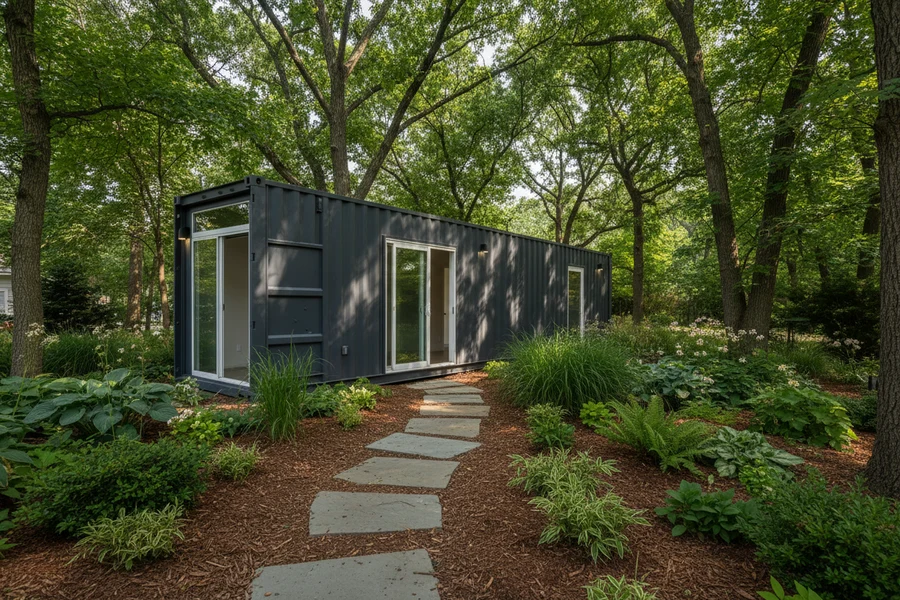
Their most comparable model
Utopia One 40 — one bedroom, ~320 sq ft
A 40ft High Cube finished as a one-bedroom dwelling — kitchen, bathroom, HVAC, electrical and finishes installed at the factory. High Cube matters here: it gives roughly 8'10" of interior height before the floor and ceiling assemblies, which is what keeps a finished ceiling comfortably above the 7'0" IRC minimum.
$65,000 — unit only, before site costs
View the One 40 →| Model | Configuration | Unit price |
|---|---|---|
| Basecamp 40 | 1 bedroom cabin, 40ft | $60,000 |
| Utopia One 40 | 1 bedroom, 40ft High Cube, ~320 sq ft | $65,000 |
| Vista 40 | 2 bedroom, 40ft High Cube — aimed at Airbnb/VRBO use | $75,000 |
| Unit prices only. Land, foundation, utilities, septic, permits and delivery are additional — see what turnkey never includes. | ||
Buying a shell instead?
If you've decided to build rather than buy finished, start with the container itself. Compare delivered pricing on new and used containers from suppliers in your area, then work through our buying guide for grades and inspection.
Financing a Container Home
This is where a lot of prefab purchases stall, and it's worth understanding before you fall in love with a model.
| Route | Viability | Notes |
|---|---|---|
| Conventional mortgage | Difficult | Lenders want comparable sales, a permanent foundation, and a conventionally classified dwelling. Container homes often fail on comparables alone — there may be nothing similar sold nearby to appraise against. |
| Construction loan | Possible | Draws against build milestones. Works better when the unit is permitted as site-built and an appraiser can value the finished property. |
| Manufactured home loan (HUD-code units) | Possible | Only if the unit carries a HUD label. Different terms and usually higher rates than a conventional mortgage. |
| Manufacturer financing | Varies | Some offer it or have lending partners. Compare the rate against alternatives rather than accepting it as convenience. |
| Personal or land loan | Common in practice | Higher rates, shorter terms, but frequently the realistic route for smaller units. |
| Cash | Most common | The majority of container home purchases in this price range are cash or land-equity funded. |
⚠️ The HUD-code distinction changes your financing entirely
If the unit is built to HUD code it is a manufactured home, and the default loan product is a chattel loan that treats it as personal property rather than real estate. Published 2026 rates run roughly 7–12% against 6–7% for a conventional mortgage, with terms of 15–20 years rather than 30. On a $90,000 unit that difference is substantial over the life of the loan.
Getting a conventional mortgage on a HUD-code home is possible but conditional: the home must post-date 15 June 1976, sit on a permanent foundation meeting the HUD Permanent Foundation Guide, and have its title converted from a vehicle title to real estate at the state DMV. A modular home on a permanent foundation, by contrast, is appraised the same way as a stick-built home of the same size and finish in the same neighbourhood — the factory origin doesn't depress the appraisal.
So "what code is it built to" is also the answer to "how will I finance it." Ask it first, not last.
How the appraisal problem actually works
Appraisers value against comparable sales of similar homes in the same area, usually within the previous 24 months. Container homes are uncommon, so there often aren't any. When comparable data is thin, the appraiser values the property against conventional dwellings instead — and if the appraisal comes in below the purchase price, that gap becomes yours to cover in cash, not the lender's. This is the mechanism behind most container home financing failures, and it's worth understanding before you commit.
What strengthens a financing application
Stamped structural plans, an issued permit, a permanent code-compliant foundation, and a detailed budget covering the whole project rather than just the unit. Ask any lender for two or three completed container files they have closed before signing anything — a lender who has done it before is worth more than a slightly better rate from one who hasn't. And make sure the financing covers your entire project scope, not just the module. That's the 50–70% point from earlier arriving in a different form.
ContainerCompass isn't a lender or financial adviser — this is general information, and your own circumstances and local lending market will determine what's actually available to you.
Common Mistakes
| Mistake | What happens | The fix |
|---|---|---|
| Budgeting from the unit price | A project 40–50% over budget before you've bought land | Assume the quote is 50–70% of the total |
| Buying land before checking use | A parcel where your dwelling type isn't permitted | Written confirmation as a purchase contingency |
| Assuming factory compliance is a permit | A finished unit nobody will approve | Ask your building department, not the seller |
| Confusing modular with HUD-code | The wrong financing, and depreciation instead of appreciation | Establish the code before anything else |
| Reading a CE mark as US compliance | No standing with any US building department | Ask for a US listing or insignia |
| Wiring a large deposit | No recovery path if the manufacturer fails | Card or escrow, never wire |
| Ignoring deed restrictions | Civil enforcement regardless of what zoning allows | Pull recorded covenants before buying land |
| Buying the smallest unit for value | The worst cost per square foot in the category | Compare all-in cost, not unit price |
| Forgetting crane and site access | A unit that can't physically reach its foundation | Confirm access before ordering |
| Skipping stamped engineering | Failed plan review; every cut opening needs reinforcement | Engineered plans aren't optional |
| Assuming the septic will work | A lot that won't perc, discovered after closing | Site evaluation before closing |
| Treating delivery as included | A five-figure surprise | Get delivery quoted to your ZIP code |
Buyer's Checklist
In order. Each step protects the money you're about to spend on the next one.
- Decide which of the three products you're actually buyingShell, prefab, or expandable unit. They differ by an order of magnitude in price and in whether anyone will let you live in them.
- Confirm with your building department that a container dwelling can be permitted on your parcelBefore anything else. Zoning is categorical and no engineer can fix a prohibited use.
- Pull the recorded deed restrictions and HOA covenantsThey operate independently of zoning and can prohibit what the jurisdiction allows.
- Establish what code the unit is built to, in writingBefore discussing price. It determines permitting, financing and insurance.
- Get a septic site evaluation and confirm utility connection costs to the property lineBoth are large, both are variable, and both are commonly discovered too late.
- Build the full budgetUnit, land, foundation, utilities, septic, permits, delivery, crane, driveway. Not the unit price.
- Confirm site access for delivery and crane placementA finished unit that can't reach its foundation is an expensive problem.
- Verify the manufacturer using the questions aboveCompleted units, references, code documentation, deposit terms.
- Get written lender confirmation for this specific construction typeNot general pre-approval — confirmation they'll finance a container dwelling.
- Confirm an insurer will write a policy at that addressFrequently overlooked, occasionally a deal-breaker.
- Structure the deposit through escrow or credit cardNever a wire transfer.
- Get delivery, warranty and completion dates in the contract, with remediesA date without a consequence is a hope, not a term.
If you take one thing from this guide
Two questions decide this purchase, and neither is about the home. What code is it built to, and will my jurisdiction permit it on my parcel? Answer both in writing before you pay a deposit, and almost every other risk in this market becomes manageable.
Frequently Asked Questions
How much does it cost to buy a container home?
Finished container homes typically run $25,000–$50,000 for a studio built from a single 20ft container, $45,000–$90,000 for a one-bedroom 40ft High Cube, $80,000–$150,000 for a two-bedroom two-container build, and $130,000–$250,000 or more for three bedrooms and up. Those are unit prices. Add land, foundation, utility connections, septic or sewer, permits and delivery — commonly another 30–50% on top, and considerably more on a rural site with no existing utilities.
Can you buy a prebuilt container home?
Yes. A number of manufacturers build finished units in a factory and deliver them substantially complete — kitchen, bathroom, HVAC, electrical, insulation and finishes installed. You still need land, a foundation, utility connections and local permits. The unit typically arrives requiring final hookups rather than construction. The key questions are which building code it was built to, whether your jurisdiction will accept that classification, and what the manufacturer's delivery radius and warranty actually cover.
Are the container homes for sale on Amazon and eBay legitimate?
The listings are usually real in the sense that something does arrive. The problem is what it is. Most low-priced expandable and folding units sold through marketplaces are imported structures built to no US building code, without UL-listed electrical or an ICC-ES evaluation report, which means most building departments will not permit them as dwellings. The advertised price frequently excludes freight, customs and duties. They can be reasonable value for a non-habitable studio, office or storage building where no permit is required — but check with your building department before buying one intending to live in it.
Can you get a mortgage on a container home?
It's difficult but not impossible. Conventional lenders want comparable sales to appraise against, a permanent foundation, and a clearly classified dwelling — container homes often fail the comparables test because nothing similar has sold nearby. Construction loans are more achievable when the unit is permitted as site-built. Units carrying a HUD label can use manufactured home financing. In practice a large share of container home purchases in this price range are cash, land-equity, or personal loan funded.
What is the cheapest container home you can buy?
Imported expandable units start around $10,000–$15,000, but as covered above they're generally not permittable as dwellings in the US. The cheapest realistically habitable option is a single 20ft finished unit from a US manufacturer at roughly $25,000–$50,000, or building your own from a used container — a shell at $2,000–$5,000 plus $25,000–$60,000 of conversion work depending on how much you do yourself. Our container home cost guide breaks down the build route in detail.
Do I need a permit for a prefab container home?
Almost always, yes — for a habitable dwelling. Factory construction doesn't remove the requirement for local approval; it changes what the review looks at. Your building department reviews the structure against your adopted code edition, plus the foundation, anchorage, and utility connections, all of which are done on your site. The exception is narrow: in California, HCD-approved factory-built housing generally cannot be subjected to duplicate local plan review, though local permitting and inspection of the installation still applies. See our permits guide.
Is a container home cheaper than a regular house?
Usually in absolute terms, because they're smaller. Not necessarily per square foot. Container construction sits in the same $150–$350 per square foot band as modular ADUs and custom site-built work, and it doesn't undercut HUD-code manufactured housing at roughly $50–$100 per square foot. The real advantages are durability, speed of factory construction, portability, and the aesthetic. If the lowest possible cost per square foot is your goal, manufactured housing beats containers on that specific measure.
How long does delivery take after ordering?
Production lead times for finished units commonly run 8–20 weeks depending on the manufacturer's queue and how customized your order is, plus transit. Manufacturers selling reservations rather than taking full orders are typically managing a production queue, so ask specifically for a current lead time in writing rather than a general estimate. Site work — foundation, driveway access, utility trenching — should be done in parallel so the site is ready when the unit arrives.