Dallas container market — quick reference
Used 20ft (WWT)
$1,500–$2,400
Texas regional range
Used 40ft (cargo worthy)
$2,800–$4,200
Texas regional range
Delivery within 50 miles
$300–$550
Tilt-bed, standard access
Zoning
Traditional zoning code
Your district is the first question
Permit for permanent placement
Yes — via Development Services
Verify current requirements
Supply driver
Rail logistics
No seaport — everything arrives inland
In this guide
How the Inland Market Shapes Dallas Pricing
Dallas is a major container market, but it's an inland one, and that shapes pricing in ways worth understanding before you start comparing quotes.
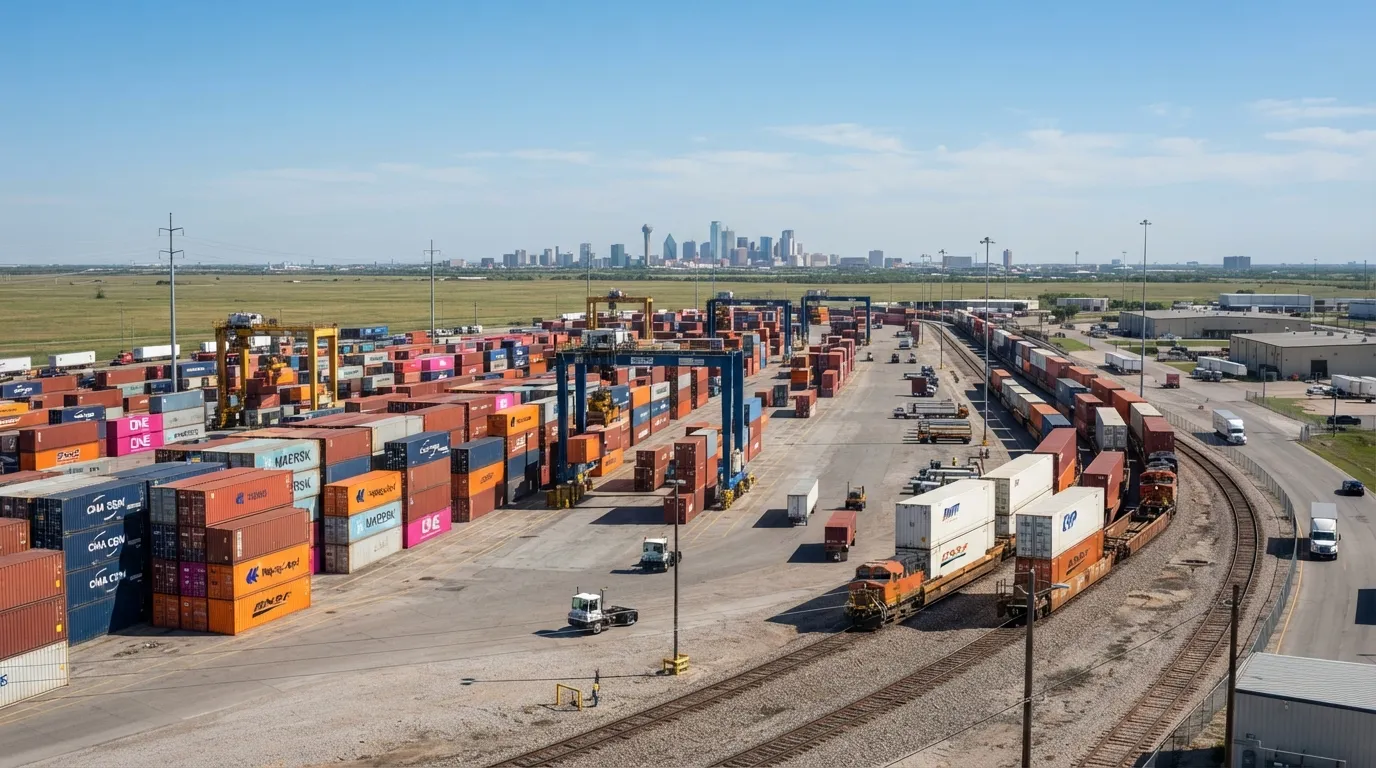
There's no seaport here. Every container sitting in a North Texas depot arrived by rail or truck from the coast — most commonly from the Gulf. That transport cost is part of what you pay, which is why industry sources note a Dallas container can price slightly above an identical unit sitting at a port depot.
The upside is that Dallas is one of the strongest intermodal markets in the country. The DFW area is served by three Class I railroads and four rail intermodal facilities, and the International Inland Port of Dallas covers roughly 7,500 acres in southern Dallas County. Supply here is deep — it just moves on rail schedules rather than tides.
Sources: Container Management Dallas buying guide; Eveon Containers and Conex Depot Dallas location pages; Freightquote DFW metro freight data.
The practical consequence
Dallas container prices track rail logistics. When rail yards are full and inbound traffic is steady, local inventory is good and pricing is competitive. When export demand pulls containers out of the system, inventory tightens and prices firm up. If you have flexibility on timing, it's worth getting quotes a few weeks apart rather than accepting the first number — the swing is real.
⚠️ Don't assume a fixed price difference
The Houston-versus-Dallas price gap is a mechanism, not a measured percentage. Industry sources describe inland transport as something that can make Dallas units slightly more expensive — that's a directional statement, not a quantified spread. Compare actual quotes rather than assuming a number.
What Containers Cost in Dallas
These are Texas regional ranges. Actual quotes vary with depot inventory, container condition, and rail supply conditions at the time you buy.
| Container | Wind & water tight | Cargo worthy | One-trip |
|---|---|---|---|
| 20ft standard | $1,500–$2,400 | $2,000–$3,000 | $3,500–$5,500 |
| 40ft standard | $2,000–$3,200 | $2,800–$4,200 | $5,000–$7,500 |
| 40ft High Cube | $2,200–$3,500 | $3,000–$4,500 | $5,500–$8,500 |
| Delivery (within 50 mi) | $300–$550 for standard tilt-bed access | ||
Rental rates in Texas typically run $90–$150/month for a 20ft and $135–$215/month for a 40ft on a standard monthly agreement, before delivery and pickup fees. Our rental pricing guide covers how the break-even against buying works — the short version is that past 12–18 months, buying usually wins.
⚠️ Grades are seller-assigned, not certified
There's no official global standard for grading shipping containers. "Cargo worthy" and "wind and water tight" are trade language — two dealers can apply the same label to visibly different containers and neither is breaking a rule. The only externally verified document is the CSC safety approval plate. Get the grade written into your contract, and see our container buying guide for what to inspect.
Dallas Zoning — The First Question, Not the Last
This is where Dallas differs most sharply from Houston. Dallas uses a traditional zoning code, so your property's zoning classification determines what's allowed before anything else does.
| Mechanism | How it works in Dallas |
|---|---|
| Zoning classification | Your district determines whether a container is permitted and under what conditions. Check your classification before buying anything. |
| Permits | Required through Dallas Development Services. Industry guidance describes Dallas as generally requiring a permit for containers used as permanent storage on residential property. |
| Residential placement | The city is described as increasingly attentive to container placement in residential neighborhoods. Expect scrutiny. |
| Temporary use | Containers for active construction or moving may be allowed for a limited window — a different and generally easier path than permanent placement. |
| Commercial & industrial zones | Containers are far more common and face fewer restrictions. This is where most Dallas container activity happens. |
| Historic & conservation districts | Dallas runs both. Exterior work in a historic district requires Certificate of Appropriateness review. Conservation districts regulate form and character. |
| HOAs and PIDs | Layered on top of city rules and independently enforceable. |
Permit specifics here are drawn from industry sources rather than city documents. Verify with Dallas Development Services before relying on any of it for a purchase decision.
Which City Are You Actually In?
Worth checking before you do anything else. Several addresses that people describe as "Dallas" are in separate incorporated cities with their own zoning codes and their own rules on containers.
⚠️ Separate cities inside and around Dallas
Enclaves: Highland Park, University Park, Cockrell Hill, Addison.
Surrounding cities: Richardson, Garland, Mesquite, Irving, Farmers Branch, Carrollton, Plano, Duncanville, DeSoto, Cedar Hill, Lancaster, Balch Springs.
If your address is in any of these, Dallas's zoning code doesn't govern your property — that city's does. The Park Cities in particular have significantly more restrictive land use controls than Dallas.
Unincorporated Dallas County is a separate category again, with county rather than city rules applying. Much of the acreage where container home projects are genuinely viable sits in unincorporated areas or in the surrounding counties.
Delivery Access Across DFW
A tilt-bed truck needs a clear straight run to slide the container off the back. Requirements vary by carrier and equipment. Shipped.com, for example, publishes a minimum of 60ft of straight-line clearance for a 20ft container and 100ft for a 40ft, plus 14ft of width and up to 20ft of overhead height for unloading. Confirm the specific requirement with your supplier before scheduling.
Difficult — historic inner city
Swiss Avenue, Munger Place, Junius Heights, Winnetka Heights, Lake Cliff, State-Thomas, Peak's Addition
Pre-war lots, narrow streets, mature canopy. Often crane placement only. Several of these are historic or conservation districts with additional review requirements.
Difficult — dense urban
Deep Ellum, Uptown, Oak Lawn, Design District, Cedars, Bishop Arts, Knox–Henderson
Tight lots and mixed-use density. Commercial and construction sites are the realistic market rather than residential placement.
Workable — established suburban
M Streets / Greenland Hills, Lakewood, Vickery Place, Lake Highlands, Casa Linda, Kessler Park, Midway Hollow, White Rock
Real driveways, and alley access in many Dallas neighborhoods opens up placement options that don't exist in other metros. The core residential storage market.
Physically easy — master planned
Far North Dallas, Prestonwood, Frisco, Plano, McKinney, Allen, Rockwall, Prosper, Celina
Wide streets and easy truck access. The binding constraint here is HOA rules rather than physical access — and these are also separate cities with their own codes.
Easiest — acreage and exurban
Kaufman, Ellis, Hunt, Wise, Parker and Johnson Counties; rural Collin and Denton County
Room to maneuver, no HOA in many cases, and the strongest market for permanent placement and container home builds.
Easy — industrial corridors
Southern Dallas industrial, the International Inland Port corridor, Garland, Mesquite, Grand Prairie, Alliance corridor in north Fort Worth
Yard and warehouse districts with no access constraints. Strongest market for jobsite offices and multi-unit orders.
Container Homes Around Dallas
Container homes are legal in Dallas. What stops most projects isn't legality — it's documentation and engineering, plus the zoning classification question that comes first here.
A used container arrives with no mill certifications and no welding procedure specifications, because it was built as freight equipment rather than as a building product. A plan reviewer evaluating a steel structure expects both. That gap is why ICC-ES created AC462, an acceptance criteria for evaluating shipping containers as a building material. Our permits guide covers the full code framework.
Buy High Cube if people will live in it
IRC § R305.1 requires 7 feet of ceiling height in habitable space. A standard container gives roughly 7'10" bare — once you add a floor assembly and ceiling insulation, you're at or below the minimum. A High Cube gives you about 8'10" to work with. This is the single most consequential purchasing decision for a habitable build.
Most viable DFW-area container home projects happen on acreage in the surrounding counties — Kaufman, Ellis, Hunt, Wise, Parker and Johnson, or rural Collin and Denton. Fewer land use controls, room for crane access, and often no HOA.
⚠️ The rural Texas deed restriction trap
Many 1980s and 1990s rural subdivisions carry covenants banning "mobile homes" or "prefabricated structures." A board may read those as covering shipping containers, and private deed restrictions can force removal even where county rules allow the structure. Check with the county clerk before buying land.
North Texas Build Factors
| Factor | Why it matters here |
|---|---|
| Expansive clay | Blackland Prairie clays are highly expansive — they shrink and swell dramatically with moisture. Foundation design for concentrated corner loads on this soil is an engineering problem, not a pad-and-blocks problem. |
| Wind and hail | North Texas storm exposure affects any roof or cladding structure built over the container, and anchorage requirements. See our anchoring guide. |
| Temperature swing | A wider annual range than the Gulf Coast — hot summers and genuine winter cold. Insulation and thermal bridging matter for both comfort and energy code compliance. See our insulation guide. |
| Zoning classification | Unlike Houston, this is the first question rather than the last. Confirm your district before committing to anything. |
Compare Dallas container prices
Get delivered pricing from suppliers serving the DFW area — compare grades and delivery costs before committing.
Dallas Container FAQ
Do I need a permit for a shipping container in Dallas?
For permanent placement, generally yes. Dallas uses a traditional zoning code, so your zoning classification determines what's allowed, and permits are handled through Dallas Development Services. Industry guidance describes Dallas as generally requiring a permit for containers used as permanent storage on residential property. Temporary containers for active construction or moving may be allowed for a limited window under different rules. Verify current requirements with Dallas Development Services, since procedures change.
Can I put a shipping container in my backyard in Dallas?
It depends on your zoning classification, which is the first thing to check. Dallas is described as increasingly attentive to container placement in residential neighborhoods, so expect scrutiny for permanent residential placement. Commercial and industrial zones are far more permissive. If you're in a historic or conservation district, additional review applies. And if your address is actually in Highland Park, University Park, Addison, or one of the surrounding cities, Dallas's rules don't apply to you at all — check with that city.
How much does a shipping container cost in Dallas?
Texas regional ranges: a used 20ft in wind and water tight condition typically runs $1,500–$2,400, and a used 40ft cargo worthy container $2,800–$4,200. One-trip containers cost more — roughly $3,500–$5,500 for a 20ft and $5,000–$7,500 for a 40ft. Delivery within 50 miles typically adds $300–$550. Because Dallas is inland, the cost of moving containers from the coast is part of the price, and inventory tracks rail logistics rather than port throughput.
Why are Dallas container prices different from Houston?
Dallas is landlocked. Every container in a North Texas depot arrived by rail or truck from a coastal port, and that transport cost is part of what you pay. Houston sits next to the largest container port on the Gulf Coast, so its containers didn't need the inland haul. Industry sources note this can make Dallas units slightly more expensive than identical containers at a seaport depot. Treat it as a mechanism rather than a fixed percentage — compare actual quotes.
Can a truck deliver a container to my Dallas property?
It depends on your lot. Tilt-bed delivery needs a clear straight run. Requirements vary by carrier — Shipped.com, for example, publishes a 60ft minimum for a 20ft container and 100ft for a 40ft, along with 14ft of width and up to 20ft of overhead clearance for unloading. Historic inner-city neighborhoods like Swiss Avenue, Munger Place and Winnetka Heights often can't accommodate it. Established Dallas neighborhoods with alley access are frequently easier than they look, since the alley opens up placement options. Confirm clearance requirements with your supplier before scheduling.
Where can I put a container home near Dallas?
Most viable DFW container home projects happen on acreage in the surrounding counties — Kaufman, Ellis, Hunt, Wise, Parker and Johnson, plus rural Collin and Denton County. These areas have fewer land use controls, room for crane access, and often no HOA. Inside Dallas proper, your zoning classification governs and the city is increasingly attentive to residential container placement. Whatever the location, check for recorded deed restrictions with the county clerk before buying land — many rural Texas subdivisions ban "prefabricated structures," which a board may read as covering containers.