Houston container market — quick reference
Used 20ft (WWT)
$1,500–$2,400
Gulf Coast regional range
Used 40ft (cargo worthy)
$2,800–$4,200
Gulf Coast regional range
Delivery within 50 miles
$300–$550
Tilt-bed, standard access
Zoning
None in City of Houston
Deed restrictions govern instead
Permit for permanent placement
Yes — building permit
Verify with City of Houston
Biggest local factor
Flood zone status
Check FEMA maps first
In this guide
Why Houston Container Prices Are Competitive
Most container pages tell you they have good prices. Very few explain why prices differ from one metro to another — which makes it hard to know whether a quote you've been given is reasonable.
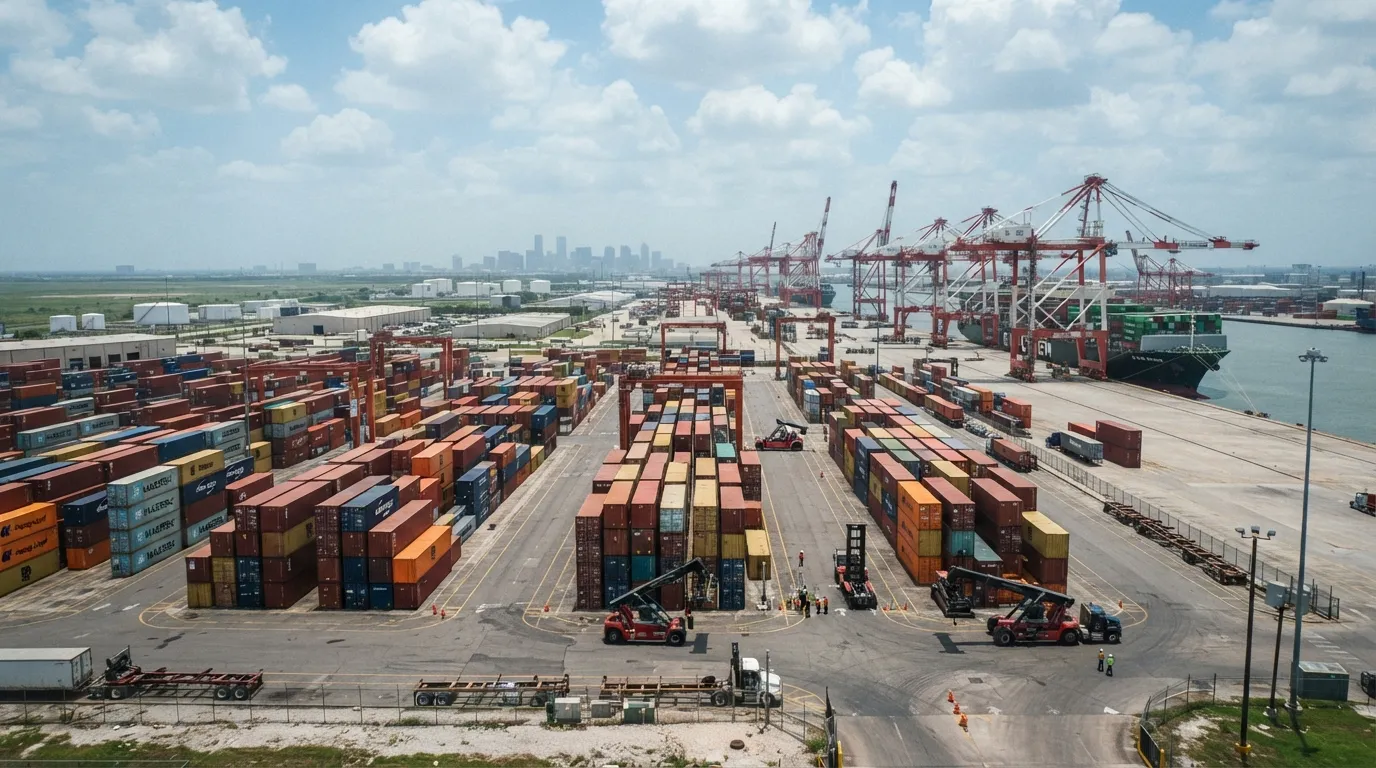
Houston's advantage is straightforward: the containers are already here. Port Houston is the largest container port on the Gulf Coast, and containers arrive by sea and sit in depots a short drive from where they landed. There's no long inland haul baked into the price.
That's the mechanism worth understanding when you compare quotes. In a landlocked market, every container in a local depot had to be moved there by rail or truck from a coastal port first — and that transport cost is inside the number you're quoted. In Houston it largely isn't. Drayage from Houston to the Dallas–Fort Worth market has been reported in the $800–$1,200 range, which gives you a sense of what inland transport adds to the underlying economics.
Sources: Port Houston intermodal publications; The Waterways Journal on Port Houston container volumes; MeisterPrep Houston port logistics guide. Port rankings and volume figures reflect 2023-era reporting.
What this means practically
If you're in the Houston area and a quote seems high relative to the ranges below, it's worth getting a second and third quote before accepting. The local supply picture generally supports competitive pricing here. Conversely, if you're comparing a Houston quote against one from an inland market, expect the inland number to run higher — that's the transport cost, not necessarily a worse deal.
What Containers Cost in Houston
These are Gulf Coast regional ranges. Actual quotes vary by depot inventory, container condition, and how far you are from the port.
| Container | Wind & water tight | Cargo worthy | One-trip |
|---|---|---|---|
| 20ft standard | $1,500–$2,400 | $2,000–$3,000 | $3,500–$5,500 |
| 40ft standard | $2,000–$3,200 | $2,800–$4,200 | $5,000–$7,500 |
| 40ft High Cube | $2,200–$3,500 | $3,000–$4,500 | $5,500–$8,500 |
| Delivery (within 50 mi) | $300–$550 for standard tilt-bed access | ||
Rental rates in the Gulf Coast region typically run $90–$150/month for a 20ft and $135–$215/month for a 40ft on a standard monthly agreement, before delivery and pickup fees. See our rental pricing guide for how the break-even against buying works.
⚠️ Grades are seller-assigned, not certified
There's no official global standard for grading shipping containers. "Cargo worthy" and "wind and water tight" are trade language — two Houston dealers can apply the same label to visibly different containers and neither is breaking a rule. The only externally verified document is the CSC safety approval plate. Get the grade written into your contract, and see our container buying guide for what to inspect.
The Zoning Question — And Why It's the Wrong Question
Houston is famously the largest US city without a conventional zoning ordinance. Most container guides handle this one of two ways: they either say "Houston has no zoning so you can do whatever you want," or they ignore it entirely. Both are unhelpful.
The accurate framing is more useful. Because there are no zoning districts, the question isn't whether containers are permitted in your zone — there are no zones. The questions that actually determine what you can do are:
- What do your deed restrictions say? Private recorded covenants running with the land are the real constraint in Houston. They're enforced by civic clubs, property owners' associations, and the City's own deed restriction enforcement program.
- Can you get a building permit? A permanent accessory structure — which includes a container placed for long-term use — generally requires one.
- Are you actually in the City of Houston? This trips up more people than the other two combined. See below.
Where to look up your deed restrictions
Recorded subdivision restrictions are filed with Harris County. If your neighborhood has a civic club or POA, they'll typically have a copy as well. This is worth doing before you buy a container, not after it's sitting in your driveway — deed restrictions can be enforced even where the city has no objection.
Which City Are You Actually In?
This is the single most important thing to check, and it's where most Houston container advice goes wrong. Houston's lack of zoning is well known, and people apply it to the entire metro area. It applies only inside the City of Houston.
⚠️ These are separate incorporated cities with their own land use rules
Enclaves inside Houston: Bellaire, West University Place, Southside Place, and the Memorial Villages — Bunker Hill Village, Hedwig Village, Hunters Creek Village, Piney Point Village, Spring Valley Village, Hilshire Village. Also Jersey Village, Jacinto City, Galena Park.
Surrounding cities: Pearland, Sugar Land, Missouri City, Stafford, Katy, Friendswood, League City, Pasadena, Deer Park, La Porte, Humble, Tomball, Webster, Seabrook.
If your address is in any of these, "Houston has no zoning" does not apply to you. Each has its own zoning code and its own rules on containers. Check with that city directly.
Unincorporated Harris County is a third category again — county rules apply rather than city rules, including flood and platting review. Much of the acreage where container home projects are genuinely viable falls into this category or into the surrounding counties.
Permits and Deed Restrictions
| Mechanism | How it works in Houston |
|---|---|
| Zoning | No conventional zoning ordinance inside the City of Houston. No residential district bans containers by category, because there are no districts. |
| Building permit | Industry guidance indicates a building permit is required for a permanent accessory structure, including a container placed on residential property for long-term use. Verify current requirements with the City of Houston before ordering. |
| Deed restrictions | The real constraint. Private recorded covenants, enforceable independently of city rules. Look yours up with Harris County. |
| HOA / POA | Where present, layered on top and independently enforceable — a board can object even where the city has no issue. |
| Floodplain regulation | City of Houston and Harris County floodplain rules apply and are significant post-Harvey. Confirm the FEMA flood zone for your specific address. |
| Building code | Container structures are designed under the adopted building code. For habitable builds this means IBC § 3115 (2021) / § 3114 (2024) and IRC § R301.1.4. See our container home permits guide. |
Permit specifics here are drawn from industry sources rather than city documents. Verify with the City of Houston Permitting Center before relying on any of it for a purchase decision.
Delivery Access Across Houston
A tilt-bed truck needs a clear straight run to slide the container off the back. Requirements vary by carrier and equipment. Shipped.com, for example, publishes a minimum of 60ft of straight-line clearance for a 20ft container and 100ft for a 40ft, plus 14ft of width and up to 20ft of overhead height for unloading. Confirm the specific requirement with your supplier before scheduling.
Houston's building stock varies enormously, and delivery access varies with it:
Difficult — often crane only
The Heights, Woodland Heights, Norhill, Montrose, First and Sixth Ward, Eastwood, Riverside Terrace, Third Ward
Pre-war lots, narrow streets, mature tree canopy, overhead lines. Tilt-bed clearance is rarely available. Crane placement is the realistic option and costs meaningfully more.
Difficult — dense urban
Midtown, EaDo, Rice Military, Washington Corridor, Near Northside, Upper Kirby townhome blocks
Townhome and low-rise density with tight lots. Commercial and construction sites are the realistic market here rather than residential placement.
Workable — established suburban
Oak Forest, Garden Oaks, Spring Branch, Meyerland, Westbury, Braeswood, Sharpstown, Clear Lake, Alief
Real driveways and wider lots. This is the core residential storage market — standard tilt-bed delivery generally works.
Physically easy — master planned
Cypress, Katy, Spring, Klein, Kingwood, Atascocita, Pearland, Sienna, Fulshear, Bridgeland, Cinco Ranch
Wide streets, easy access. The binding constraint here isn't physical — it's HOA rules and deed restrictions, which are near-universal in these communities.
Easiest — acreage and exurban
Waller, Montgomery, Liberty, Chambers and Brazoria Counties; north Harris County acreage; Hockley, Magnolia, Dayton, Crosby
Room to maneuver, no HOA in many cases, and the strongest market for permanent placement and container home builds.
Easy — industrial corridors
Ship Channel corridor, Pasadena, Deer Park, La Porte, Baytown, north Houston industrial, Stafford
Yard and warehouse districts with no access constraints. The strongest market for jobsite offices and multi-unit orders.
Container Homes Around Houston
Container homes are legal in Houston. That's the easy part. What stops most projects isn't legality — it's documentation and engineering.
A used container arrives with no mill certifications and no welding procedure specifications, because it was built as freight equipment rather than as a building product. A plan reviewer evaluating a steel structure expects both. That gap is why ICC-ES created AC462, an acceptance criteria for evaluating shipping containers as a building material. Our permits guide covers the full code framework.
Buy High Cube if people will live in it
IRC § R305.1 requires 7 feet of ceiling height in habitable space. A standard container gives roughly 7'10" bare — and once you add a floor assembly and any ceiling insulation, you're at or below the minimum. A High Cube gives you about 8'10" to work with. This is the single most consequential purchasing decision for a habitable build.
Practically, most viable Houston-area container home projects happen on acreage outside city limits — Waller, Montgomery, Liberty, Chambers and Brazoria Counties, or north Harris County acreage. There's room for crane access, fewer land use controls, and often no HOA.
⚠️ The rural Texas deed restriction trap
Many 1980s and 1990s rural subdivisions carry covenants banning "mobile homes" or "prefabricated structures." A board may read those as covering shipping containers. Private deed restrictions can force removal even where county rules allow the structure. Check with the county clerk before buying land, not after.
Gulf Coast Build Factors
| Factor | Why it matters here |
|---|---|
| Wind | Houston sits in a hurricane-exposed region. Anchorage and a continuous load path aren't paperwork — they're the design. Confirm the design wind speed for your site. See our anchoring guide. |
| Flood | FEMA Special Flood Hazard Area status drives elevation requirements. A sealed steel box is an effective float — flood-resistant design is required in SFHAs, and this is the first thing to check post-Harvey. |
| Expansive clay soils | Gulf Coast clays shrink and swell seasonally. Foundation design for concentrated corner loads on expansive soil is an engineering problem, not a pad-and-blocks problem. |
| Humidity | Condensation control inside a steel box in a Gulf Coast climate is the hardest part of a habitable build. Closed-cell spray foam applied directly to the steel is the standard approach — see our insulation guide. |
Compare Houston container prices
Get delivered pricing from suppliers serving the Houston area — compare grades and delivery costs before committing.
Houston Container FAQ
Do I need a permit for a shipping container in Houston?
For permanent placement, generally yes — industry guidance indicates the City of Houston requires a building permit for a permanent accessory structure, including a container used for long-term storage on residential property. Houston has no zoning ordinance, so there's no zoning district question, but the building permit requirement and your deed restrictions both still apply. Verify current requirements with the City of Houston Permitting Center, since procedures change.
Can I put a shipping container in my backyard in Houston?
Often yes, but the deciding factor is usually your deed restrictions rather than city rules. Houston has no zoning, so there's no residential district prohibition — but recorded subdivision covenants are enforceable and commonly restrict accessory structures. Look up your subdivision's restrictions with Harris County, check with your civic club or POA if you have one, and confirm the building permit requirement with the city. If your address is in Bellaire, West University Place, or one of the Memorial Villages, you're in a different city with its own zoning code entirely.
How much does a shipping container cost in Houston?
Gulf Coast regional ranges: a used 20ft in wind and water tight condition typically runs $1,500–$2,400, and a used 40ft cargo worthy container $2,800–$4,200. One-trip containers cost considerably more — roughly $3,500–$5,500 for a 20ft and $5,000–$7,500 for a 40ft. Delivery within 50 miles typically adds $300–$550. Houston's port proximity generally supports competitive pricing relative to inland markets.
Why are container prices different in Houston than Dallas?
Houston sits next to the largest container port on the Gulf Coast, so containers arrive by sea and sit in depots near where they landed. Dallas is landlocked — every container in a North Texas depot arrived by rail or truck from the coast, and that transport cost is part of what you pay. Industry sources note this can make Dallas units slightly more expensive than identical containers sitting at a seaport depot. It's a mechanism rather than a fixed percentage, so compare actual quotes rather than assuming a spread.
Can a truck deliver a container to my Houston property?
It depends heavily on your lot. Tilt-bed delivery needs a clear straight run. Requirements vary by carrier — Shipped.com, for example, publishes a 60ft minimum for a 20ft container and 100ft for a 40ft, along with 14ft of width and up to 20ft of overhead clearance for unloading. Inner-loop neighborhoods like the Heights, Montrose and the Sixth Ward frequently can't accommodate it because of narrow streets, tree canopy and overhead lines; crane placement is the alternative and costs more. Established suburban areas and acreage generally work fine. Confirm clearance requirements with your supplier before scheduling.
Are container homes legal in Houston?
Yes. Houston has no zoning ordinance prohibiting them, and container structures are permittable under the adopted building code. The practical obstacles are documentation and engineering rather than legality — used containers arrive without the mill certifications and welding specifications a plan reviewer expects for a steel structure, and a licensed structural engineer is required for cutting openings, joining containers, foundations and anchorage. Most viable Houston-area projects happen on acreage in the surrounding counties. See our permits guide for the full code framework.