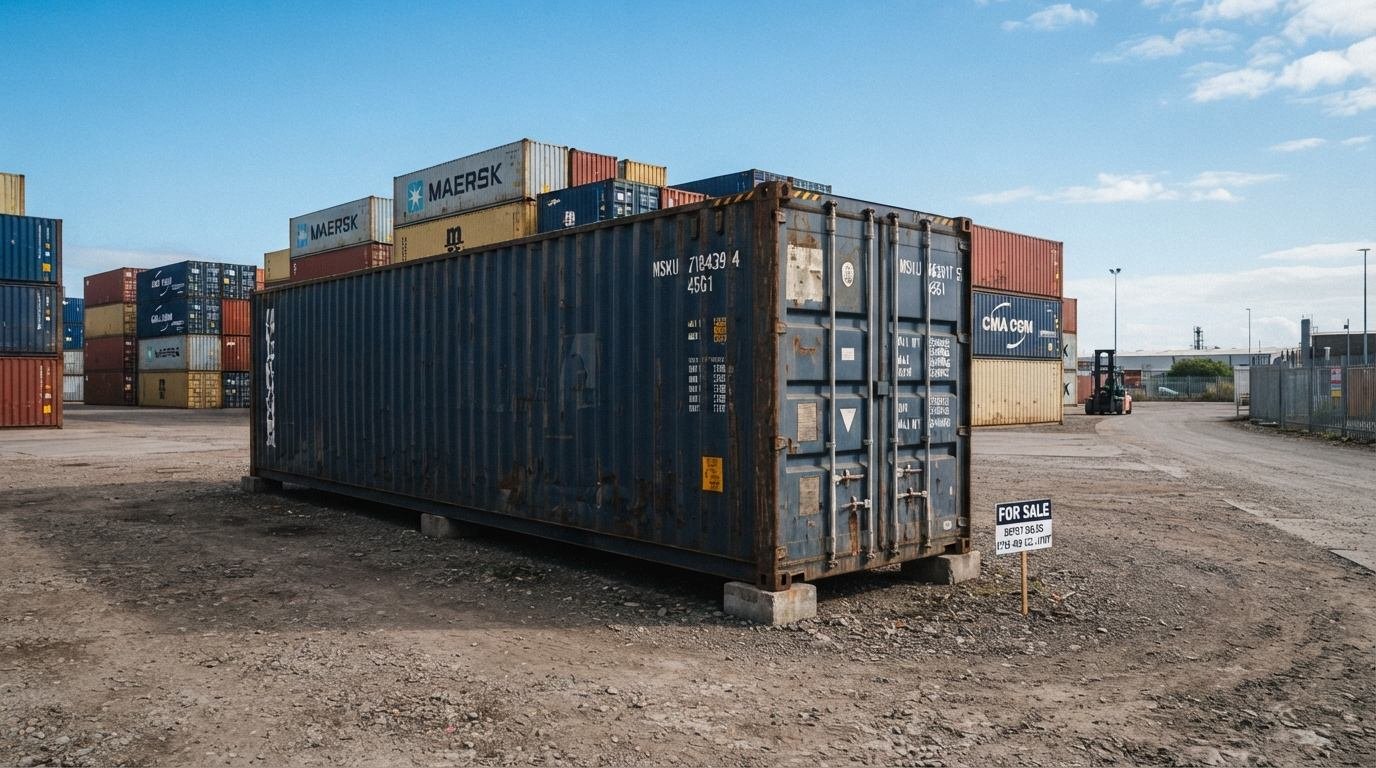
Used conex containers — quick facts
What is a conex?
Intermodal steel container
Same as a shipping container
Most common sizes
20ft and 40ft
8ft wide, 8'6" or 9'6" tall
Used 20ft price range
$1,500–$3,500
WWT grade, delivered
Used 40ft price range
$2,000–$4,500
WWT grade, delivered
In this guide
What Is a Conex Container?
"Conex" is shorthand for Container Express — a term originating with the US military in the 1950s when the Army developed standardised steel shipping containers for transporting military supplies. The original CONEX box (Container Express) was smaller than today's ISO containers — approximately 8'6" × 6'3" × 6'10" — and became iconic through widespread military use in Korea and Vietnam.
In modern usage, "conex," "conex box," and "shipping container" are used interchangeably to refer to standard ISO intermodal steel containers — the 20ft and 40ft steel boxes used in global shipping. If someone is selling a "used conex," they're selling a used shipping container. The terminology is regional and industry-specific; the product is the same.
Conex vs Shipping Container — Is There a Difference?
| Term | What it refers to | Where used |
|---|---|---|
| Conex / Conex box | ISO intermodal steel container (20ft or 40ft standard) | Military, industrial, and rural US markets; older terminology |
| Shipping container | Same product | General civilian use; most common term |
| Intermodal container | Same product — emphasises multi-mode transport capability | Logistics, port, and shipping industry |
| Sea can / sea container | Same product — emphasises ocean shipping origin | Canada, Australia; some US coastal markets |
| ISO container | Same product — emphasises ISO standard specification | Technical, engineering, and import/export contexts |
| Cargo container | Same product | General use; often used in media and non-specialist contexts |
In practice, when shopping for a used conex, you should search using all these terms — local suppliers in different regions use different terminology, and searching only "conex" will miss suppliers who list the same product as "shipping container" or "sea can."
Conex Container Sizes
Modern conex/shipping containers come in standard ISO sizes. The most widely available on the used market:
| Size | Exterior dimensions | Interior dimensions | Floor area | Availability |
|---|---|---|---|---|
| 20ft Standard | 20' × 8' × 8'6" | 19'4" × 7'8" × 7'10" | ~148 sq ft | Very high — most common used size |
| 40ft Standard | 40' × 8' × 8'6" | 39'5" × 7'8" × 7'10" | ~301 sq ft | Very high — most common used size |
| 40ft High Cube | 40' × 8' × 9'6" | 39'5" × 7'8" × 8'10" | ~301 sq ft | High — increasingly available used |
| 45ft High Cube | 45' × 8' × 9'6" | 44'4" × 7'8" × 8'10" | ~340 sq ft | Low — domestic use only, rare used |
| 10ft | 10' × 8' × 8'6" | 9'4" × 7'8" × 7'10" | ~72 sq ft | Very low — uncommon in US market |
For full dimensional specifications including door opening sizes, weights, and payload capacity, see our complete container specifications guide.
Used Conex Grades Explained
Used containers are sold in grades that describe their condition. Understanding these grades is essential when comparing prices — a "cargo worthy" container at $3,500 and a "wind and water tight" container at $2,500 are meaningfully different products.
One-Trip
Best condition available
Used exactly once to ship cargo from a manufacturer — typically from China or Southeast Asia to the US. Essentially new condition; no meaningful rust; clean floor boards; doors operate perfectly. The premium choice for any conversion project where appearance matters.
20ft: $4,000–$6,000 · 40ft: $5,500–$8,000
CW — Cargo Worthy
Certified for continued cargo use
Meets ISO structural standards for continued international cargo shipping. Has a valid CSC (Container Safety Convention) plate. May have surface rust, minor dents, and wear — but structurally sound. A good balance of condition and price for most conversion projects.
20ft: $2,500–$4,000 · 40ft: $3,500–$5,500
WWT — Wind & Water Tight
Most common used grade
Watertight and structurally sound but no longer certified for international cargo use. Surface rust is expected; doors may need minor adjustment; floor boards may show wear. The most widely available used grade and the best value for storage, barns, and conversion projects where cosmetic perfection isn't required.
20ft: $1,500–$3,500 · 40ft: $2,000–$4,500
AS-IS
Inspect carefully before buying
Sold without any condition guarantee. May have structural damage, significant rust-through, compromised doors, or other issues. Can be a good deal if issues are cosmetic and you have the skills to repair them — but requires a thorough on-site inspection before purchase. Never buy AS-IS without seeing the container in person.
20ft: $800–$2,000 · 40ft: $1,200–$3,000
What Are Conex Containers Used For?
Single and multi-container residential builds; rural retreats; off-grid homes
Most common use — secure on-site storage for equipment, inventory, or materials
Equipment storage, livestock shelter, hay storage; two-container barn is the classic configuration
Job site offices, construction trailers, remote workspace — converted with electrical and HVAC
Dedicated gym space in a 20ft or 40ft container — insulated, climate controlled, private
20ft container converted to a swimming pool — structural integrity makes them ideal
Disaster relief, temporary housing, emergency supply storage
Dedicated creative or fabrication workspace separate from the home
What to Check Before Buying a Used Conex
Used conex containers are sold as-is in most transactions — once you've paid and taken delivery, problems become your problem. A 15-minute on-site inspection before you commit can save thousands. The key things to check:
- Corner posts — must be straight and plumb. Bent or bowed corner posts indicate the container has been dropped or impacted and may not be structurally sound
- Doors — must open, close, and latch smoothly. Binding or racked doors indicate the frame is out of square, which affects the entire structure
- Light test — close the doors in daylight and check for any light leaking through walls, roof, or floor seams
- Floor boards — knock with your knuckle; hollow sound indicates rot. Check for chemical staining or strong odors for livestock or food use
- Rust-through — surface rust is normal and manageable; rust-through (holes) is a structural issue. Use a magnet to detect Bondo filler hiding rust holes
Free: 34-point conex inspection checklist
Download and bring to any used conex inspection — catches structural damage, rust-through, contaminated floors, and door alignment issues before you commit.
Where to Find Used Conex Containers
| Source | Pros | Cons |
|---|---|---|
| Container marketplaces (Shipped.com) | Compare multiple suppliers; delivered pricing; wide geographic coverage | Lead-based model; pricing varies; quality varies by local supplier |
| Local container depots | Inspect in person before buying; negotiate directly; no middleman | Requires travel; inventory varies; may not deliver |
| Freight forwarders & logistics companies | Access to off-lease containers; often well-maintained; bulk pricing possible | May require minimum order; not always set up for consumer sales |
| Craigslist / Facebook Marketplace | Lowest prices; local sellers; direct negotiation | No vetting; condition unknown until inspection; scams exist — always inspect in person |
| Container dealers (Container One, UsedConex) | Consistent grading; national delivery; online pricing | Premium over local depot; delivery costs vary |
Compare conex prices from local suppliers
Shipped.com shows delivered pricing from container suppliers near you — compare WWT and cargo worthy pricing before committing.
Frequently Asked Questions
What does "conex" stand for?
Conex stands for Container Express — a term coined by the US Army in the 1950s for their standardized military shipping container program. The original CONEX boxes were smaller than today's ISO containers. In modern usage, "conex" is simply an informal term for any standard intermodal shipping container, particularly in military, industrial, and rural American contexts.
Are conex containers the same as shipping containers?
Yes. In modern usage, "conex," "conex box," "shipping container," "sea can," "ISO container," and "intermodal container" all refer to the same product — a standardized steel box built to ISO specifications, available in 20ft and 40ft standard sizes. The terminology varies by region and industry but the product is identical.
How much does a used conex container cost?
A used 20ft conex in wind and water tight (WWT) condition typically costs $1,500–$3,500 delivered, depending on your location and local market conditions. A used 40ft WWT conex runs $2,000–$4,500 delivered. Cargo worthy (CW) containers with a valid CSC plate cost $500–$1,000 more. Prices vary significantly by region — coastal port cities tend to have lower prices due to higher container supply. Use a marketplace like Shipped.com to compare delivered pricing from local suppliers.
What is the difference between a WWT and cargo worthy conex?
A Wind and Water Tight (WWT) conex is structurally sound and watertight but is no longer certified for international cargo use — its CSC plate has expired or it doesn't meet current cargo standards. A Cargo Worthy (CW) conex has a valid CSC plate and meets ISO standards for continued international shipping. For most non-shipping uses (storage, conversion, barns), WWT is perfectly adequate and costs $500–$1,000 less. If you need to ship goods internationally in the container, you need CW.
How long do used conex containers last?
Properly maintained shipping containers last 25–30 years in cargo service and significantly longer in static use. Corten (weathering steel) forms a stable rust patina that protects the underlying metal. The main threats to longevity are rust-through from poor drainage, floor board rot from moisture accumulation, and door seal failure. A container that is kept off the ground, painted or allowed to patina naturally, and has functional door seals will last for decades in static use.
Can I build a home out of a used conex container?
Yes — used conex containers are one of the most popular building blocks for container homes, particularly in rural and off-grid settings. A single 40ft conex provides approximately 300 square feet of usable space before insulation and framing — enough for a studio or one-bedroom layout. For a full family home, two or three containers are typically used. See our container homes guide and case studies for real examples and cost breakdowns.