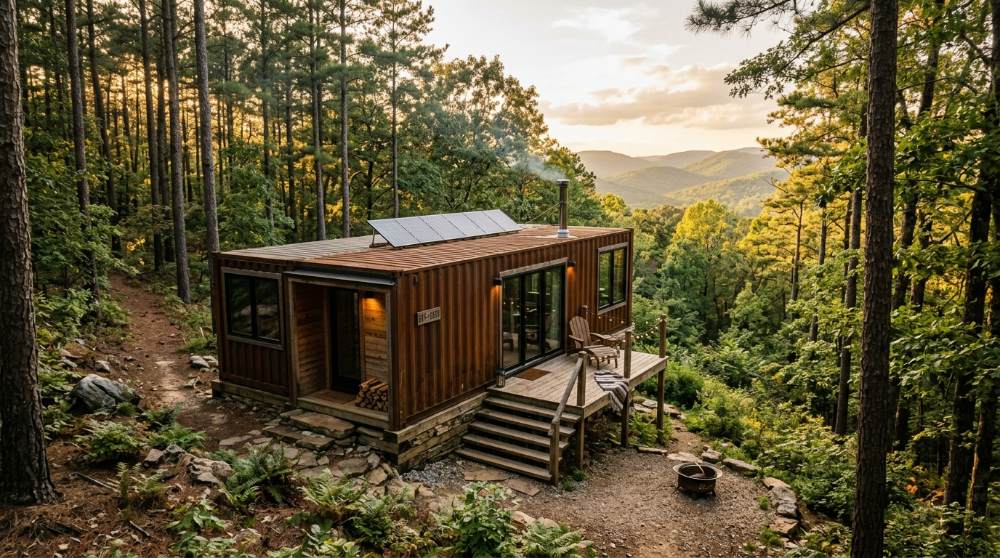
Ryan ran a roadside convenience store in Arkansas. By most conventional measures, it was a successful small business — steady income, a recognizable role in his community, the kind of enterprise that takes years to build. By his own measure, it had stopped feeling right. So he sold the store, bought land in the Ouachita Mountains without road access, and started building a life in a 170-square-foot shipping container.
That story, documented by filmmaker Kirsten Dirksen in a YouTube video that has circulated widely in off-grid and sustainable living communities, is not primarily a story about a shipping container. It is a story about what someone gives up and what they gain when they choose to live entirely outside of the systems — electrical grid, municipal water, conventional supply chains — that most Americans take for granted. The container is the starting material. What Ryan built around it is the story.
The Decision: Roadless Land and a Different Definition of Success
The Ouachita Mountains stretch across western Arkansas and southeastern Oklahoma, covering some of the oldest mountains in North America and terrain that ranges from gentle ridges to steep, heavily forested hollows. Property in remote Ouachita country — particularly land without road access — is available at prices well below anything comparable in accessible areas, precisely because the absence of road access imposes real and permanent costs on every aspect of ownership and habitation.
Ryan's decision to buy roadless land was not accidental or uninformed. It was a deliberate choice to prioritize isolation, natural environment, and cost over the convenience that road access provides. Getting there means walking, riding an ATV, or arriving by other means. Deliveries work the same way. Emergency access works the same way. The trade-off is real, and it defines nearly every aspect of how the property functions and what infrastructure decisions make sense on it.
The convenience store represented a kind of success that required being available to customers, tied to inventory cycles, dependent on suppliers and utility companies and regulators. The mountain property represents the opposite: maximum self-determination at the cost of maximum personal effort.
Both are coherent choices. Ryan chose the latter — not as an act of rejection or deprivation, but as a conscious alignment of daily life with what he actually values. That distinction matters. The off-grid container home movement is full of people who chose it for the wrong reasons and struggled. Ryan's story is one of someone who understood the trade-off clearly before making it.
The Container: 170 Square Feet, Solar-Powered, Off Everything
The home itself is a single shipping container, measuring approximately 170 square feet — consistent with a 20-foot standard ISO container modified for habitable use. The unit is solar-powered, collecting energy through panels that charge a battery system capable of running the home's electrical needs without any grid connection. Water comes from rainwater collection, filtered and stored on-site. Sanitation is handled through a composting toilet, which eliminates the need for a septic system entirely. There is no utility bill. There is no monthly invoice from any external provider.
The off-grid systems Ryan assembled are each individually well-understood technology. Solar panels paired with battery storage have become genuinely cost-effective over the past decade, particularly in sun-rich southern states like Arkansas where average daily peak sun hours in the Ouachita region run approximately five per day. At five hours of daily solar production, a well-sized system can run a modest household's electrical needs — lighting, small appliances, phone charging, a laptop, a refrigerator — with battery capacity sufficient to cover overnight demand and cloudy-day variability.
Rainwater collection is similarly well-established in off-grid applications, particularly in regions like the Ouachitas where annual rainfall is sufficient to supply a single-person household's needs through a properly sized collection and storage system. Arkansas law explicitly permits rainwater harvesting, which is not universal across states. The composting toilet eliminates the excavation, regulatory approval, and ongoing maintenance of a septic system — costs that can run from $3,000 to $15,000 or more depending on soil conditions and local requirements.
| System | Ryan's approach | Key considerations for replication |
|---|---|---|
| Power | Solar panels + battery storage | Size to load; Ouachita avg ~5 peak sun hours/day; battery capacity covers overnight and cloudy days |
| Water | Rainwater collection + filtration | Legality varies by state; Arkansas permits it; verify local rules; size to annual rainfall |
| Sanitation | Composting toilet | Eliminates septic cost and permitting; check county health codes; modern units are odor-controlled |
| Heating/Cooling | Passive design + supplemental | Ouachita winters below freezing; insulation spec (closed-cell spray foam) is critical |
| Road access | None — property is roadless | Access via foot or ATV; limits deliveries, emergency response, and resale market |
| Structure | 170 sq ft shipping container | Single 20ft container; spray foam insulated; converted for residential use |
| Food | Growing own food on property | Mountain soil and growing season require site-specific planning |
The Container as Home: Insulation, Condensation, and the Design Problem
A 170-square-foot solar-powered shipping container in the Arkansas mountains faces exactly the technical challenges documented across multiple container home projects: thermal performance in a climate with genuine seasonal temperature variation, moisture management on a steel structure prone to condensation, and the design challenge of making a narrow, rectangular steel box feel like a home rather than a repurposed freight object.
The Ouachita Mountains experience a humid subtropical climate with hot summers and cold winters. Temperatures in the foothills regularly drop below freezing from November through February, and summer highs regularly exceed 90°F. An uninsulated container in this climate would be uninhabitable for much of the year — a furnace in July and a refrigerator in January. Adequate insulation is not a comfort preference in this environment; it is the condition of habitation.
Closed-cell spray foam insulation is the established technical standard for container residential applications precisely because it addresses the condensation problem that batts and rigid board cannot. In a heating climate, warm interior air reaching cold steel produces condensation on interior surfaces — the genesis of mold, corrosion, and structural degradation. Closed-cell foam bonded directly to the steel surface eliminates that cold interface and the condensation it produces. Ryan's mountain environment makes the requirement even more critical than it would be in a mild coastal climate.
The insulation question is covered in depth elsewhere in this series
See our complete container insulation guide for a breakdown of spray foam vs rigid board vs batt, R-value requirements by climate zone, and what a proper installation costs — all directly applicable to a build like Ryan's.
At 170 square feet, the design challenge is not just insulation but function: fitting a sleeping area, kitchen, bathroom, and living space into a footprint smaller than most studio apartment kitchens. The container home design community has developed a repertoire of responses to this constraint — Murphy beds, fold-down tables, built-in storage using every vertical inch, lofted sleeping areas that convert ground-floor space to daytime living use.
What the Off-Grid Systems Cost and Save
The financial case for off-grid living is frequently misunderstood in both directions — either romanticized as an escape from all expense or dismissed as prohibitively costly. The reality is more nuanced. Initial capital costs for a complete off-grid system are real and significant.
Solar + battery storage
$8,000 – $20,000
A properly sized system for a modest single-person household — 1,500 to 3,000 watt-hours daily consumption. Cost depends on panel count, battery chemistry (LiFePO4 vs lead-acid), and inverter spec.
Rainwater collection + filtration
$2,000 – $8,000
Includes first-flush diversion, sediment and carbon filtration, UV sterilization, and adequate storage tank capacity for dry-season use. Scale depends on roof catchment area and annual rainfall.
Composting toilet
$1,000 – $4,000
Quality units from Nature's Head, Sun-Mar, or Separett. Eliminates $3,000–$15,000 in septic system cost and permitting. Modern units are low-maintenance and odor-controlled.
10-year utility savings
$16,000 – $25,000+
No electric bill ($137/mo national average = $1,644/yr), no water bill, no septic maintenance. Over a 10-year horizon, compounding savings meaningfully offset upfront system costs for a single-person household.
The land cost equation is equally important. Roadless mountain land in the Ouachitas sells at a substantial discount to accessible land of comparable natural quality. That discount — which might represent tens of thousands of dollars of savings on a small parcel — partially or fully offsets the cost of the off-grid systems that make habitation on that land possible. The economics only work if you actually want to be in that location and are genuinely willing to forgo road access. For a buyer who has made that choice consciously, as Ryan has, the financial arithmetic can be favorable.
Kirsten Dirksen and the Off-Grid Documentary Tradition
About Kirsten Dirksen
Dirksen is a documentary filmmaker who has spent more than a decade profiling people living in unconventional spaces — micro-apartments in Tokyo, earthships in New Mexico, cave homes in Spain, container villages in Las Vegas, and off-grid homesteads across the American West and South. Her YouTube channel has accumulated more than a million subscribers and functions as one of the most comprehensive archives of alternative living approaches in any format.
What distinguishes her work from real estate media and lifestyle content is her commitment to showing the actual mechanics of the lives she documents — not just the beautiful spaces but the systems, compromises, and daily realities that make them function. The video documenting Ryan's Ouachita home is part of a long tradition of container home profiles in her catalog.
Watch on YouTube →Across Dirksen's container home profiles — in Louisiana, Texas, California, and internationally — a consistent pattern emerges: the most successful container home dwellers are those who chose the form factor for deliberate reasons rather than novelty. Ryan's profile fits that pattern precisely. He is not building a container home as a design statement or an investment vehicle. He is building a life, and the container is the most practical way to build it where he wants to live it.
Where Ryan's Story Fits in This Series
This series has documented shipping container applications across a wide spectrum of scale, formality, and purpose: the Youngstown Veterans' Haven and DeLand's container village using containers to address institutional homelessness; market-rate container homes demonstrating investment viability; Hawaiian projects serving the nation's most expensive housing market; and San Diego's permitting framework for container residential builds in a major American city.
Ryan's Ouachita home occupies a different point on that spectrum: the individual, voluntary, values-driven adoption of container living as a complete life philosophy rather than a housing solution or investment strategy. He is not trying to solve a housing affordability problem, generate short-term rental income, or make a real estate investment. He is building a life that matches what he values, using a building material that makes that life possible at a price point and in a location that conventional construction could not reach.
That category of container home adoption — the deliberate, philosophically grounded retreat from conventional living toward self-sufficiency and intentionality — is one of the oldest and most consistent use cases in the container home community. It predates the current wave of institutional and market-rate container projects by decades, rooted in the back-to-the-land tradition that the Ouachita Mountains themselves have attracted for generations. Ryan's story is, in this sense, both entirely new and entirely continuous with a long tradition of people who looked at the lives available to them, decided those lives were not right, and built something different in the woods.
Key takeaways
- →170 square feet, solar-powered, rainwater-fed, composting toilet. Ryan's Ouachita container home is completely independent of the electrical grid, municipal water, and conventional sanitation — eliminating every ongoing utility cost at the expense of significant upfront system investment.
- →Roadless land was a deliberate choice, not a constraint. The absence of road access lowers land cost substantially while imposing real and permanent costs on every delivery, emergency response, and daily supply need.
- →The Ouachita Mountains offer genuinely favorable conditions: adequate rainfall for collection, sufficient sun hours for solar viability, and Arkansas's permissive stance on both rainwater harvesting and composting toilets.
- →Insulation is non-negotiable. Ouachita winters dip well below freezing; summers exceed 90°F. Closed-cell spray foam bonded to the steel surface is the established standard for preventing condensation, mold, and corrosion in container residential builds in variable climates.
- →The financial case is more nuanced than it appears. Off-grid system capital costs are real but compounding — eliminated utility bills and discounted land costs can make the total equation favorable over a 10-year horizon for a single-person, modest-consumption household.
- →The story is documented by Kirsten Dirksen, whose YouTube channel is one of the most comprehensive archives of alternative living documentation available — notable for showing mechanics and trade-offs rather than aesthetics alone.
- →Ryan's project represents deliberate, values-driven adoption of container living — not a housing affordability solution or investment strategy, but a conscious choice to build a life whose daily rhythms match what he actually values.
Looking Ahead
The off-grid container home movement that Ryan represents is not new, but the enabling technologies are better and cheaper than they have ever been. Solar panel costs have fallen more than 90% over the past 15 years. Battery storage technology has improved dramatically in energy density, longevity, and cost per kilowatt-hour. Composting toilet design has improved to the point where the systems are genuinely convenient rather than merely tolerable. The container home itself — now available as a consumer product at accessible price points — is the most accessible it has ever been as a building material.
What has not changed is the nature of the choice. Living in 170 square feet on roadless mountain land, producing your own power, collecting your own water, and composting your own waste is a life that requires more deliberate effort, more self-sufficiency, and more tolerance for limitation than conventional living provides. Ryan made that trade consciously. The question the Kirsten Dirksen video leaves viewers with — and the question this series has been circling from many different directions — is not whether that trade is right for everyone, but whether the systems that make it possible are becoming accessible enough that more people could make it if they chose to.
Sources
- "Arkansas Man Builds Solar-Powered Shipping Container Home Off-Grid" — MSN Money / The Cool Down, July 2026. msn.com
- "Arkansas Man Sells His Store, Buys Roadless Mountain Land, and Builds an Off-Grid Home" — Yahoo Lifestyle, July 2026. yahoo.com
- Kirsten Dirksen — Arkansas Off-Grid Container Home (original video). youtu.be/jojDzG4ZCZs
- Kirsten Dirksen YouTube Channel — comprehensive archive of alternative living documentation. youtube.com/@kirstendirksen
- EcoFlow — "How to Build a Solar-Powered Container Home." ecoflow.com
- Arkansas Department of Health — Rainwater Harvesting Guidance. healthy.arkansas.gov
More from the series