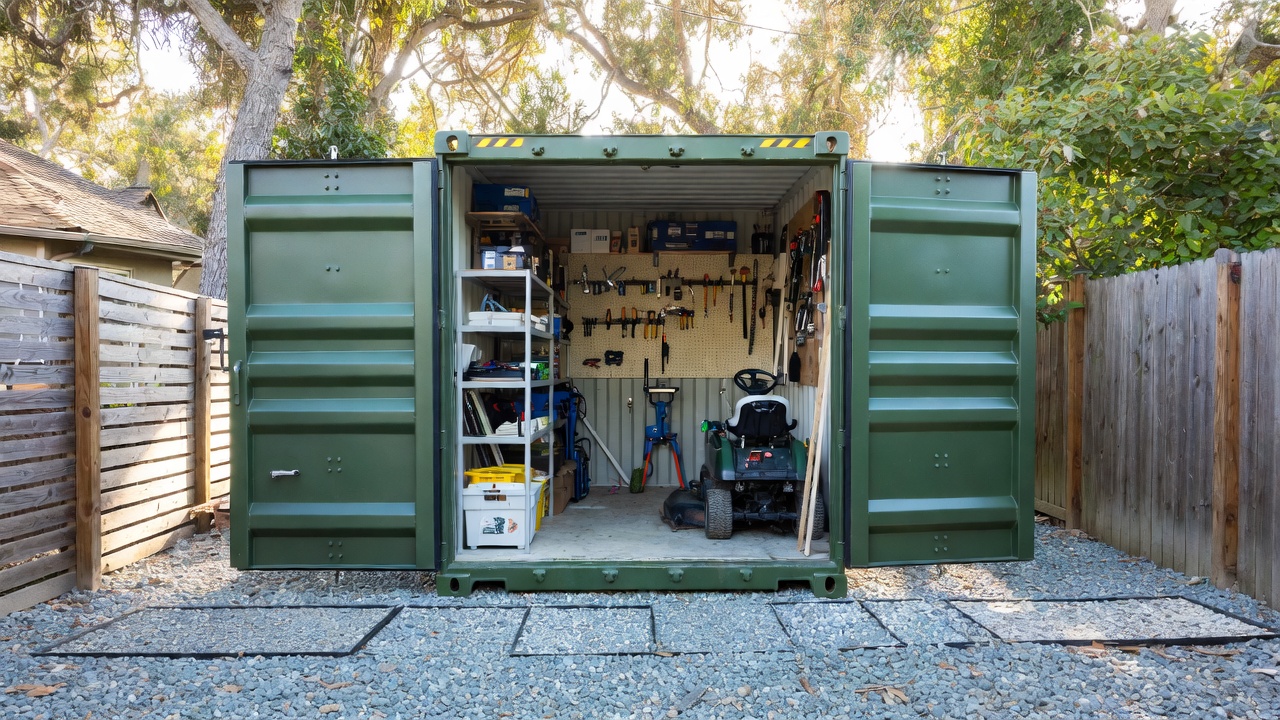
A shipping container makes a genuinely excellent shed or garage. It's more secure than any timber shed, more weatherproof, lasts longer, and at the used end of the market can be cheaper than a large traditional shed when you factor in the delivered cost of each. The tradeoffs are access (the standard door opening isn't ideal for vehicles) and appearance (which matters more in some neighborhoods than others).
In this guide
Which size?
10ft container
~80 sq ft
Good for a small garden shed, tool storage, or a single motorcycle. Easier to deliver than larger units and fits in tight spaces. Less common at depots — expect limited selection.
20ft container
~160 sq ft
The most common choice for a shed. Fits a full workshop layout, a riding mower and garden tools, or a small car. The cargo doors open wide enough for most equipment and vehicles.
40ft container
~320 sq ft
Large workshop, double garage equivalent, or combined storage and workspace. The extra length is difficult to fully utilise without proper lighting and organization but gives significant capacity.
The door opening question for vehicles
The standard cargo door opening on a shipping container is 7'8" wide and 7'5" tall. Most passenger cars (width typically 5'8"–6'4") will fit through on width, but the height clears most sedans and SUVs. Full-size trucks and vans need the full 7'5" clearance — check your vehicle height before assuming a standard container will work as a garage. A roll-up door modification (see below) is a better solution for regular vehicle access.
Container vs traditional shed
- Dramatically more secure — heavy steel, welded construction
- More weatherproof — designed for ocean freight
- Longer lifespan — 25+ years with minimal maintenance
- Stackable if you need vertical storage
- Relocatable — crane and truck to a new address
- Holds value well — resaleable as a container
- Floor is hardwood — handles heavy equipment and vehicles
- More customizable door and window placement
- Easier to get planning permission in residential areas
- Better aesthetics — blends into garden settings
- Easier to add a standard garage door from the front
- More sizes and configurations available
- Less secure — timber walls and standard padlocks
- Shorter lifespan — 10–15 years without treatment
Cost comparison
| Option | Size | Typical cost delivered | Lifespan |
|---|---|---|---|
| Used 20ft container (WWT) | 160 sq ft | $2,000–$4,000 | 25+ years |
| New 20ft container (one-trip) | 160 sq ft | $4,500–$6,500 | 30+ years |
| Large wooden shed | 150–200 sq ft | $3,000–$8,000 | 10–15 years |
| Metal utility building | 150–200 sq ft | $2,500–$6,000 | 15–20 years |
| Used 40ft container (WWT) | 320 sq ft | $3,000–$6,000 | 25+ years |
| Prefab metal garage | 300–400 sq ft | $5,000–$15,000 | 15–25 years |
On a per-square-foot basis, a used container is consistently competitive with traditional shed options. On a lifespan-adjusted basis, it's typically cheaper — you pay a similar upfront cost for a structure that lasts two to three times longer with less maintenance.
Key features and modifications
-
Security — already excellent
The standard lockbox and padlock setup on container cargo doors is significantly more secure than any residential shed. Add a high-security padlock (Abloy, Abus, or equivalent) and the container resists bolt-cutters. For higher security, a steel lockbox over the padlock hasp prevents sawing attacks. Alarm systems can be wired in with a basic 12V battery-backed unit.
-
Ventilation — add it from the start
An unventilated container builds up heat rapidly in summer and accumulates moisture year-round. Two louvred steel vents (one at each end, high on the wall) create passive cross-ventilation. For a workshop, a powered fan vent provides active air exchange. Ventilation also prevents the musty smell that develops in sealed storage containers over time.
-
Roll-up door — the right choice for garage use
The standard cargo doors open outward and require clearance in front of the container — fine for storage but impractical for a garage where you're driving straight in. A roll-up door (or sectional overhead door) installed at one end solves this. Requires cutting the end frame and welding in a new structural header, but the result is a functional garage entry. Cost including installation: $1,500–$3,500.
-
Lighting — run power in early
A container shed without lighting is hard to use effectively. Running a single 20-amp circuit from your main panel gives you enough for LED strip lighting, power tools, and a battery charger. Do this before you fill the container — retrofitting is much harder. Even a simple outdoor-rated extension cord with a weatherproof box is better than nothing as an interim solution.
-
Anchoring — don't skip this
An empty container can shift or even tip in high winds. Anchor to the ground by welding anchor points to the corner castings and driving ground anchors into the earth, or by bolting the corner castings to a concrete pad. In hurricane and tornado zones, proper anchoring is essential — check local requirements before delivery.
-
Rust prevention — check and treat regularly
A one-trip container needs minimal immediate attention. A WWT or CWO used container should be inspected for rust spots, treated with rust converter on any active rust, and repainted with a quality metal paint. Pay special attention to the roof (water pooling in dents) and the lower panels at ground level. An annual inspection is good practice.
Permits and zoning
Whether a container shed needs a permit depends entirely on your local jurisdiction. The most important factors:
- Square footage threshold: Many counties have a minimum size below which accessory structures don't need permits — typically 100–200 sq ft. A 10ft container (80 sq ft) often falls below this; a 20ft (160 sq ft) may or may not.
- Setback requirements: Even if no permit is required, zoning setback rules still apply — the container must sit a minimum distance from property lines and the main dwelling.
- HOA restrictions: Many HOAs prohibit shipping containers outright due to appearance guidelines. Check your CC&Rs before purchasing.
- "Permanent" vs "temporary": Containers on blocks (not bolted to a foundation) are sometimes classified as temporary structures, which face fewer restrictions. Check with your building department.
Using a container as a garage
A 20ft container is wide enough to fit most passenger cars (8ft interior width vs typical car width of 5'8"–6'4") but the fit is tight. A 40ft container gives you a genuine two-car garage footprint. Key considerations specific to vehicle storage:
- End opening vs cargo doors: A roll-up or sectional door installed at one end (rather than the original cargo doors) makes vehicle entry and exit practical. Budget $1,500–$3,500 for the cutout, frame, and door.
- Floor drain: For a working garage, a floor drain prevents water accumulation from wet vehicles. Requires cutting the steel floor and plumbing to a dry well or drain — budget $1,000–$2,500.
- Ventilation for vehicles: Running an engine inside a sealed container creates carbon monoxide rapidly. Adequate powered ventilation is essential if you're starting vehicles inside the container. Open the doors, or install a CO detector at minimum.
- Height clearance: Standard container exterior height is 8'6". Full-size pickups and SUVs typically stand 5'6"–6'5" — they'll fit. Cargo vans, box trucks, and lifted vehicles may not. A high-cube container (9'6" exterior) gives more headroom for taller vehicles.
Compare container prices for your shed project
For a shed or garage, a used CWO or WWT container is usually the right grade — you don't need one-trip condition for a storage application. Shipped.com lets you filter by grade and location to see what's available near you.